
A wind spinner that stalls or wobbles needs a mount and clearance check before a balance adjustment. For outdoor metal blade spinners, inspect bearing drag, repeated stopping position and corrosion separately; each observation leads to a different maintenance decision. Use the inspection record below to keep those observations together.
Start with the spinner secured and out of driving wind. Check that its blades clear the support, then gently rotate the assembly and watch the hub. Smooth resistance, a scrape at one point, and the same blade repeatedly settling downward are different clues. Identify the bearing and its service instructions before adding lubricant. These checks suit a blade rotor on a shaft; a hanging ornament that turns on a vertical swivel needs a different balance assessment.
Start with the mount and free rotation
Correct visible interference and mounting faults first. A blade touching the pole can stop a sound bearing, while a loose support can move even when the rotor itself is balanced.
Work with the blades stationary, secure the assembly, and keep fingers clear of blade edges and pinch points. Check the pole alignment, connections and blade spacing against the assembly instructions. If the rotor can be turned gently without forcing it, watch a full turn for contact with the stake, neighboring blades or nearby plants. Observe from the side as well as the front.

| What you observe | What to check next | Action before another wind trial |
|---|---|---|
| A scrape or stop at the same place in a turn | Blade clearance, assembly order and visible distortion | Correct the interference using the assembly instructions; recheck clearance. |
| Rough or gritty rotation without visible contact | Hub and bearing assembly, debris at the joint, service instructions | Identify whether the bearing is serviceable or supplied as a replacement assembly. |
| The same blade repeatedly settles at the bottom | Shaft orientation and freedom from wind, rubbing and drag | Use the horizontal-axis balance check below. |
| The hub shifts sideways or the support moves | Loose mounting, shaft condition and rotor attachment | Resolve the movement before interpreting it as imbalance. |
| A cracked blade or damaged rotating attachment | The affected part and its specified replacement | Keep the damaged assembly out of use until repaired or replaced. |
A short hand spin is useful for locating a symptom, but its duration is not a universal pass/fail test. To start, the wind must supply enough turning force—torque—to overcome resistance at the rotor’s position. Blade shape, orientation, bearing drag and, on a horizontal shaft, an uneven mass distribution can all affect that result.
Identify the bearing before adding lubricant
Use the parts diagram or bearing designation to establish what is inside the hub. A visible cap covers a location; its appearance alone does not tell you the bearing’s seal design or maintenance needs.
NSK’s Miniature Ball Bearings catalog, E126h, printed page 10, distinguishes shields, contact seals and non-contact seals. It describes factory-packed lubricant in shielded and sealed deep-groove ball bearings. Contact seal lips add friction as they slide against the inner ring; the non-contact design described there avoids that lip contact. That tradeoff matters when comparing closure designs for a wind-driven rotor.
| Documented arrangement | What the closure does | What to establish for the spinner |
|---|---|---|
| Open bearing | Has no integral shield or seal over the rolling elements | How the surrounding housing protects it and what service the instructions require. |
| Shielded bearing | Uses a metal shield over the bearing opening | Whether it is factory-lubricated and how the complete hub excludes contamination. |
| Contact-sealed bearing | Uses a contacting lip for sealing, with added lip friction | The specified bearing and replacement procedure, plus the assembly’s exposure limits. |
| Non-contact-sealed bearing | Uses a non-contact sealing arrangement with lower contact drag | The documented design and maintenance requirements for that assembly. |

For a factory-lubricated assembly, follow its replacement or service instructions rather than prying off a seal to add oil. If lubrication is specified, use the stated lubricant, location and method. Spraying the whole hub or flushing it with solvent can bypass the procedure intended for that bearing.
When choosing a spinner for outdoor use, look for clear bearing identification, maintenance instructions and a replacement-part reference. The word “sealed” on its own does not establish waterproofing or suitability for coastal exposure.
Separate blade balance from shaft wobble
A repeated heavy-side-down position can reveal a static imbalance tendency on a freely turning horizontal-axis rotor. Sideways movement at the hub is a separate observation and needs its own check.
Schenck’s SmartBalancer Operating Instructions, printed page 31, explains the distinction: a heavy point settles downward on a rotor supported so it can turn freely, but couple imbalance can remain hidden in a stationary check. Couple imbalance involves mass distribution in different planes and is assessed dynamically while the rotor turns.
For a garden spinner with a horizontal shaft:
- Verify that the mounting geometry matches the instructions and the rotor clears every fixed part. Keep the unit out of wind that drives the blades.
- Gently move the rotor to several different starting positions, release it without a push, and let it settle. Keep track of one blade by its existing shape or detail.
- Record whether that same blade repeatedly finishes at the bottom. If there is rubbing or substantial bearing drag, resolve that before interpreting the stopping position.
- Observe the hub and shaft separately during gentle rotation. Record where the movement occurs, rather than labeling every wobble a balance fault.
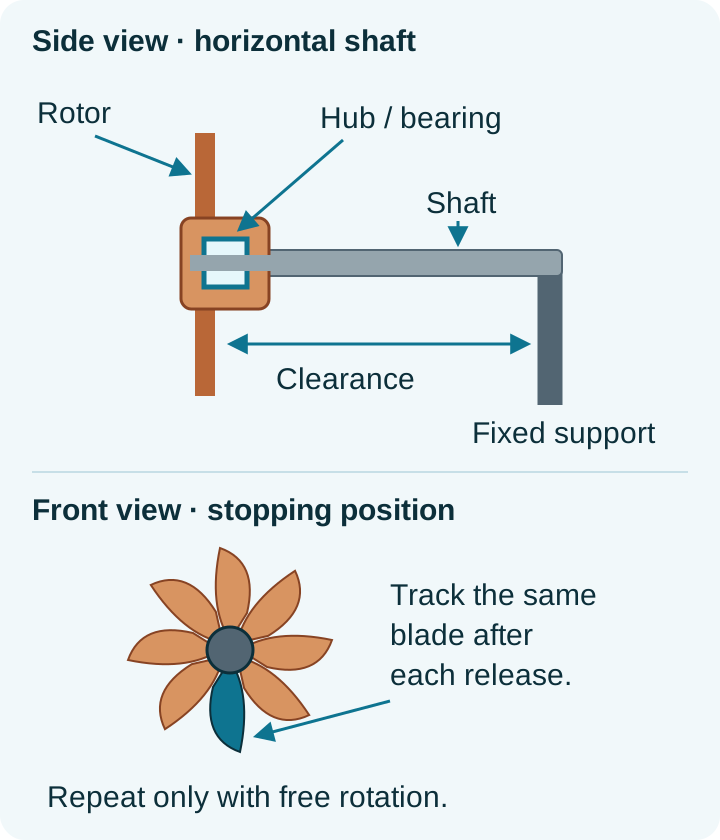
A repeatable downward position is a reason to investigate mass distribution; it is not a dynamic-balance certificate. Wind, rubbing and seal friction can hide the tendency. This gravity check also does not transfer directly to a vertical-axis hanging ornament.
If a blade is visibly distorted or the assembly keeps wobbling, use the maker’s repair or replacement guidance. Avoid adding taped weights, drilling blades or bending them by eye: those changes alter the rotor without establishing the correct mass distribution or blade geometry.
Check corrosion at the finish and at the joint
Inspect the outer finish and the moving joint separately. A chip in paint tells you where the exterior needs attention; it does not reveal the condition of the bearing’s internal rolling surfaces.
NSK’s Rust and Corrosion troubleshooting reference identifies water entry and moisture condensation among the causes of bearing corrosion. It describes pits on bearing rings and rolling elements, and points to sealing, lubrication and storage as areas to address. A newly rough bearing therefore warrants attention even if the blades still look tidy.

After damp, sandy or coastal exposure, look for deposits around the shaft entry, damaged caps, coating loss and changes in rotation. Use the spinner’s compatible exterior-cleaning instructions, keeping their treatment of the bearing housing distinct from treatment of the blades. Store the assembly dry as directed. Adding oil does not restore metal already lost to pitting.
If you also use fabric wind toys, the guide to cleaning sand and salt from a kite covers sail and line care. A fabric rinse procedure should not be carried over to a spinner’s bearing housing.
For a purchase comparison, ask what supports any corrosion-resistance claim: the tested material and finish, specimen, exposure method and assessment criterion. ASTM B117’s public summary explains that salt-fog testing provides relative corrosion information and that extrapolation to natural exposure needs corroborating atmospheric evidence. Salt-spray hours alone do not translate into years in a coastal garden.
Windsock vs wind spinner: choose the signal you need
Choose a windsock when the intended signal is wind direction; choose a decorative spinner for rotating movement. A fixed-axis spinner’s clockwise or counterclockwise rotation alone does not identify the direction the wind comes from.
The FAA’s description of a wind direction indicator states that a windsock’s large opening points into the wind. Its trailing end extends downwind. A spinner may instead rotate around a fixed shaft; designs that turn into the wind or carry a separate vane need to be read according to those features.
| Intended use | Feature to look for | How to read it |
|---|---|---|
| See where the wind comes from | Windsock with a freely moving mount | Observe the direction faced by the large opening. |
| Add moving garden decoration | Rotor with clear blade travel and an appropriate mount | Watch rotation as the decorative effect; check service instructions for outdoor care. |
| Judge conditions for kite flying | Wind observations and the kite’s specified range | Use the kite-flying wind-speed guide rather than estimating speed from spinner rotation. |
Neither a decorative spinner’s rotation rate nor an uncalibrated garden windsock provides a universal wind-speed scale.
Keep a wind-spinner inspection record
Copy this record before cleaning or changing parts, then complete it again after the permitted maintenance. Keep the description of the symptom separate from the action taken so you can see whether the same fault returns.
| Inspection field | Your record |
|---|---|
| Date, product and model | ____________________ |
| Mounting type and shaft orientation | ____________________ |
| Bearing or hub part reference from instructions | ____________________ |
| Blade clearance and location of any contact | ____________________ |
| Hand-rotation feel: smooth, rough or catching | ____________________ |
| Repeated stopping position, if horizontal-axis check applies | ____________________ |
| Location of hub, shaft or support movement | ____________________ |
| Coating damage and condition around shaft entry | ____________________ |
| Permitted maintenance or required replacement part | ____________________ |
| Action taken, recheck result and date | ____________________ |
If interference is removed and the rotor turns freely, recheck it under the installation conditions in its instructions. If roughness, repeatable settling or hub movement remains, keep the record with the part reference for the repair decision. Browse the kite and wind-toy field guides for related material and outdoor-care questions.
References & Sources
- B117-26a: Standard Practice for Operating Salt Spray (Fog) Apparatus — public summary — ASTM International
- Aeronautical Information Manual, §4-3-4: wind direction indicator — Federal Aviation Administration