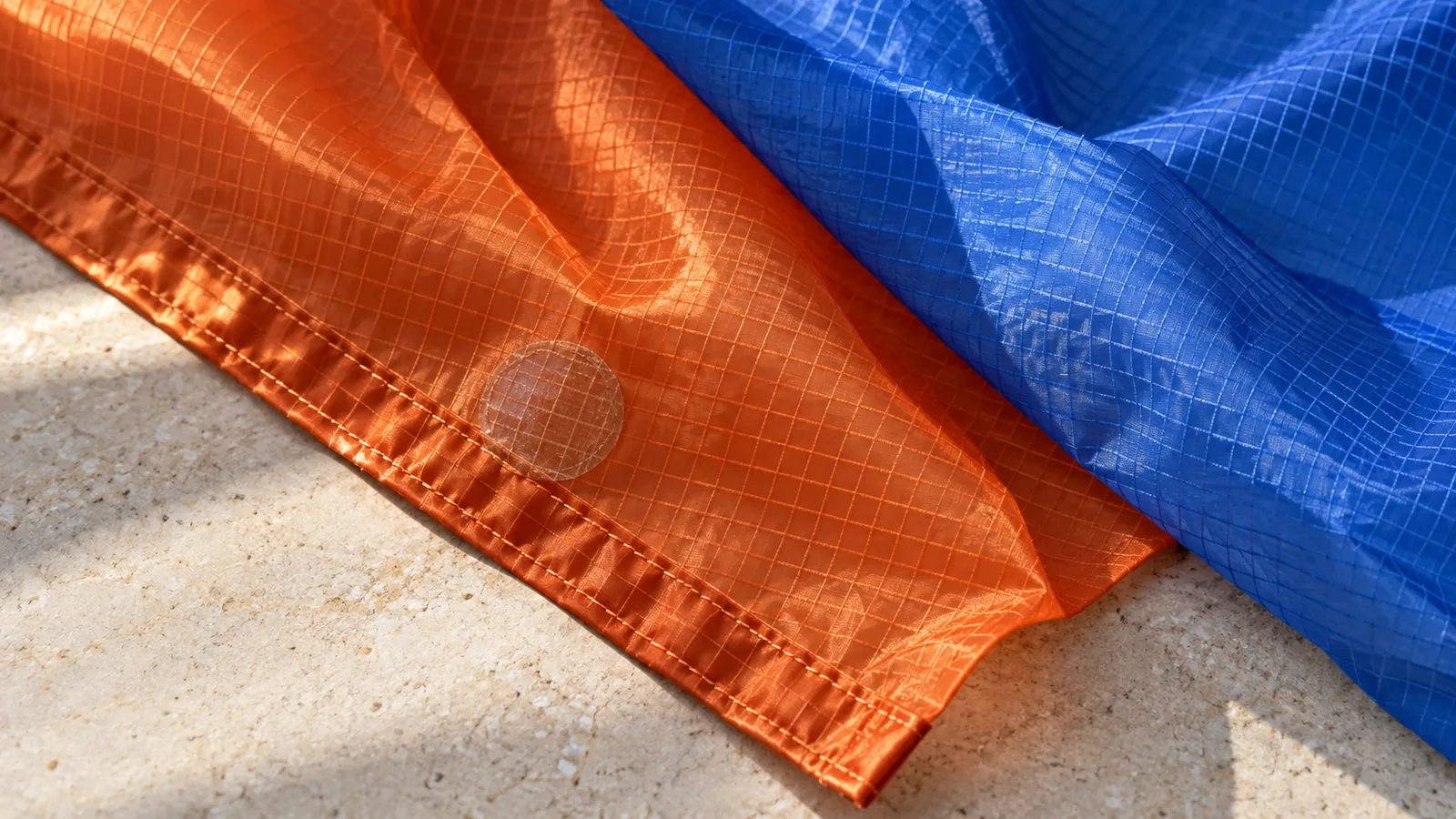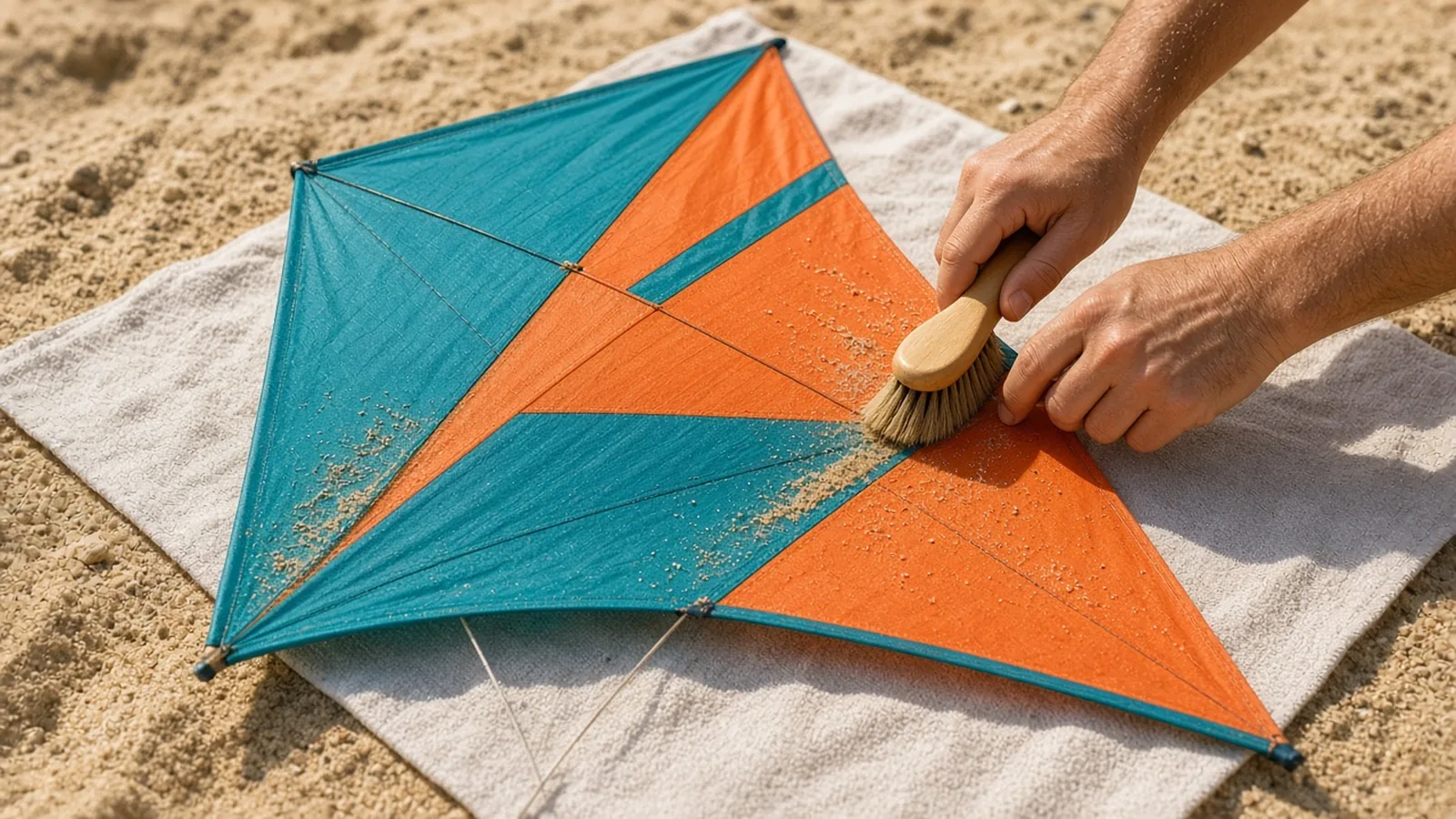
Sand left on the sail and flying lines damages both, and solvent on the seams can dissolve the adhesive that holds them. Brush dry sand off first, rinse with fresh water after salt, and stop when the mark is mildew or a stain the maker has not described.
Two Prism notes set the limits. The current Synapse manual is written for that kite: dust beach sand off with a soft brush, rinse with fresh water if the kite has been swimming, and clean with warm water and a little dish detergent on a soft sponge. The 2009 Prism field-repair booklet is written for sport kites. It repeats the sand and salt advice, names compressed air for sand on bridles and fittings, and gives the factory fold below. A framed sport kite is the kind in the stunt kite comparison. A single-line kite packs differently. Kite types lists both families so you can see which one you have before you copy the fold.
Match the dirt before you wet the sail
Loose sand turns into grinding paste as soon as it gets wet. Use the row that matches what is on the kite, and leave the other rows alone.
| What is on the kite | What to do |
|---|---|
| Dry loose sand on the sail, lines, bridle or fittings | Dust it off before any water. The Synapse manual names a soft brush for lines and sail. The 2009 booklet names compressed air, when you have it, for sand on bridles and fittings. Stop and ask the maker if sand is packed into a tear or a fitting you cannot see into. |
| The kite went into salt water | Rinse with fresh water after the loose sand is gone. Both Prism notes call this a good idea when the kite has been swimming. Soap comes later, and only for dirt that remains. Stop if the only water you have is more salt water. |
| Mud or other dirt stuck to the sail | Wipe the patch with warm water and a little dish detergent on a soft sponge. The Synapse manual calls that the best way to clean its kite. Then rinse the soap off. Stop if the mark is oily, tarry, or deep in the coating, or the cloth is one the maker has not named. |
| Mildew, mold, or a coating you cannot name | Do not start a wash. Ask the maker of that kite before you use any cleaner. |
Takeaway: Brush loose sand while it is dry, rinse salt with fresh water, and use the sponge only for stuck dirt on a kite the Prism notes cover.
Brush off dry sand before any water
Beach sand wears the cloth and the lines. The Synapse manual says it wears lines and sail. The 2009 booklet says it wears bridles and fittings. The 1981 kitemaking article says sand is abrasive on kite covers that fly at the beach; that note, and the fabric comparison around it, is on the ripstop nylon page.
After a beach session, dust the sand off before the kite goes in the bag. Follow the Synapse note with a soft brush on the sail and the flying lines. Where sand sits on bridles and fittings, the 2009 booklet says compressed air works well if you have it. The booklet does not give a pressure, so this page does not add one.
Leave the hose until the loose sand is gone. Water on dry sand makes the grit the brush was meant to lift.
Takeaway: Brush sand off the sail and lines, and use compressed air only as the 2009 booklet describes it for bridles and fittings, before any rinse.
Rinse salt with fresh water
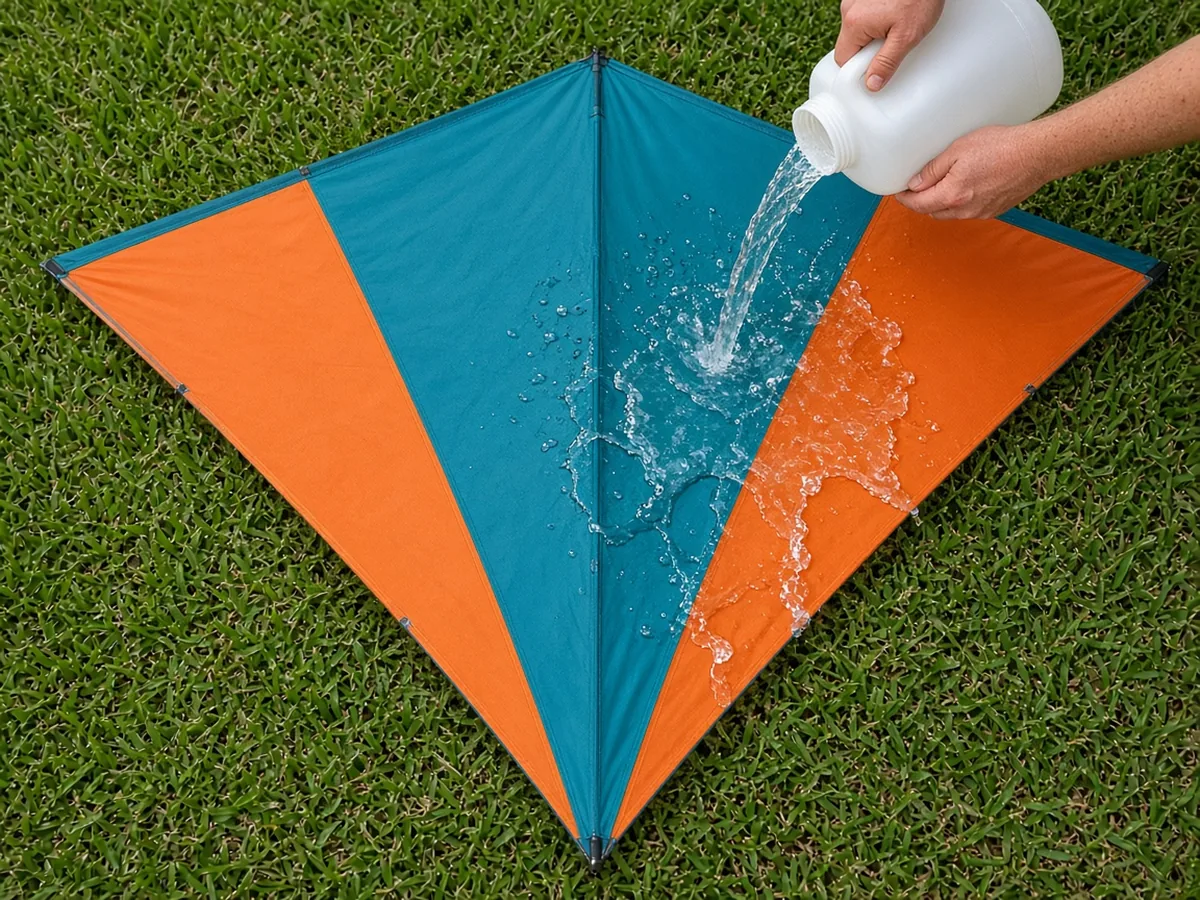
Both Prism notes say a freshwater rinse is a good idea if the kite has been swimming in salt water. Do it after the loose sand is off, so the rinse is not dragging grit across the sail.
Lay the kite flat and rinse the sail, the bridle and the flying lines with fresh water. The notes do not give a duration, a temperature or a number of passes. Continue until salt crust is gone from the cloth and the lines, and let the water run off.
Soap stays out of this step. Salt is the reason for the fresh water. The sponge method in the next section is for dirt that is still stuck after the rinse.
Takeaway: After salt water, rinse with fresh water once the loose sand is gone, and add soap only where dirt is still stuck.
Spot-clean mud with warm water and a sponge
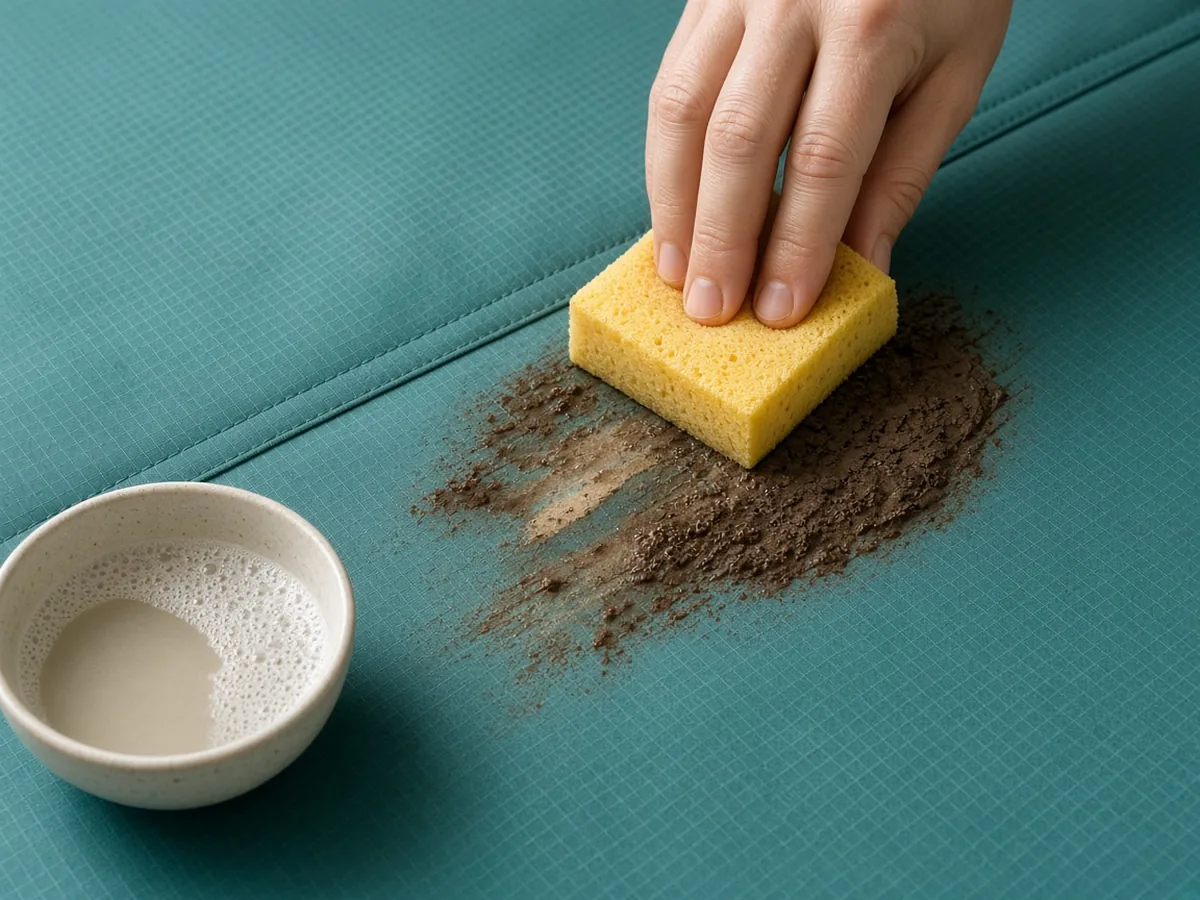
The Synapse manual says warm water and a little dish detergent on a soft sponge works best for cleaning kites, and it says to avoid solvents because they can dissolve the adhesives in the seams. The 2009 booklet repeats that solvent warning. Wipe the muddy patch. Neither note gives a dilution, a soak time or a washing-machine cycle, so this page does not add them.
The 1981 article is about ripstop nylon, not every kite cloth. It says you can wash that fabric in warm water and hang it on a clothesline to dry, and that a dryer is out. Light surface dirt comes out. Deep soil and stains do not reliably come out. Ripstop holds suds a long time, and leftover soap foams again the next time the sail gets wet. Rinse the sponged area with fresh water until the suds are gone.
The cleaning notes do not mention clear panels or printed marks. Ask the maker of that kite before you sponge those areas.
Takeaway: For stuck dirt on a kite covered by the Synapse note, use a soft sponge with warm water and a little dish detergent, then rinse until the suds are gone.
Dry in the shade, then fold
Neither Prism note gives a drying time. Both say to keep the kite out of the sun when it is not flying. The Synapse manual gives fading and brittleness as the reason. The 2009 booklet gives fading. Spread the sail in the shade until the cloth is dry, then fold. A hot car trunk is off limits in both notes, including while the sail is drying.
The 2009 booklet describes the factory fold for its framed sport kites in these words: disconnect the upper and lower leading edges at the joints and fold the wings in half. Then fold the leading edges against the spine so all the spars are next to each other. Tuck the standoffs into the sail and roll the sail neatly up to, but not around, the bundle of leading edges and spine. Avoid wrinkles as you fold. The booklet says wrinkles break down the coatings in the sail and cause it to stretch out.
That sequence needs a leading edge, a spine and standoffs. It is the pack for the framed sport kites in that booklet. It is not a pack method for a single-line delta, diamond or dragon, or for a foil. Those follow the sheet that came with the kite.
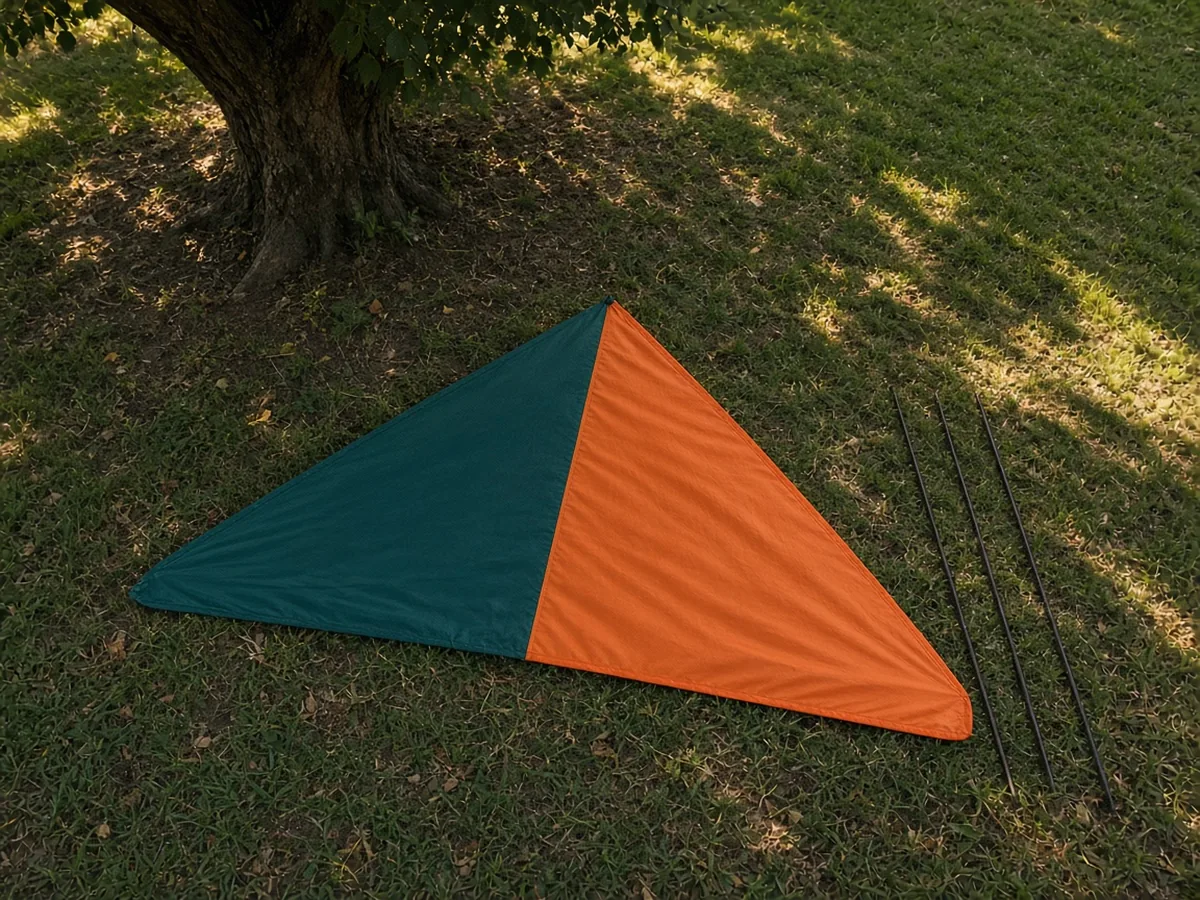
Takeaway: Dry the sail in the shade, keep it out of a hot trunk, and use the Prism factory fold only on a framed sport kite of the kind that booklet describes.
Stop for mildew, deep stains and unknown coatings
Mildew and deep stains do not have a remover in these sources. The 1981 article says deep soil and stains do not reliably wash out of ripstop. Public forum threads about second-hand kites suggest alcohol, strong cleaners and mild soap in the same conversation. Those posts are not a compatibility test for a coating, so this page does not pick one. Stop, leave the chemical on the shelf, and ask the maker of that kite.
The same stop applies when you do not know the cloth. Paper, silk and decorative kites sit outside the Prism sport-kite notes and outside the ripstop wash paragraph. Inflatable traction kites, with bladders, valves and a control bar, are a different job, and this page does not cover them.
Solvents stay off the sail even when a stain looks stubborn. Both Prism notes say solvents can dissolve the adhesives in the seams.
This site publishes guides. It does not sell kites or clean them for readers. The about page says who operates it. The person who can speak for a coating is the maker of that kite.
Takeaway: If the problem is mildew, a deep stain, or a cloth the maker has not named, do not improvise a chemical. Ask that maker.
Checklist before the kite goes away
Run this after the matching row above, and again before the next launch.
- Loose sand is off the sail, the flying lines, the bridle and the fittings.
- Salt, if the kite swam, has been rinsed with fresh water.
- Soap, if you used the sponge, has been rinsed until the suds are gone.
- The sail is dry, in the shade, and not in a hot car.
- A framed sport kite is folded the way the 2009 booklet describes: sail rolled up to the spars, not around them, without sharp wrinkles.
- A single-line kite or a foil is packed the way its own maker describes.
- The next pre-flight matches the note for that kite. The Synapse manual says to check the setup, that the sail is intact, and that the flying line is not worn. The 2009 booklet says to check that the kite is assembled, the frame is intact, and the bridle and lines are not worn.
- The wind for the next session still fits the kite. Compare the forecast with published ranges on the wind speed chart. Nothing on this page changes those ranges.
Further care reading is in Materials and Care and on the field guides index.
Takeaway: Store the kite dry, out of the sun and out of a hot trunk, and check the sail, frame and lines before the next launch.
Related reading
- Ripstop nylon for kites: fabric weight, coatings, and the short care note this page expands.
- Stunt kites compared: leading edge, spine and line count on framed sport kites.
- Single line kites: deltas, diamonds and other single-line sails, which do not use the sport-kite fold.
- Kite wind speed chart: published wind ranges to check before the next session.
Method and sources
Care steps for sand, salt, soap, solvents, sun and the hot trunk come from the Maintenance section of the Prism Synapse manual, read on 11 October 2026, and from page 27, “Care and feeding,” of Prism’s 2009 booklet Don’t Panic! The kite pilot’s guide to field repairs. The Synapse page applies to that kite. The booklet applies to the sport kites it describes. The factory fold is quoted from that booklet and is not treated as a pack method for other kite types.
The ripstop wash, the dryer warning, the note that deep soil and stains do not reliably come out, and the warning that ripstop holds suds come from G. William Tyrrell Jr., “Mastering Nylon,” Kite Lines (1981), as reprinted in Kiting (Summer 2015). That article is about ripstop nylon for kitemaking. It is old, and it is not a wash method for paper, silk or inflatable traction kites.
No drying time, soap dose, soak time, rinse duration or mildew chemical appears in these sources, so none is stated here. Forum posts were read only to see that cleaner advice conflicts. They are not used as evidence that a chemical is safe on a coating. Fabric weights and coating comparisons stay on the ripstop page.
Frequently Asked Questions
How do you clean a kite?
Brush dry sand off the sail and lines. If the kite has been in salt water, rinse it with fresh water. For stuck dirt, the Prism Synapse manual describes warm water and a little dish detergent on a soft sponge. Skip solvents, because Prism says they can dissolve seam adhesive. These notes cover Prism sport kites, not every cloth.
How do you clean a kite after the beach?
Dust the sand off the sail, flying lines, bridle and fittings before you pack the kite. The Synapse manual names a soft brush for the lines and sail. The 2009 Prism repair booklet names compressed air, when you have it, for sand on bridles and fittings. Rinse with fresh water only if the kite went into salt water.
Should you rinse a kite after salt water?
Yes, with fresh water, if you are following the Prism Synapse manual or the 2009 Prism sport-kite booklet. Both call a freshwater rinse a good idea after the kite has been swimming. Neither note gives a rinse time, a water temperature or a number of passes.
Can you use dish soap on a kite?
The Synapse manual says warm water and a little dish detergent on a soft sponge works best for cleaning that kite. Rinse until the suds are gone. A 1981 ripstop article says the cloth holds soap a long time, and leftover suds foam again the next time the sail gets wet. The notes do not give a dose, a soak time or a machine cycle, and they say to avoid solvents.
How should you store a kite after it gets wet?
Rinse salt with fresh water if that is why the kite is wet, then dry the sail in the shade and keep it out of a hot car trunk. For a framed sport kite, the 2009 Prism booklet says to disconnect the leading-edge joints, fold the wings, lay the spars together, tuck the standoffs into the sail, and roll the cloth up to the spars without wrapping it around them. Other kite types need their own maker's pack method.
How do you clean mildew off a kite?
These sources do not give a mildew treatment. Stop, and ask the maker of that kite before you try alcohol, bleach or another cleaner. Conflicting forum tips are not a test of your coating.
References & Sources
- Synapse Manual, Maintenance — Prism Kites
- Don't Panic! The kite pilot's guide to field repairs (Care and feeding, p. 27) — Prism Designs, 2009
- Mastering Nylon (G. William Tyrrell Jr., Kite Lines, 1981; reprinted in Kiting, Summer 2015) — Fly Market Kitemaking Supply (PDF)