Choosing ripstop nylon fabric by denier alone risks wasted sail panels and repair patches that will not bond. Match the finished fabric weight to the sail design, identify the coating on the surface you will repair, and compare air-permeability results only with their test conditions attached.
For kite sails, ripstop nylon fabric needs a specification that separates yarn size, finished mass and surface treatment. Denier describes the yarn; grams per square metre describe the cloth you must lift. PU and silicone identify different treatments, so repair materials must match the actual surface. An air-permeability result describes airflow through a specimen under test conditions; it cannot establish tear resistance, waterproofness or the service life of a completed sail. Use the checks below to screen a candidate fabric, then use the kite design’s strength and construction requirements to make the final choice.
| Input or item | Typical value or source | Why it matters |
|---|---|---|
| Yarn linear density | Denier: grams per 9,000 m of yarn; OQLF definition | Describes yarn size, not finished sail mass |
| Fabric areal mass | Supplier’s finished g/m²; published examples used in the calculation below | Lets you calculate the cloth contribution to mass |
| Coated faces | Supplier’s coating and finish description for each face | Identifies the construction, including different surface treatments |
| Silicone repair compatibility | GEAR AID specifies silicone adhesive for its silnylon patches | A patch must adhere to the surface treatment |
| Air-permeability evidence | Method, pressure difference, airflow direction and specimen condition | A bare result is insufficient for a controlled comparison |
Read denier and fabric weight as separate measurements
Denier measures yarn linear density; finished areal mass measures how much a given area of fabric weighs. The OQLF definition of denier uses the mass of a fixed yarn length. ASTM D3776/D3776M’s public scope addresses fabric mass per unit area, with different options for a roll, full-width sample, small swatch or narrow fabric.
There is no universal denier-to-g/m² conversion. A yarn number does not specify the amount of yarn woven into an area or the mass of its finish. Reinforcing yarns, weave and treatment remain separate variables. A small swatch also has a limited evidential reach: ASTM’s public abstract says the small-swatch option represents the sample, not necessarily its entire lot.
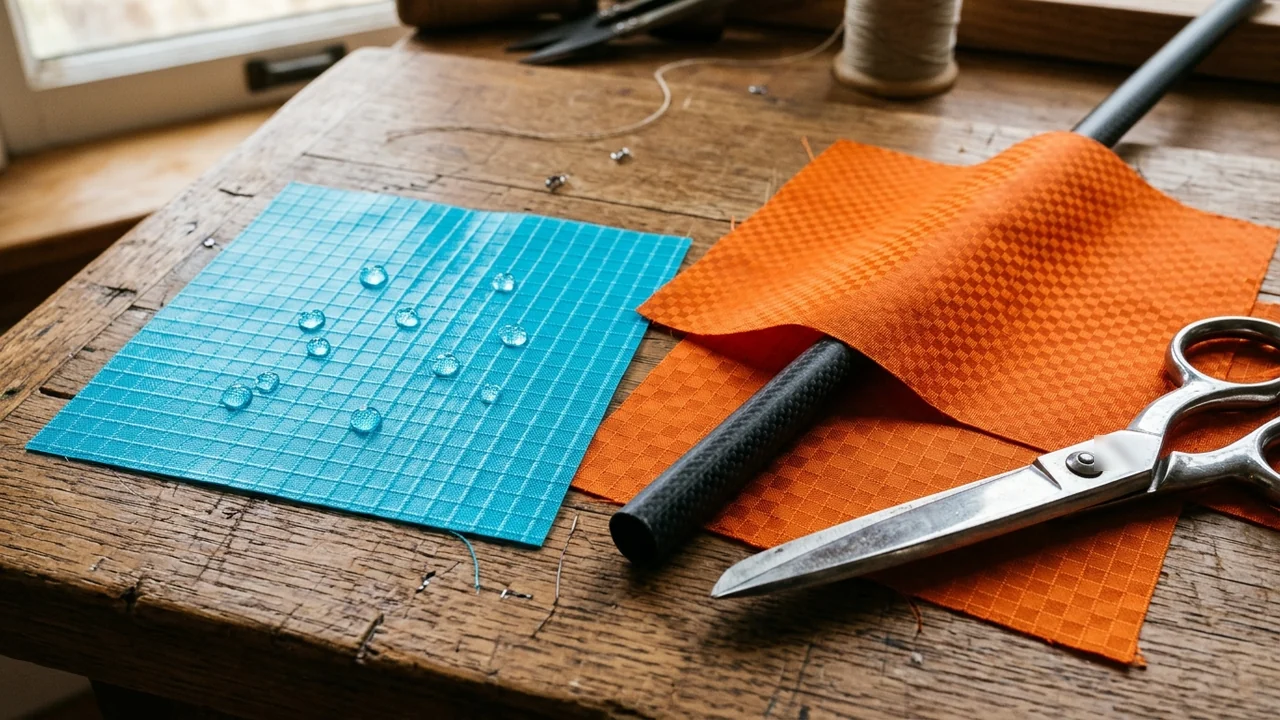
The ripstop kite fabric comparison recaps Chikara and Mirai’s yarn, fibre and coated-face specifications alongside broader material choices. Their constructions differ in more than denier; use the finished weights below to budget cloth mass for your own cut pieces.
Set a sail-cloth mass budget before cutting
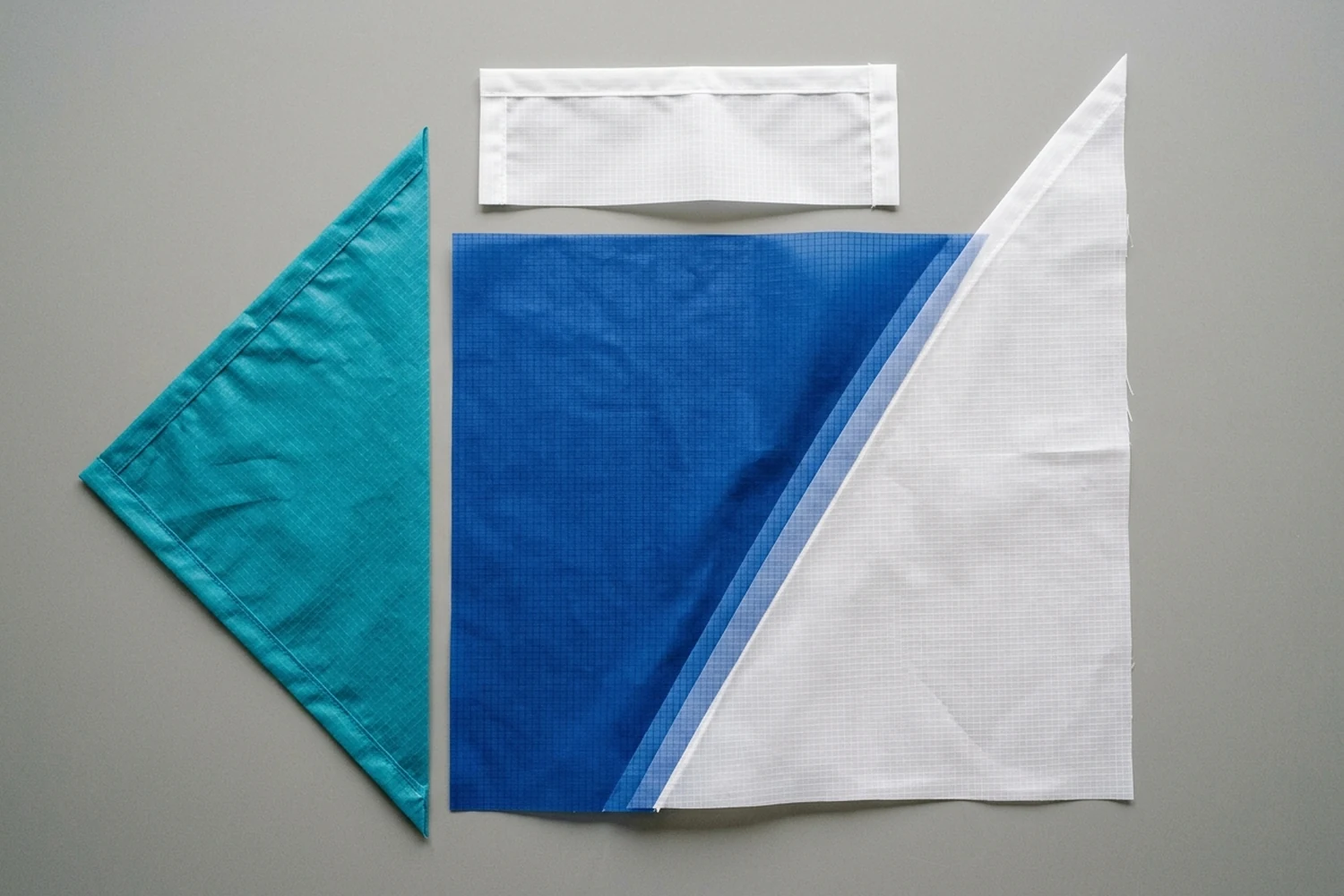
Calculate the cloth mass from its finished areal mass and the total area of cloth in the cut pieces. Count material retained in hems and overlaps; an assembled kite’s projected outline is not necessarily that area.
Formula: cloth mass (g) = finished areal mass (g/m²) × cut cloth area (m²).
Example calculation (assuming a 90 g sail-cloth budget and 2.0 m² of cut cloth including overlaps): Using Top Fabrics’ published weights, Chikara at 41 g/m² gives 41 × 2.0 = 82 g; Mirai at 48 g/m² gives 48 × 2.0 = 96 g. The allowable areal mass is 90 ÷ 2.0 = 45 g/m². Replace the 90 g budget and 2.0 m² cut area with your own sail plan, and account for thread, reinforcement patches, fittings and frame mass separately when estimating total kite weight.
Rules-of-Thumb: If the allowable finished cloth mass per area is less than 48 g/m² (for example,
90 g ÷ 2.0 m² = 45 g/m²) → choose the 41 g/m² candidate, provided it also meets the design’s seam, coating and strength requirements, because the 48 g/m² cloth exceeds the budget. Recalculate theg/m²ceiling whenever your sail area or target cloth budget changes.
Reducing mass cannot compensate for an unsuitable seam, reinforcement or strength specification. Keep those design requirements alongside the mass calculation rather than treating the lightest swatch as the automatic winner.
Compare PU and silicone by construction and repair needs
Choose a coating with the whole sail construction in mind, including how you will repair it. The fetched kite-fabric sheets document PU constructions; GEAR AID’s silnylon patch specifications document the need for silicone-compatible adhesive on silicone-treated fabric. Neither establishes a universal flight-performance ranking between PU and silicone.
| Fabric treatment | Documented distinction | Dominant Failure Mode & Prevention |
|---|---|---|
| PU-coated kite nylon | Published constructions differ in which faces receive coating or finish | A replacement can miss the intended mass or surface construction; confirm finished g/m² and treated faces before cutting |
| Silicone-treated nylon | GEAR AID supplies a silicone-adhesive patch specifically for silicone-treated fabrics | An incompatible adhesive can leave the repair unbonded; use repair materials approved for that surface |
| Water-repellent finish alongside a coating | A surface finish is listed separately from the coating layer | Water beading can be mistaken for proof of low airflow; obtain permeability evidence separately |
“Silnylon” is useful as a treatment description, but it does not supply the missing sail specification. A repair-product compatibility statement cannot establish fabric stretch, seam behaviour or suitability for a particular kite. Record both faces of the actual cloth instead of inferring them from its colour or sheen.
Use an air-permeability test for the question it answers
An air-permeability test measures air passing through fabric; it does not test every way a kite sail can fail. ASTM D737’s public scope includes treated and coated fabrics, and its significance section identifies sails among the applications where permeability matters. It also explains that construction, finishing and airflow direction can affect results.
For a useful report, request the method and edition, units, pressure difference, test area, flow direction and specimen conditioning. Establish whether the result describes new cloth or a specimen after a specified ageing treatment. Confirm that both candidate fabrics were tested under the same pressure drop and conditioning standard before comparing their airflow numbers.
The Chikara and Mirai pages publish permeability figures and a short pressure explanation, but do not identify a complete test protocol. Those listings therefore cannot establish a controlled comparison or prove compliance with D737. A low reported airflow value also leaves separate questions unanswered: resistance to tearing, water penetration, seam leakage and changes after use.
Keep the specification with the repair kit
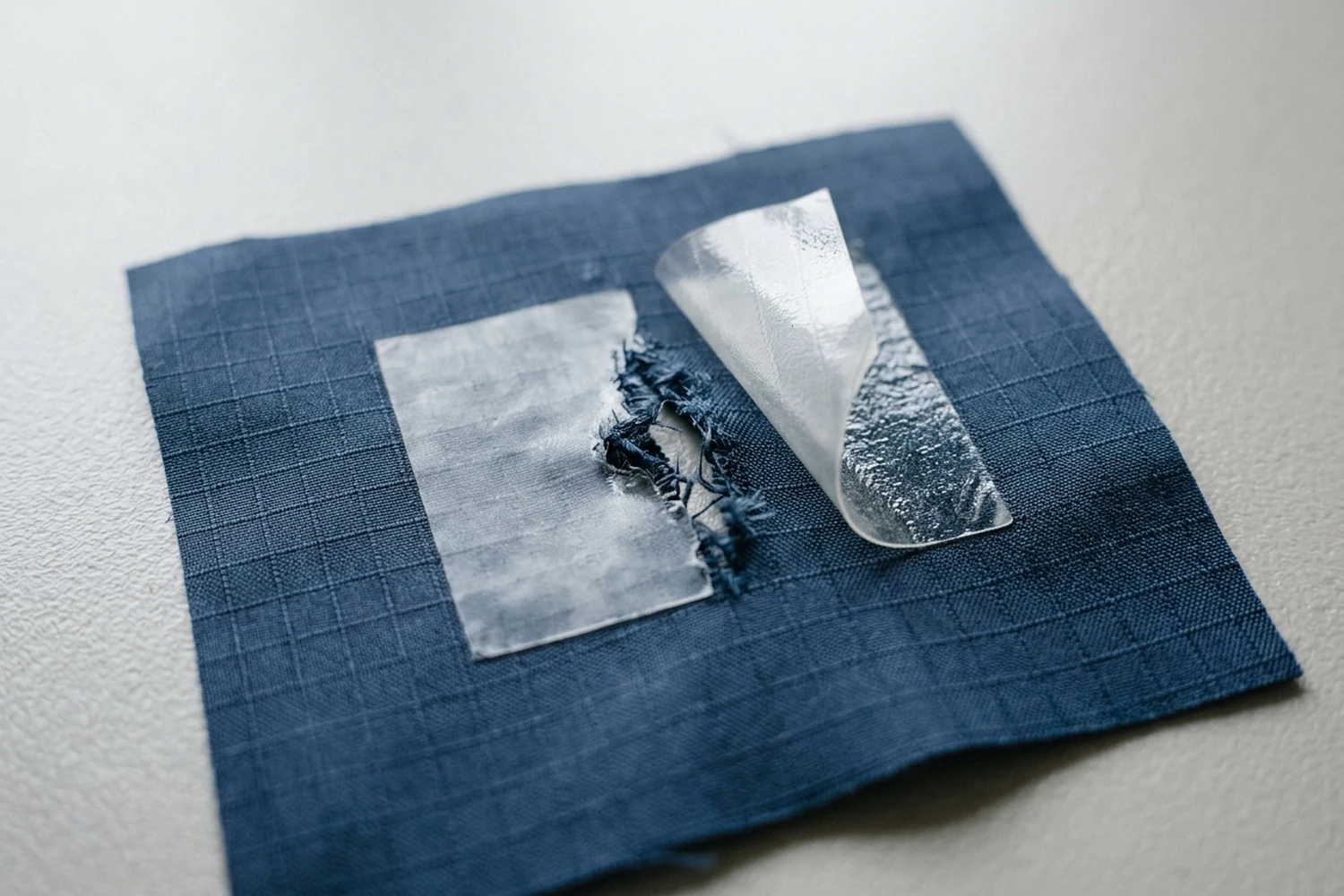
Retain the fabric identity and surface-treatment information so a later repair does not become an adhesive experiment. GEAR AID’s silicone-specific patch is a practical example of why the coating matters beyond the initial build. Use the kite sail tear repair guide to assess the damaged location and repair approach before adding material to a loaded seam or attachment area.
The lifecycle tradeoff is added patch mass and repair work as well as the original cloth mass. Recheck the cause of damage before replacing an entire sail with heavier fabric.
Method and sources
This guide separates published material specifications from design calculations. Fabric examples come from Top Fabrics’ Chikara and Mirai pages; denier terminology comes from OQLF; measurement scope comes from ASTM’s public D3776/D3776M and D737 pages. Coating-related repair compatibility comes from GEAR AID. Substitute your own cut panel area and target cloth mass in the mass-budget equation before selecting a fabric weight. Sources accessed October 19, 2026.
Updated November 2026.
References & Sources
- Chikara fabric specifications — Top Fabrics
- Mirai fabric specifications — Top Fabrics
- Denier: yarn linear density — Office québécois de la langue française
- ASTM D3776/D3776M-20: public fabric mass scope — ASTM International
- ASTM D737-18(2023): public air-permeability scope — ASTM International
- Tenacious Tape Silnylon Patches: material and adhesive compatibility — GEAR AID