Choosing between ripstop polyester vs nylon for a kite sail comes down to how moisture absorption, breaking elongation, tear resistance, and ultraviolet exposure affect sail shape before an uncoated or degraded panel fails. Nylon is a family of polyamide polymers that is resistant to wear, heat, and chemicals, though dimensional stability due to water absorption imposes limits. On Top Fabrics’ Icarex page, Icarex is described as having excellent UV resistance due to being polyester, keeping its original colour intensity better than nylon and being more resistant to UV degradation.
Compare the published distributor specifications for kite sail ripstop polyester and ripstop nylon in the reference table below before selecting a kite fabric material.
| Kite sail fabric specimen | Published fiber, coating, weight, strength, elongation, and air permeability |
|---|---|
| Icarex Ripstop Polyester (Material and Weight) | On Top Fabrics’ Icarex specification sheet, the material is Polyester with a double sided polyurethane coating, a weight of 37 g/m2, and a roll width of 1.40 m. |
| Icarex Ripstop Polyester (Tearing Strength) | On Top Fabrics’ Icarex specification sheet, the tearing strength is Warp 1.2 kg and Fill 1.2 kg. |
| Icarex Ripstop Polyester (Breaking Elongation) | On Top Fabrics’ Icarex specification sheet, the breaking elongation is Warp 12 and Fill 18 (% / 5cm). |
| Icarex Ripstop Polyester (Air Permeability) | On Top Fabrics’ Icarex specification sheet, the air permeability is 0.02 cc/cm2/sec, which the page notes is measured at a pressure difference of 1 atmosphere given a certain thickness of the fabric. |
| Chikara Ripstop Nylon (Material and Weight) | On Top Fabrics’ Chikara specification sheet, Chikara is 30Denier Nylon 6.6 (Yarn Warp 33 Dtex / Fill 33 Dtex) manufactured by Toray Industries in Tokyo, Japan, with Double sided Polyurethane / Double sided WR coating and a weight of 41 g/m2. |
| Chikara Ripstop Nylon (Tearing Strength) | On Top Fabrics’ Chikara specification sheet, the tearing strength of Chikara is Warp 5.0 kg and Fill 5.0 kg. |
| Chikara Ripstop Nylon (Breaking Elongation) | On Top Fabrics’ Chikara specification sheet, the breaking elongation of Chikara is Warp 49.3 and Fill 51.2 (% / 5cm). |
| Mirai Ripstop Nylon (Material and Weight) | On Top Fabrics’ Mirai specification sheet, Mirai is 40Denier Nylon 6 (Yarn Warp 44 Dtex / Fill 44 Dtex) with Single sided Polyurethane / Double sided WR coating, a weight of 48 g/m2, and a roll width of 1.50 m. |
| Mirai Ripstop Nylon (Mechanical and Airflow Figures) | On Top Fabrics’ Mirai upper specification table, Mirai has tearing strength of Warp 2.3 / Fill 2.4 kg, breaking strength of Warp 49 / Fill 46 kg/5cm, breaking elongation of Warp 36 / Fill 36 (% / 5cm), and air permeability of 0.1 cc/cm2/sec. |
Polymer Chemistry, Moisture Regain, and Wet-Sail Dimensional Stability
Evaluating ripstop polyester vs nylon for a kite sail starts with how ester and polyamide polymer chains respond to ambient humidity, coastal mist, and wet grass. For a general overview of how ripstop cloth is labeled and used across kites, see our ripstop nylon kite fabric guide.
- Under 16 CFR 303.7, the Federal Trade Commission establishes generic names and definitions for manufactured fibers and incorporates ISO 2076:2013(E) by reference.
- Under 16 CFR 303.7(c), polyester is defined as a manufactured fiber in which the fiber-forming substance is any long chain synthetic polymer composed of at least 85% by weight of an ester of a substituted aromatic carboxylic acid, including but not restricted to substituted terephthalate units, and para substituted hydroxy-benzoate units.
- Most references to polyester relate to PET (polyethylene terephthalate), and polyester fibers used in fabric manufacture are highly water-resilient.
- Under 16 CFR 303.7(i), nylon is defined as a manufactured fiber in which the fiber-forming substance is a long-chain synthetic polyamide in which less than 85 percent of the amide linkages are attached directly to two aromatic rings.
- Nylon is a family of polyamide polymers that is resistant to wear, heat, and chemicals, though dimensional stability due to water absorption imposes limits.
- Early nylon was developed as a replacement for silk and can undergo significant elongation before fracture, with four main nylon grades designated as nylon 66, 11, 12, and 46 (common nomenclature PA, such as PA6 or PA6/66).
Textile conditioning standards and kitemaking manuals document how humidity exposure and moisture alter fabric state and dimensions:
- Under ASTM D1776/D1776M-20 Section 1.1, this practice covers the conditioning and testing of textiles when conditioning is specified in a test method, and because prior exposure of textiles to high or low humidity may affect moisture pick-up equilibrium, a procedure is given for preconditioning the material when required.
- Under ASTM D1909-13 Section 4.1, the commercial moisture regain value listed for a specific fiber type is a defined commercial value rather than an experimentally determined quantity, and actual moisture regain values of textile materials in moisture equilibrium can deviate from listed values depending on the previous history of the material.
- In G. William Tyrrell Jr.’s Mastering Nylon article, when ironing ripstop nylon on the low nylon setting, kitemakers must not use a wet cloth or steam because they will tend to stretch the fabric, and excessive heat causes puckers that are almost impossible to remove, especially on lighter weight ripstops.
- Known as PC-31 (31g/yd²), Icarex high-end ripstop polyester has a polyurethane (PU) coating on both sides that ensures airtightness and prevents water absorption, providing outstanding performance even in light winds and rainy conditions.
- On Top Fabrics’ Icarex page, Icarex is coated in Polyurethane (PU) on both sides with Double sided WR and high dimensional stability, which the distributor states guarantees the fabric will keep its shape in wet, rainy conditions and will not deform when exposed to high temperatures and rain.
- On Top Fabrics’ Chikara page, Chikara ripstop spinnaker nylon weighs 41 grams per square meter and has a polyurethane (PU) coating on both sides that minimizes water absorption in dry, humid, or wet environments, plus a PFOA-free water-repellent (WR) coating.
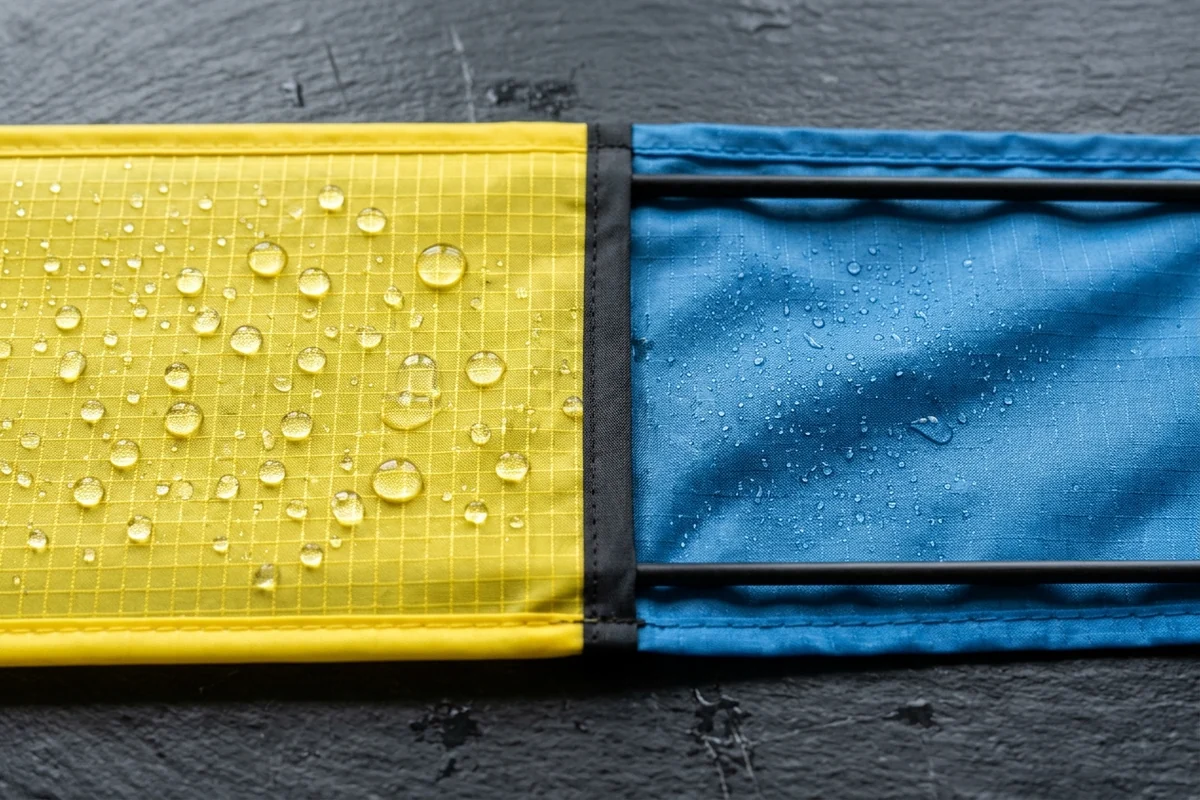
Takeaway: Select double-coated ripstop polyester when wet-sail dimensional stability in rain or coastal humidity is the primary requirement, and account for polyamide water-absorption limits and steam-induced stretch when ironing ripstop nylon (no wet cloth/steam).
Breaking Elongation, Tear Strength, and Shock Absorption in Kite Sails
Comparing ripstop nylon vs polyester on mechanical specifications reveals a direct trade-off between low-stretch frame responsiveness and elastic tear/shock resistance. For details on how yarn denier relates to finished fabric mass, see our guide on ripstop nylon fabric weights, denier, and coatings.
Published distributor specifications for Icarex polyester illustrate how low elongation supports sport and trick kites:
- On Top Fabrics’ Icarex specification page, Teijin is identified as the Japanese manufacturer of Icarex, and the yarn linear density is listed as 30Denier (Warp 33 Dtex / Fill 33 Dtex).
- On Top Fabrics’ Icarex specification sheet, the material is Polyester with a double sided polyurethane coating, a weight of 37 g/m2, and a roll width of 1.40 m.
- With minimal elongation, Icarex enhances the responsiveness and accuracy of sport kites compared to nylon, and features double-yarn reinforcement woven at 10mm intervals in both the warp and fill directions.
- According to Top Fabrics’ Icarex specification page, polyester ripstop fabrics typically offer less tear resistance than nylon.
- On Top Fabrics’ Icarex page, Icarex is listed for sport- and trick kites, single line kites, and high spec applications where light weight, airtightness, and high dimensional stability are more important than tear strength and elasticity.
- On Top Fabrics’ Icarex specification sheet, the tearing strength is Warp 1.2 kg and Fill 1.2 kg.
- On Top Fabrics’ Icarex specification sheet, the breaking strength is Warp 28 kg/5cm and Fill 31 kg/5cm.
- On Top Fabrics’ Icarex specification sheet, the breaking elongation is Warp 12 and Fill 18 (% / 5cm).
- On Top Fabrics’ Icarex specification sheet, the air permeability is 0.02 cc/cm2/sec, which the page notes is measured at a pressure difference of 1 atmosphere given a certain thickness of the fabric.
By contrast, published distributor sheets for Chikara and Mirai ripstop nylon show higher breaking elongation and higher tear strength figures for sport and foil kites:
- On Top Fabrics’ Chikara specification sheet, Chikara is 30Denier Nylon 6.6 (Yarn Warp 33 Dtex / Fill 33 Dtex) manufactured by Toray Industries in Tokyo, Japan, with Double sided Polyurethane / Double sided WR coating and a weight of 41 g/m2.
- On Top Fabrics’ Chikara specification sheet, the tearing strength of Chikara is Warp 5.0 kg and Fill 5.0 kg.
- On Top Fabrics’ Chikara specification sheet, the breaking strength of Chikara is Warp 40 kg/5cm and Fill 36.1 kg/5cm.
- On Top Fabrics’ Chikara specification sheet, the breaking elongation of Chikara is Warp 49.3 and Fill 51.2 (% / 5cm).
- On Top Fabrics’ Chikara specification sheet, the air permeability of Chikara is 0.03 cc/cm2/sec.
- On Top Fabrics’ Mirai page, Mirai is a 40D ripstop nylon launched in 2005 as a foundational fabric for sport and foil kites to resist wear and tear, offer airtightness, and absorb shocks, with a polyurethane (PU) coating on one side and a water-repellent finish on both sides.
- On Top Fabrics’ Mirai specification sheet, Mirai is 40Denier Nylon 6 (Yarn Warp 44 Dtex / Fill 44 Dtex) with Single sided Polyurethane / Double sided WR coating, a weight of 48 g/m2, and a roll width of 1.50 m.
- On Top Fabrics’ Mirai upper specification table, Mirai has tearing strength of Warp 2.3 / Fill 2.4 kg, breaking strength of Warp 49 / Fill 46 kg/5cm, breaking elongation of Warp 36 / Fill 36 (% / 5cm), and air permeability of 0.1 cc/cm2/sec.
- On Top Fabrics’ Mirai page, the distributor states under MEDIUM-LOW STRETCH that Mirai has a little more stretch ability than Chikara and Icarex.
- In the Prism Synapse Pilot’s Guide, the Synapse does not have any parts that require assembly, and soft parafoil wings like the Synapse must be inflated by the wind flowing past them to fly, with smooth, moderate winds between 8 - 12 mph recommended for first flights and an advertised wind range of 5-25 mph.
When reading tear strength figures on fabric sheets, tongue-tear laboratory rules explain why reported tear values are comparative only under identical procedures and why tear propagation differs from tear initiation:
- Under ASTM D2261-13(2017) Section 5.2, the force registered in a tear test is irregular, and empirical reported values are considered to reflect comparative performance of similar fabrics tested and measured in the same way, with no known procedure available that can be used with all fabrics to determine minimum tearing strength.
- Under ASTM D2261 Sections 1.2, 1.3, and 1.4, the tongue tear test method applies to most fabrics including woven fabrics, requires that the tear be initiated before testing, and values obtained are not directly related to the force required to initiate or start a tear.
Takeaway: Match low-elongation ripstop polyester to kites that prioritize crisp frame response and dimensional stability, and choose ripstop nylon when higher tear resistance and elastic shock absorption are required.
Weave Bias, Framed Wingtip Tension, and Bridle Tuning Sensitivity
How a ripstop weave is oriented and tensioned across a kite frame determines whether the canopy holds a symmetrical airfoil or drifts off trim. Before changing tow points on a sluggish kite, review our kite bridle adjustment diagnostic guide.
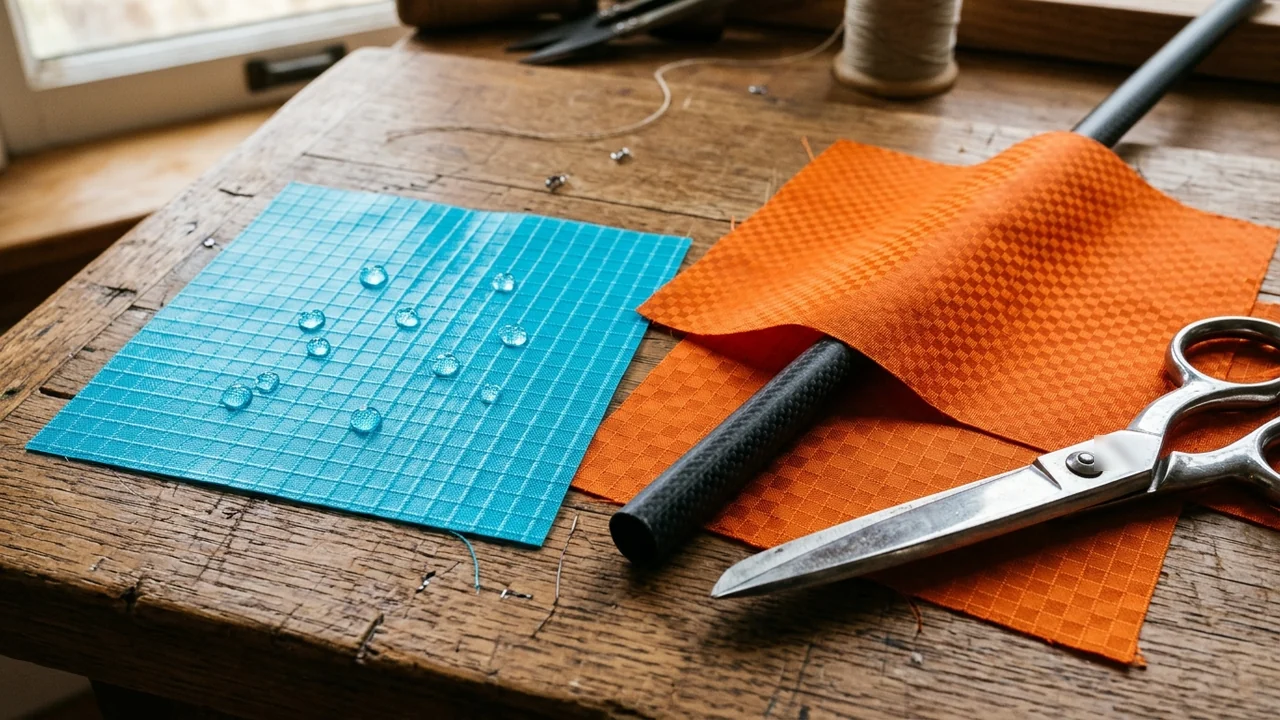
- In G. William Tyrrell Jr.’s Mastering Nylon article, ripstop nylon was originally developed as a synthetic replacement for silk in parachutes during World War II and gets its rip-stopping tear resistance from a slightly larger-diameter thread running checkerboard-style throughout the base weave in 1/8, 3/16, or 1/2“ squares.
- In G. William Tyrrell Jr.’s Mastering Nylon article, parachute ripstop weighing 1/2 - 3/4 oz. per running yard has little or no coating, is extremely stretchy, and is highly porous. In G. William Tyrrell Jr.’s Mastering Nylon article, kitemakers test fabric samples by holding the fabric up to their face and blowing—if air passes, the cloth fails.
- In G. William Tyrrell Jr.’s Mastering Nylon article, sailcloth ripstop (spinnaker cloth) has low-to-practically-no porosity imparted by its coating, with coating adding 1/8 to 1/2 oz. per yard, and three-quarter ounce (3/4 oz.) ripstop is described as probably the most popular weight for kites because of its strength-to-weight ratio and easy sewability.
- In G. William Tyrrell Jr.’s Mastering Nylon article, even ripstop usually has more stretch along the diagonal (bias) than along the straight of the weave, so kitemakers must maintain an even, symmetrical bias on both sides of a kite (such as a delta) or the kite will favor one side.
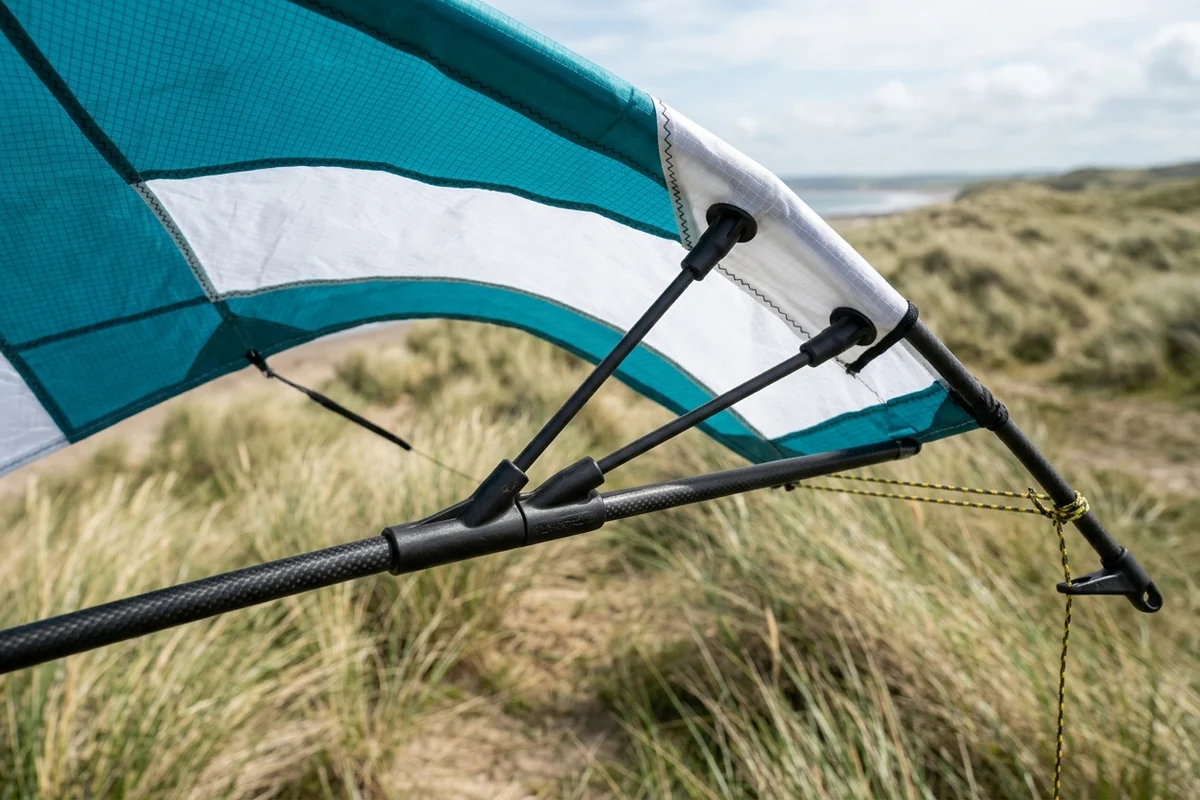
On framed dual-line sport kites, wingtip tensioning and standoff geometry interact directly with small bridle adjustments:
- In the Prism Synthesis SUL Pilot’s Guide, each side of the kite is tensioned by tying off the short line at each wingtip with a clove hitch knot using just enough tension to take the slack out of the sail, and the manual notes that the kite will fly better if the sail is a bit loose instead of too tight.
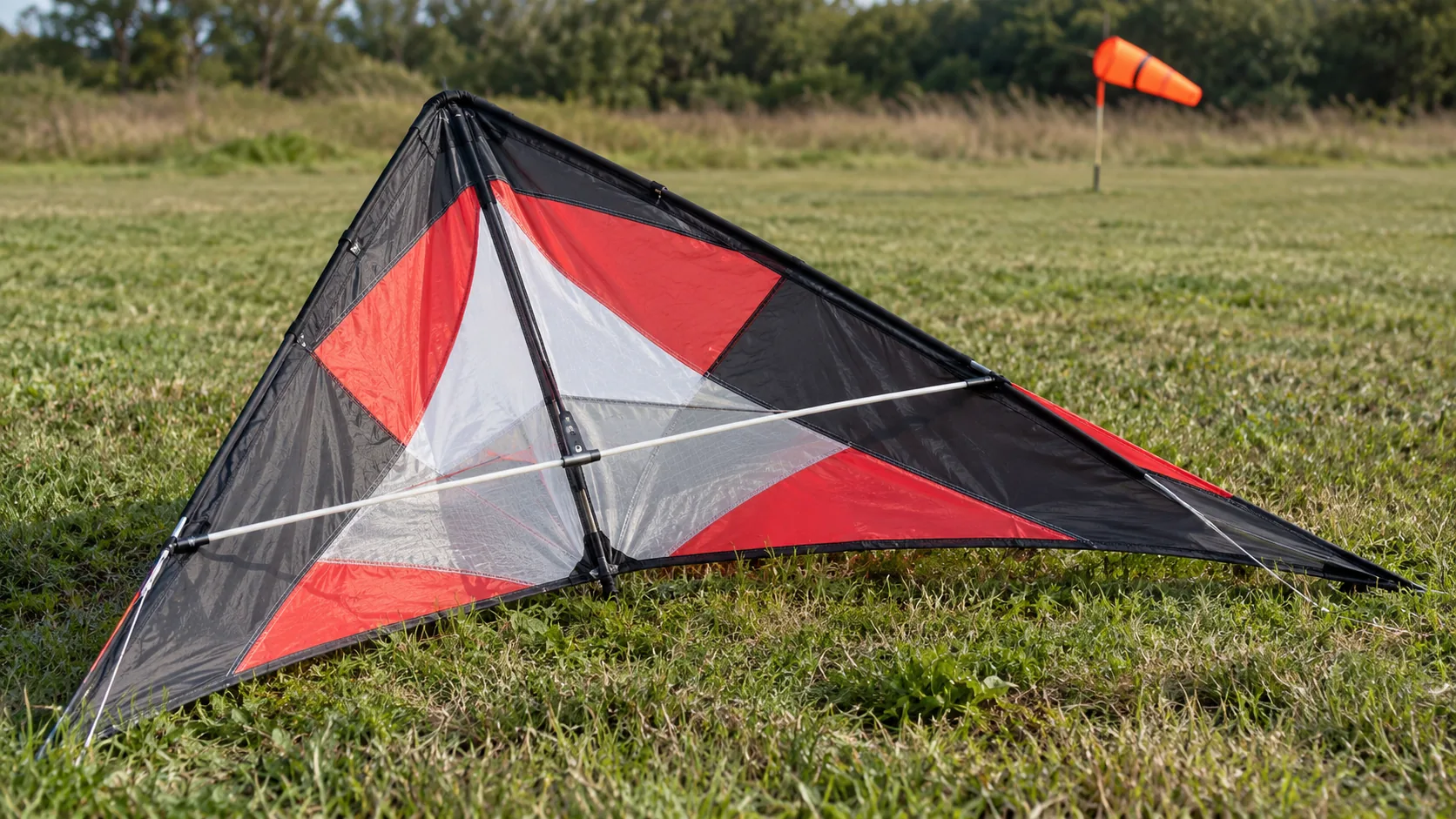
- In the Prism Synthesis SUL Pilot’s Guide, two thin standoff rods on each wing push the sail out and hold the kite in its 3-D shape, affecting lift, forward drive, and tracking; sliding the outer standoff retainer fittings along the lower spreaders toward the spine increases lift and drive in lighter winds, while sliding them out perpendicular to the spreaders slows the kite down and adds drag for crisper cornering and stall control.
- In the Prism Synthesis SUL Pilot’s Guide, once a sport kite is dialed in, small changes in bridle and standoff position still make a big difference in how the kite flies; the Synthesis SUL bridle is set for light (3-8 mph) winds with two knots about 1-1/2“ apart marking the adjustment range, and adjustments are made in 1/2“ increments by sliding the pigtails toward the nose in the lightest winds or away from the nose in winds closer to 8 mph.
Takeaway: Maintain symmetrical diagonal bias across left and right sail panels during layout, and verify wingtip clove-hitch tension and standoff seating before sliding bridle pigtails.
UV Degradation, Hot-Cutting Temperatures, and Post-Flight Care
Sunlight exposure, beach sand abrasion, hot-cutting tools, and post-flight storage affect polyester and nylon sails differently over their service life:
- On Top Fabrics’ Icarex page, Icarex is described as having excellent UV resistance due to being polyester, keeping its original colour intensity better than nylon and being more resistant to UV degradation.
- On Top Fabrics’ Chikara page, the distributor states that many nylon fabrics are attacked by ultraviolet radiation and may crack or disintegrate if they are not UV-stable (a problem known as UV degradation), while stating that Chikara has good UV resistance.
- In G. William Tyrrell Jr.’s Mastering Nylon article, wear on nylon includes degradation of colors and cracking caused by sunlight after many hours of flight, and sand is abrasive on kite covers that frequent the beach.
- In G. William Tyrrell Jr.’s Mastering Nylon article, hot-cutting ripstop nylon uses a 25- to 45-watt model with a tip temperature of 500° minimum for light cloth, or 55- to 80-watt heaters with 700-to-1000° tip temperatures for heavy cloth or high production on light cloth.
- In G. William Tyrrell Jr.’s Mastering Nylon article, ripstop nylon can be washed in warm water and hung on a clothesline to dry, must not be put in a dryer, and holds suds a long time so spills or rain on the kite later will produce foam.
- In the Prism Synthesis SUL Pilot’s Guide maintenance instructions, pilots are instructed to dust off abrasive beach sand after a beach session with compressed air or a soft brush, keep the kite out of hot car trunks, avoid solvents that can dissolve seam adhesives (using warm water and a little dish detergent on a soft sponge instead), and keep the kite out of the sun when not in use to prevent the sail from fading or becoming brittle; the guide recommends a freshwater rinse after salt-water exposure.
Takeaway: Protect both nylon and polyester sails from prolonged ground UV exposure, abrasive beach sand, solvents, and hot car trunks after flying, and do not put ripstop nylon in a dryer.
Sail Coatings and Field Repair Tape Compatibility
Successful sail construction and field patching depend on matching the adhesive tape to the fabric substrate and surface coating. For stitched patch geometry and stop-point reinforcement, see our kite sail tear repair guide.
- In G. William Tyrrell Jr.’s Mastering Nylon article, kite nylons are coated by rolling urethane or acrylic into the cloth’s grain under high pressure and some heat, giving the fabric slickness, low porosity, and enough body to be sewn conventionally.
- In G. William Tyrrell Jr.’s Mastering Nylon article, when one side of coated ripstop has more coating than the other, kitemakers present the slicker side to the wind, and wind, weather, and wear-and-tear on a frequently flown kite eventually break down the crispness of the coating and soften the fabric.
- In the Prism field-repair guide (Don’t Panic!), transparent Tedlar tape is described as a clear film that won’t yellow or crack from UV exposure over time, with an aggressive adhesive on one side recommended for tears as long as 10“ in the middle of the sail, applied to the back surface of the sail.
- In the Prism field-repair guide (Don’t Panic!), fixing a sail tear with Tedlar requires cleaning the back side of the sail with a little rubbing alcohol, aligning the torn edges with masking tape on the FRONT of the sail, cutting a Tedlar patch that extends at least 1“ around the perimeter of the tear with rounded corners, and applying the patch smoothly to the back side before removing the masking tape.
- In the Prism field-repair guide (Don’t Panic!), many Prism kites use clear wing panels made from transparent Mylar laminated over polyester reinforcement fibers in places where less stretch is wanted to control the airfoil shape or reinforce a stressed area; Mylar tears follow the same Tedlar procedure as cloth panels, adding a second patch on the front side if the tear is in a high-stress area.
- In the Prism Synthesis SUL Pilot’s Guide (Prismatex Mylar Repair section), Prismatex repair tape must be applied to the BACK side of the sail with slightly rounded corners to preserve the sparkle effect, because applying it to the front leaves the patched area without sparkles.
- On Into The Wind’s Kite Repair Instructions page, puncture holes or small tears in the sail can be repaired with adhesive-backed ripstop tape cut in oval or circular shapes on the back of the kite, burnished with the back of a spoon, and left to cure for a day before using the kite; sewing the tape edges is possible if silicone is sprayed on the needle, while larger tears or punctures in high stress areas may require sewn fabric patches or panel replacement.
- On Into The Wind’s Kite Repair Instructions page, Into The Wind’s summary of Prism’s Tedlar repair instructions states that Tedlar outperforms colored ripstop tape in strength, adhesion, and UV resistance, should always be used on both the front and the back of the sail with rounded corners extending approximately 1/2“ beyond the tear, and should be burnished over paper against a hard table surface with the back of a spoon.
- On GEAR AID’s Tenacious Tape repair guide, GEAR AID recommends cleaning the repair area with isopropyl alcohol, cutting a patch with rounded corners that overlaps the repair area by at least 0.5’’ in all directions, applying at an optimal operating temperature for initial adhesion of 50-104°F (10-40°C), and allowing 24 hours for the adhesive to reach full strength (clean-adhesive technology allows repositioning within 48 hours; Special Notes state the adhesive can be repositioned for up to 72 hours).
- On GEAR AID’s Tenacious Tape repair guide, Tenacious Tape is listed as best applied to Nylon, Polyester, Vinyl, Canvas, Rubber, Bicast Leather (PU Leather), Non-Oiled Leather, Vinyl Plastic (PVC), TPU, EVA Plastic, PET Plastic, OPP Plastic, Sunbrella, and WINDSTOPPER.
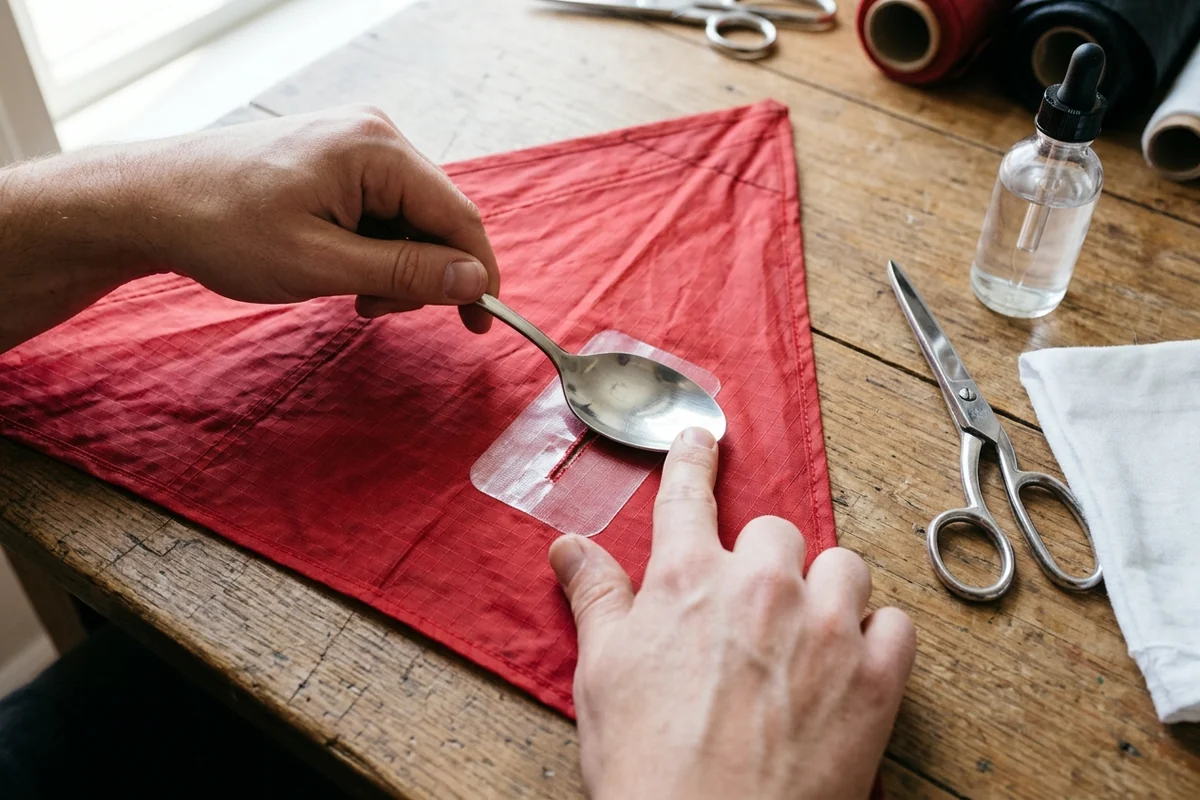
Takeaway: Clean coated nylon or polyester sail surfaces with alcohol before patching, round all patch corners, burnish firmly, and allow full adhesive cure time when specified.
Pre-Build and Field Inspection Checklist for Kite Sail Fabrics
Use the inspection table below to record your fabric verification checks before cutting panels or tuning a kite in the field:
| Inspection item | Verification step to complete | Builder or pilot notes |
|---|---|---|
| Base polymer and yarn grade | Confirm whether the cloth is ripstop polyester or ripstop nylon and record the supplier specification sheet | ____________________ |
| Porosity and face coating check | Perform a breath blow test for airtightness and identify the slicker coated face to orient toward the wind | ____________________ |
| Panel bias symmetry layout | Align left and right sail templates so diagonal weave bias is symmetrical across the spine | ____________________ |
| Wingtip and standoff seating | Check wingtip clove-hitch slack removal and standoff retainer positions before moving bridle pigtails | ____________________ |
| Repair tape and surface prep | Match Tedlar, Prismatex, ripstop tape, or Tenacious Tape to the panel material and prep with alcohol | ____________________ |
| Post-flight cleaning and storage | Brush off beach sand, rinse salt water with fresh water, line-dry away from dryers, and store out of sun and hot trunks | ____________________ |
Takeaway: Record fabric grade, coating orientation, weave bias symmetry, frame seating, and patch preparation before flight so sail performance and repairs stay consistent.
Explore more fabric and maintenance guides in the Materials and Care category or browse all articles on the main blog index.
Sources
- U.S. Federal Trade Commission / Cornell Legal Information Institute — Generic Names and Definitions for Manufactured Fibers
- Xometry — Nylon vs. Polyester: Differences and Similarities
- ASTM International — Standard Practice for Conditioning and Testing Textiles
- ASTM International — Standard Tables of Commercial Moisture Regains and Commercial Allowances for Textile Fibers
- ASTM International — Standard Test Method for Tearing Strength of Fabrics by the Tongue (Single Rip) Procedure
- Top Fabrics — Icarex Ripstop Polyester Technical Specifications
- Top Fabrics — Chikara Ripstop Nylon Technical Specifications
- Top Fabrics — Mirai Ripstop Nylon Technical Specifications
- Fly Market Kitemaking Supply — Mastering Nylon by G. William Tyrrell Jr.
- Prism Designs — Synthesis SUL Pilot’s Guide
- Prism Designs — Synapse Pilot’s Guide
- Prism Designs — Kite Pilot’s Guide to Field Repairs
- Into The Wind Kites — Kite Repair Instructions
- GEAR AID — Tips for Using Tenacious Tape Repair Tape
Frequently Asked Questions
What is the chemical difference between ripstop polyester and ripstop nylon?
Under 16 CFR 303.7, the Federal Trade Commission establishes generic names and definitions for manufactured fibers and incorporates ISO 2076:2013(E) by reference. Under 16 CFR 303.7(c), polyester is defined as a manufactured fiber in which the fiber-forming substance is any long chain synthetic polymer composed of at least 85% by weight of an ester of a substituted aromatic carboxylic acid, including but not restricted to substituted terephthalate units, and para substituted hydroxy-benzoate units. Under 16 CFR 303.7(i), nylon is defined as a manufactured fiber in which the fiber-forming substance is a long-chain synthetic polyamide in which less than 85 percent of the amide linkages are attached directly to two aromatic rings.
How do ripstop polyester and ripstop nylon compare on stretch and tear strength?
According to Top Fabrics' Icarex specification page, polyester ripstop fabrics typically offer less tear resistance than nylon. On Top Fabrics' Icarex specification sheet, the tearing strength is Warp 1.2 kg and Fill 1.2 kg. On Top Fabrics' Icarex specification sheet, the breaking elongation is Warp 12 and Fill 18 (% / 5cm). On Top Fabrics' Chikara specification sheet, the tearing strength of Chikara is Warp 5.0 kg and Fill 5.0 kg. On Top Fabrics' Chikara specification sheet, the breaking elongation of Chikara is Warp 49.3 and Fill 51.2 (% / 5cm). On Top Fabrics' Mirai upper specification table, Mirai has tearing strength of Warp 2.3 / Fill 2.4 kg, breaking strength of Warp 49 / Fill 46 kg/5cm, breaking elongation of Warp 36 / Fill 36 (% / 5cm), and air permeability of 0.1 cc/cm2/sec.
Why does humidity or wet weather affect nylon and polyester kite sails differently?
Nylon is a family of polyamide polymers that is resistant to wear, heat, and chemicals, though dimensional stability due to water absorption imposes limits. Most references to polyester relate to PET (polyethylene terephthalate), and polyester fibers used in fabric manufacture are highly water-resilient. In G. William Tyrrell Jr.'s Mastering Nylon article, when ironing ripstop nylon on the low nylon setting, kitemakers must not use a wet cloth or steam because they will tend to stretch the fabric, and excessive heat causes puckers that are almost impossible to remove, especially on lighter weight ripstops. On Top Fabrics' Icarex page, Icarex is coated in Polyurethane (PU) on both sides with Double sided WR and high dimensional stability, which the distributor states guarantees the fabric will keep its shape in wet, rainy conditions and will not deform when exposed to high temperatures and rain.
Which repair tapes bond to coated ripstop nylon and polyester kite sails?
In the Prism field-repair guide (Don't Panic!), transparent Tedlar tape is described as a clear film that won't yellow or crack from UV exposure over time, with an aggressive adhesive on one side recommended for tears as long as 10" in the middle of the sail, applied to the back surface of the sail. On Into The Wind's Kite Repair Instructions page, puncture holes or small tears in the sail can be repaired with adhesive-backed ripstop tape cut in oval or circular shapes on the back of the kite, burnished with the back of a spoon, and left to cure for a day before using the kite; sewing the tape edges is possible if silicone is sprayed on the needle, while larger tears or punctures in high stress areas may require sewn fabric patches or panel replacement. On GEAR AID's Tenacious Tape repair guide, Tenacious Tape is listed as best applied to Nylon, Polyester, Vinyl, Canvas, Rubber, Bicast Leather (PU Leather), Non-Oiled Leather, Vinyl Plastic (PVC), TPU, EVA Plastic, PET Plastic, OPP Plastic, Sunbrella, and WINDSTOPPER.