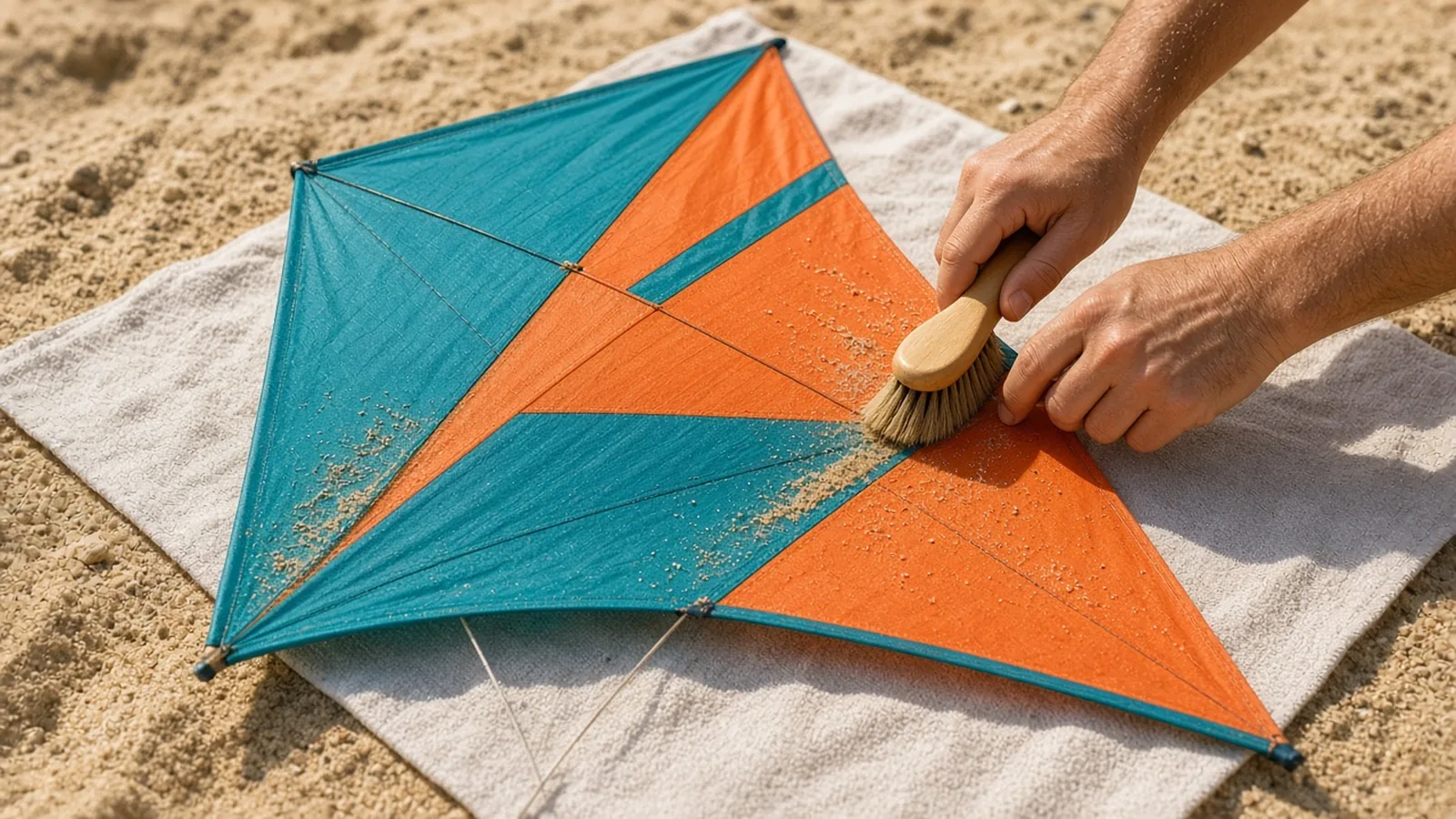
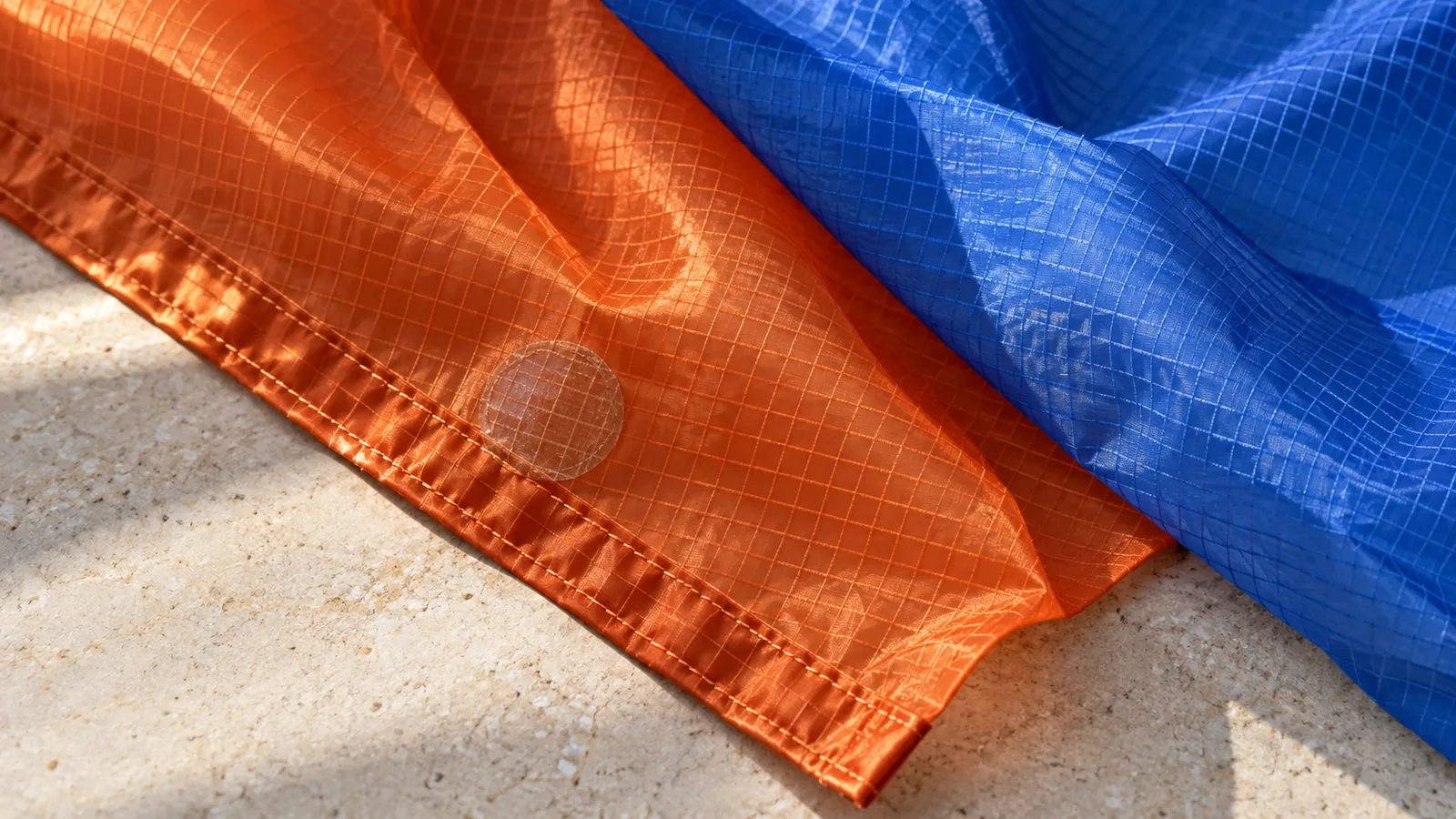
How to repair a kite tear starts with where the damage sits and what the sail is made of. A small hole or a short tear in the open panel of a low-load recreational sail can be taped when a maker’s note names that cloth.
A seam, a spar pocket, a rod through the nose, cloth you cannot name, or a traction kite goes to the original maker. Nothing here puts a strength rating back on the sail.
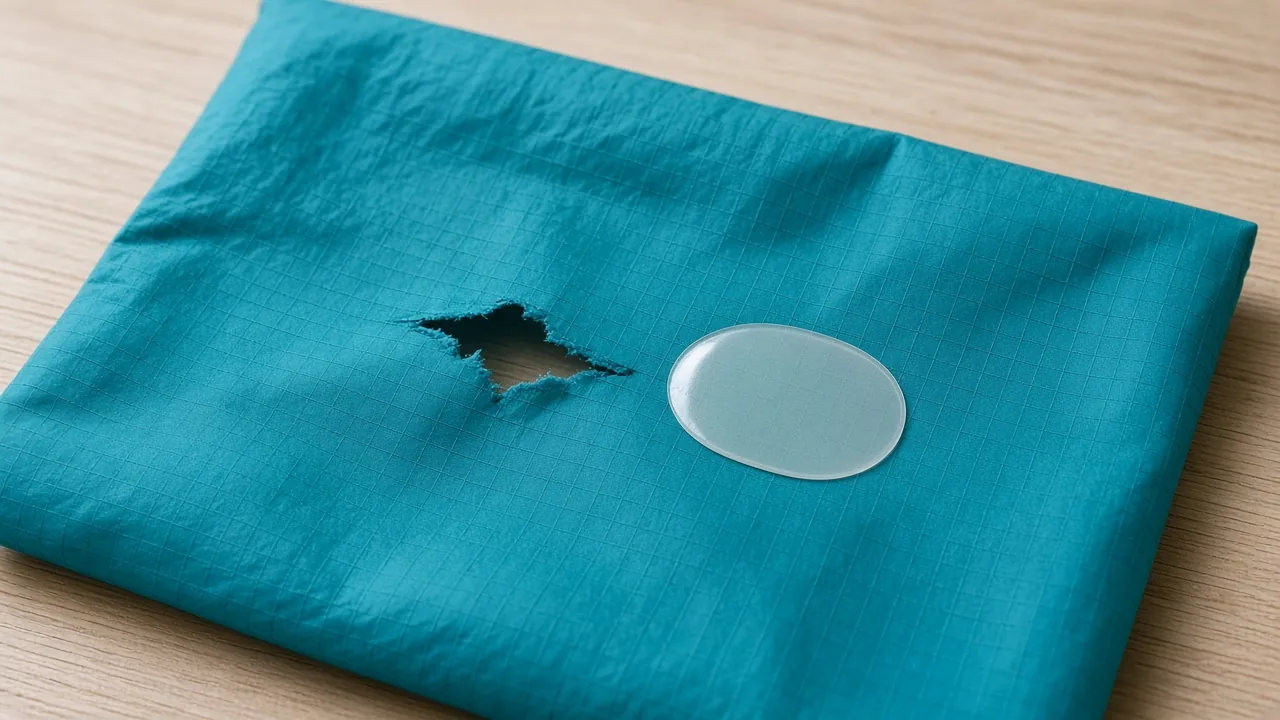
The ripstop nylon guide stops at patching small holes. The notes below are the branch for which tape, which side, and where to stop. Replacing a spar is a different job, and this page does not do it.
What this page will patch
This page covers a small hole or a short tear in the open cloth of a recreational sail that is not pulling a person. The sail has to match one of the materials in the tables.
| Situation | What you do |
|---|---|
| Small hole or short tear in open cloth, and you can name the material | Use the row for that material. Keep that source’s side count. |
| You cannot tell whether the cloth is ripstop, a clear Mylar panel, or Prismatex | Ask the maker before any tape. |
| The tear reaches a seam, or the sleeve a spar slides through | Stop. Use the maker list further down. |
| A spar is poking through the nose | Send the sail. The Prism field-repair booklet treats that as a sail to send in. |
| The kite is a traction kite, or the hole is in a bladder or a valve | Outside this page. |
| A spar is broken and the sail cloth is intact | Outside this page. This is not a frame guide. |
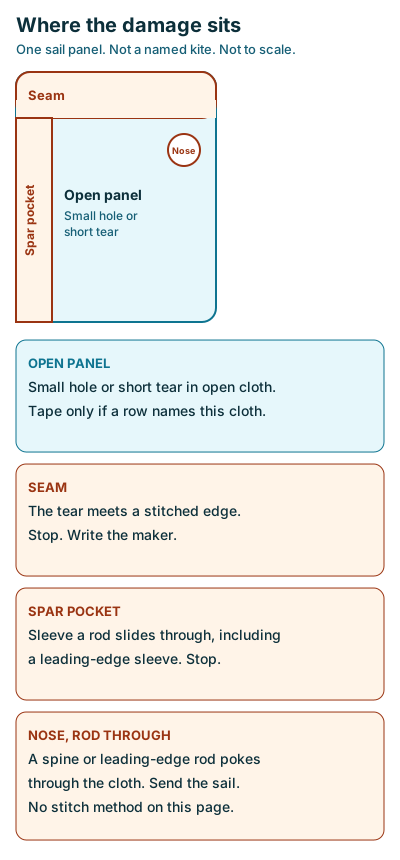
Schematic of damage locations on one sail panel. Open cloth is the only taped area on this page, and only when a source names the material. Not a named kite, and not to scale.
Takeaway: Tape an open-panel hole only when a source names that cloth. A seam, a spar pocket, or a rod through the nose stops the patch.
Match the damage to a material and a method
Read across one row. Leave the side count in that row. The next row is a different kite, or a different note.
| Damage location | Material or model the note covers | Patch method | Sides the tape covers | Source, fetched 11 October 2026 |
|---|---|---|---|---|
| Open panel, puncture or small tear | Ripstop, as Into The Wind describes the common sail repair | Adhesive-backed ripstop tape, cut as an oval or a circle. White tape on the back. Press with the back of a spoon. Leave it a day before flying, if you can. | Back. The page uses the back so the front color stays. It does not add a front piece for this tape. | Into The Wind, Kite Repair Instructions |
| Open panel, middle of the sail, tear the booklet puts at up to 10 inches | Ordinary sail in the Prism field-repair booklet | Transparent Tedlar. Clean the back with a little rubbing alcohol. Masking tape on the front lines up the edges. The patch extends at least 1 inch past the tear. Round the corners. Apply on the back, then remove the front tape. | Back only | Prism field-repair booklet, sail tears |
| Open clear panel | Mylar laminated over polyester fibers, on Prism kites in that booklet | The same Tedlar steps as the cloth panels. If the booklet’s “high-stress” label fits the spot, add a second patch on the front. | Back, plus the front when that booklet calls the area high-stress | Prism field-repair booklet, Mylar tears |
| Open panel on this one model | Prismatex Mylar on the Prism Synthesis SUL | Prismatex repair tape supplied with that kite. Masking tape on the front, with a folded tab. Tape on the back. Round the corners. The strip has two backings. | Back only, so the sparkle stays | Synthesis SUL manual, Prismatex Mylar Repair |
| Tedlar, with no model named on the page | Into The Wind’s account of Prism’s Tedlar instructions | Round the corners. The patch stays about 1/2 inch past the tear. Burnish over paper with the back of a spoon. | Front and back | Into The Wind, Tedlar paragraph |
| Seam, spar pocket, leading-edge sleeve, or a rod through the nose | Any cloth | No patch method on this page | None here | Stop. Maker list below |
| Cloth you cannot name | Unknown | No tape | None here | Ask the maker |
Takeaway: Ripstop tape, Tedlar, and Prismatex tape stay in separate rows because the notes name different cloth and different sides.
How many sides the tape covers
The fetched notes do not share one side count. Use the row that names your sail.
| Note | What it covers | Sides | How far past the tear |
|---|---|---|---|
| Prism field-repair booklet, sail tears | Ordinary sail, transparent Tedlar | Back only. The booklet says the patch is applied to the back surface. | At least 1 inch around the perimeter. Round the corners. |
| Prism field-repair booklet, Mylar tears | Clear Mylar laminated over polyester fibers on Prism kites in that booklet | Back, using the cloth steps. A second patch goes on the front if the tear is in a high-stress area. | The booklet points you at the cloth steps. It does not give a separate overlap for the front piece. |
| Into The Wind, Tedlar paragraph | That page’s account of Prism Tedlar instructions. No model is named. | Front and back. The page says Tedlar should always be used on both. | About 1/2 inch beyond the tear. Round the corners. |
| Into The Wind, ripstop paragraph | Puncture holes or small tears, adhesive-backed ripstop tape | The back, where white tape leaves the front color alone. A front piece is not part of this paragraph. | Cover the tear with an oval or a circle. No inch figure. |
| Synthesis SUL manual, Prismatex Mylar Repair | Prismatex Mylar on the Synthesis SUL | Back only. The manual says the front would leave the patched area without sparkles. | Long enough to cover the tear. No inch figure. Round the corners slightly. |
A Synthesis SUL with Prismatex follows that manual’s back-only steps. An ordinary sail repaired from the field-repair booklet follows that booklet’s back-only Tedlar steps. A reader who is using Into The Wind’s Tedlar paragraph follows the both-sides line printed there. Three instructions, three scopes.
The booklet’s original publish date was not verified. Dates on this page for that PDF are the fetch date, 11 October 2026.
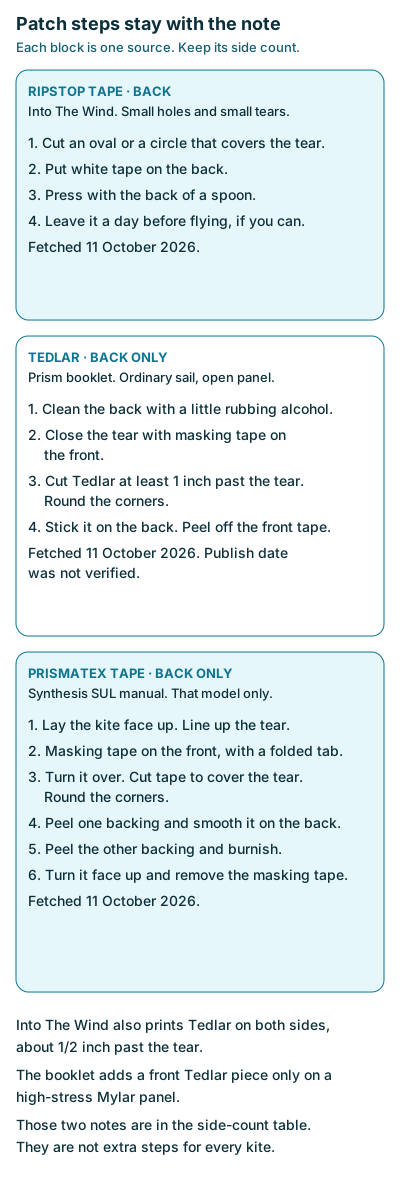
Patch steps for three notes fetched on 11 October 2026. The both-sides Tedlar line and the high-stress front piece stay in the table above. They are not added onto every kite.
Takeaway: Count the sides from the note that names your sail. The booklet’s ordinary-sail Tedlar and the SUL Prismatex tape are back-only. Into The Wind’s Tedlar paragraph says both sides.
Ripstop tape, from Into The Wind
Into The Wind’s repair page, fetched 11 October 2026, says puncture holes or small tears in the sail can be repaired with adhesive-backed ripstop tape.
- Cut the tape in an oval or a circle that covers the tear.
- White tape on the back leaves the sail’s color alone from the front.
- Press the tape with the back of a spoon, or another smooth object, so the adhesive is burnished to the sail.
- If you can leave the kite for a day before you fly it, the page says the tape holds better.
The same page says larger tears in fabric, or puncture holes in high-stress areas, call for a fabric patch sewn on or a sail panel replaced. This page does not give a stitch method for those. They belong on the maker list.
Brush loose sand off before you tape. The steps for dry sand, salt, and storage are on how to clean a kite. If sand is packed down inside the tear, that cleaning page says to ask the maker.
Takeaway: For a small ripstop hole, Into The Wind’s note is white ripstop tape on the back, burnished, with a day to sit if you can spare it.
Tedlar on the back, from the Prism field-repair booklet
The booklet’s sail-tear section says to put transparent Tedlar on the back of the sail. It describes Tedlar as a clear film with adhesive on one side, and it says a back patch stays close to invisible from the front. That sentence is about appearance. The booklet gives no strength figure for the patch, and this page has none to add.
The booklet recommends Tedlar for tears as long as 10 inches in the middle of the sail. A tear that runs into a seam is outside that sentence. The booklet also says it is not usually worth sewing a new cloth panel, and a mangled sail is a call to them. This page does not turn that into a sewing lesson.
Steps for an ordinary sail in that booklet:
- Clean the back of the sail in the repair area with a little rubbing alcohol.
- If you have masking tape, put it on the front to line up the torn edges and close the tear.
- Cut a Tedlar patch that extends at least 1 inch past the tear all the way around. Round the corners. The booklet says that keeps them from peeling up.
- Smooth the patch onto the back. Then take the masking tape off the front.
The booklet says the patch is a shiny spot from the back. From the front, it says the repair should be close to invisible.
Fine sand can collect on the edges of a Tedlar patch, in the booklet’s words, and a little alcohol on a rag cleans those edges. That note is about Tedlar edges on the sails the booklet covers. It is not a cleaner for every coating. Loose sand, salt, and the warning about solvents on seam adhesive are on the cleaning guide.
Clear Mylar panels in that booklet
The booklet says many Prism kites have clear wing panels of transparent Mylar laminated over polyester reinforcement fibers. For a tear in those panels, it says to follow the same Tedlar steps as for cloth. If the tear is in a high-stress area, stick a second patch on the front. The booklet does not define that area in inches. If you cannot tell whether the panel is this Mylar, ask the maker before you copy the front piece.
This paragraph is the booklet’s Mylar note. It is not the Synthesis SUL process in the next section.
Takeaway: On an ordinary sail in the field-repair booklet, Tedlar goes on the back, at least 1 inch past the tear. A front piece shows up only in that booklet’s high-stress Mylar sentence.
Prismatex on the Synthesis SUL, back only
The Synthesis SUL manual, fetched 11 October 2026, has a section titled Prismatex Mylar Repair. It applies to the Prismatex Mylar on that kite. Leave it there. A different clear panel does not inherit these steps.
The manual says to put the repair tape on the back so the sparkle stays. Tape on the front leaves the patched area without sparkles. The tape in the steps is the Prismatex repair tape included with the kite.
The manual’s list of tools is a smooth clean table, high quality masking tape, Prismatex repair tape, scissors, and small weights or a second pair of hands.
- Lay the kite face up on a clean surface.
- Spread the torn panel so the edges of the tear line up. Hold it flat with small weights or a second pair of hands.
- Put masking tape on the front to hold the tear. Leave a folded tab at one end so the tape peels off cleanly.
- Turn the kite over to reach the back.
- Cut a piece of Prismatex repair tape long enough to cover the tear. Round the corners slightly.
- Peel the backing off one side and smooth that side down over the tear.
- Peel the backing off the other side and burnish it down.
- Turn the kite face up, peel off the masking tape, and stop.
The two backings belong to the Prismatex repair strip in this manual. The ripstop steps and the booklet’s Tedlar steps do not describe a second backing. This manual also does not say to wipe the panel with rubbing alcohol. Keep the alcohol step in the booklet’s section.
Takeaway: On a Synthesis SUL, Prismatex repair tape goes on the back only, using the eight steps in that manual.
What to send when you stop
Stop the patch when any of these is true.
- The tear meets a seam.
- The damage is in a spar pocket, including the sleeve along a leading edge.
- A spine or a leading-edge rod is poking through the nose.
- The sail is mangled past a small open-panel tear.
- You cannot name the cloth.
The Synthesis SUL support note asks you to include the model of the kite, the name of the part, and a mailing address if Prism needs to send something. That note was fetched 11 October 2026. It is Prism’s list for their own repairs. Another maker can ask for a different set.
The field-repair booklet says to contact them when a sail is mangled, and to send in the sail when a rod has poked through the nose so a new nose can be sewn on. It prints temporary field ideas for that nose, including stitching. This page does not repeat them. The booklet’s phone and street address sit in the PDF, and the publish date was not verified, so this page does not treat that block as a current address. Use the contact printed in the manual for the kite in your hands.
Into The Wind’s page is a retailer’s repair note, not the maker of every kite it mentions. For a severe tear, write the maker named on your sail.
Takeaway: A seam, a spar pocket, a rod through the nose, or a mangled sail gets a note to the maker, with the model and the part. It does not get a stitch method from this page.
Outside this page
A bladder, a valve, and a load-bearing traction kite are out. The stunt kite comparison separates power and traction kites from recreational stunt kites. It does not cover their repairs. A broken spar, with the sail cloth still whole, is out as well.
Into The Wind’s repair page says to fly inside the recommended wind range for your kite and to follow the assembly instructions included with it. Published ranges by kite type are on the wind speed chart. That chart does not say whether a torn sail is fit to fly.
These notes live in the Materials and Care section.
Takeaway: The taped repairs here are small open-panel damage on a low-load recreational sail, with the tape and the side count taken from the note that names that sail.
Method and sources
The repair steps are copied from three fetched texts, and each step stays with the text it came from. Nobody on this site pulled a torn sail or compared tapes.
Sail tears, Mylar panels, the 1 inch overlap, the 10 inch middle-of-sail figure, the back-only Tedlar placement, the alcohol wipe, and the nose send-in come from Prism’s field-repair booklet, pages 17-19 of the saved text. The PDF was fetched on 11 October 2026. Its original publish date was not verified, so that fetch date is the one recorded here.
Ripstop tape on the back, the oval or circle, the spoon, the day of sitting, and the both-sides Tedlar line with about 1/2 inch of overlap come from Into The Wind’s Kite Repair Instructions, fetched the same day. That Tedlar paragraph is their account of Prism’s instructions. It is printed here beside the booklet, not merged with it.
The Prismatex steps, the back-only sparkle note, the two backings, and the support list (model, part name, mailing address) come from the Prismatex Mylar Repair and support sections of the Synthesis SUL manual, fetched the same day. They apply to that model.
Where the notes disagree on sides, the table keeps both wordings. Where a note stops at a sewn panel or a new nose, this page stops with a maker list.
Frequently Asked Questions
How do you repair a kite tear?
A small hole or short tear in the open panel can be taped when a fetched maker note names that cloth and says which side the tape covers. A seam, a spar pocket, cloth you cannot name, or a traction kite goes to the original maker. This page does not cover a bladder or a valve, and it does not give the sail a new strength rating.
What kite repair tape should I use?
Use the tape the note names for your cloth. Into The Wind describes adhesive-backed ripstop tape for small holes and small tears in ripstop. The Prism field-repair booklet describes transparent Tedlar on the back of an ordinary sail. The Synthesis SUL manual describes Prismatex repair tape on the back of that model's Mylar. No tape instruction here covers cloth those notes do not name.
Does kite repair tape go on one side or both?
The side count comes from the note that matches the sail. The Prism booklet puts Tedlar on the back of an ordinary sail, and adds a front piece only for a high-stress Mylar panel in that booklet. Into The Wind's Tedlar paragraph says both sides. The Synthesis SUL manual says the back only, for Prismatex on that kite.
When should a torn kite sail go to the maker?
Write the maker when the tear meets a seam or a spar pocket, when a rod pokes through the nose, when the sail is mangled, or when you cannot name the cloth. Prism's Synthesis SUL support note asks for the model, the part name, and a mailing address if they need to send something. Another maker can ask for different items.
References & Sources
- Don't Panic! The kite pilot's guide to field repairs (Sail repairs, pages 17-19) — Prism Designs
- Kite Repair Instructions — Into The Wind
- Synthesis SUL Manual, Prismatex Mylar Repair — Prism Kites