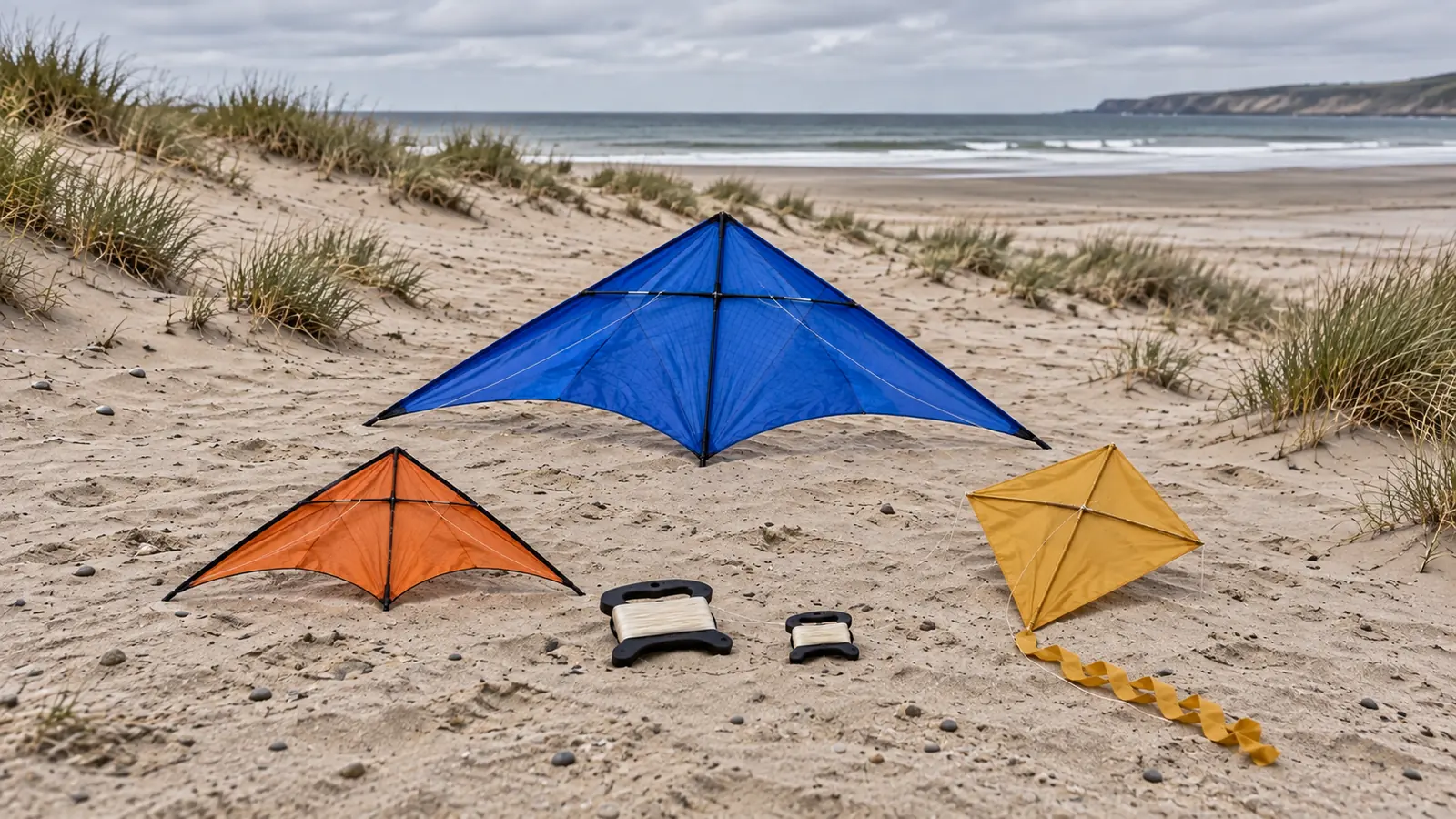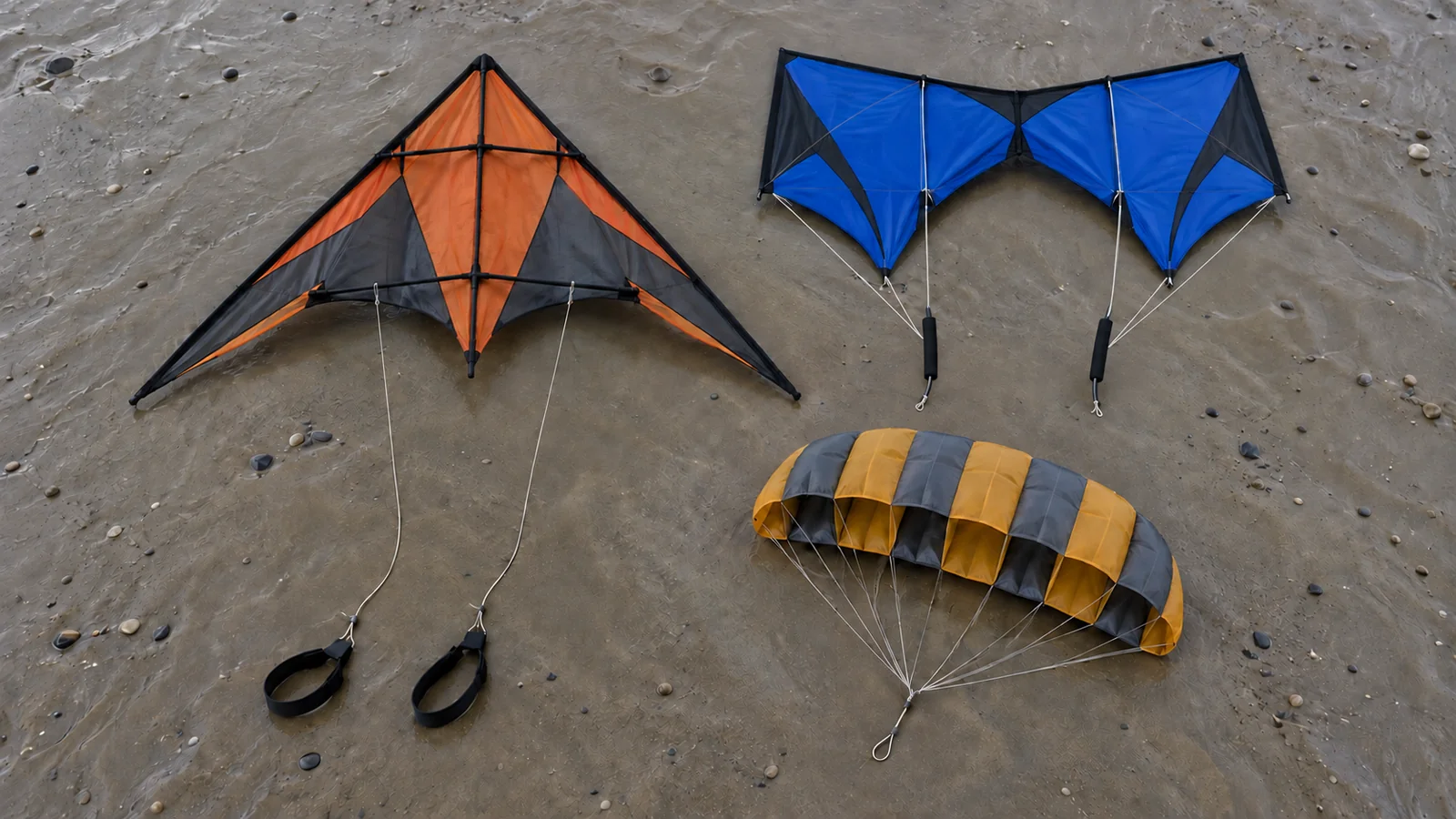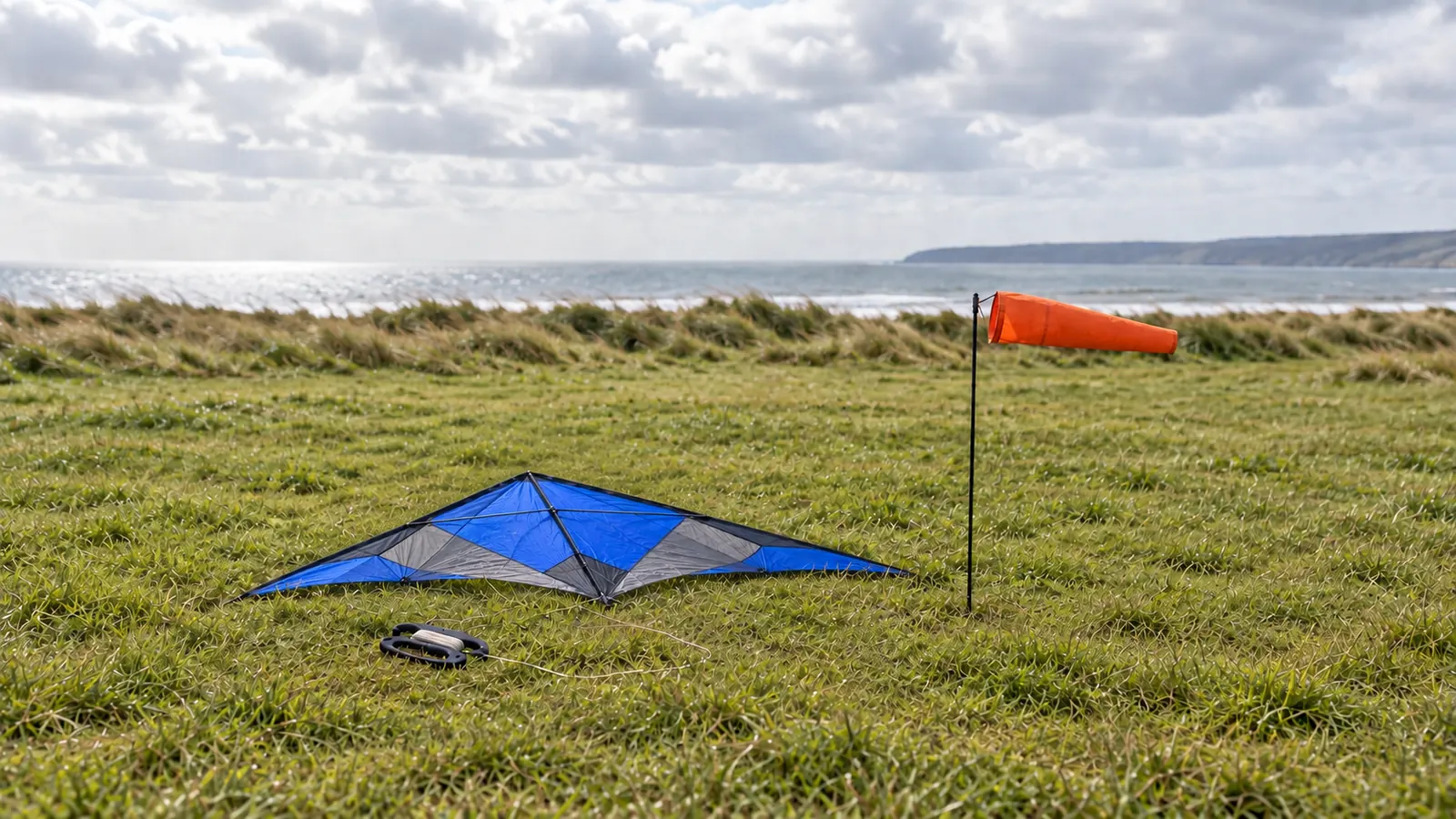
Flying in the wrong wind either leaves a kite dragging on the ground or snaps a spar in the first gust. No single wind speed suits every kite, but most published kite ratings overlap at a gentle to moderate breeze, Beaufort 3–4 on the National Weather Service scale or about 8–18 mph; check your kite’s own range, and stop when gusts pass its top figure or thunder starts.
Reading each maker’s narrower figure where a product page gives two, all 16 kite ratings we compiled from HQ and Revolution cover about 9–12 mph, the upper part of Beaufort 3, and 12 of them also cover all of Beaufort 4 (13–18 mph). Light-wind quad-line kites start near zero but stop at 12–15 mph; frameless foils and one vented sail reach furthest. This page compiles public sources and is not a test. It shows where each type sits, how to read the wind on site, how to convert mph, knots, km/h and m/s, and what to do when there is too little or too much wind.
Quick specs: what to check before you fly
| Input or item | Typical value or source | Why it matters |
|---|---|---|
| Sustained wind | Forecast or observation; NWS observations average over 2 minutes | Compare it with the kite’s published range |
| Gusts | Forecast “G” figure; swings of 10 knots or more (NWS) | The top of the gust range must stay under the kite’s limit |
| Beaufort force | NWS table or field signs | The unit most makers use for ratings |
| Kite’s published range | Product listing, in Bft, mph or km/h | Sets the lower and upper limits for that model |
| Units | mph, knots, km/h, m/s (NIST conversion factors) | Ratings and forecasts use different units |
| Field signs | Leaves, flags, dust, branches (NWS land descriptions) | Lets you judge the wind without a meter |
| Storm risk | Thunder heard means go indoors (NWS) | The one condition that ends every session |
What is the best wind speed for flying a kite?
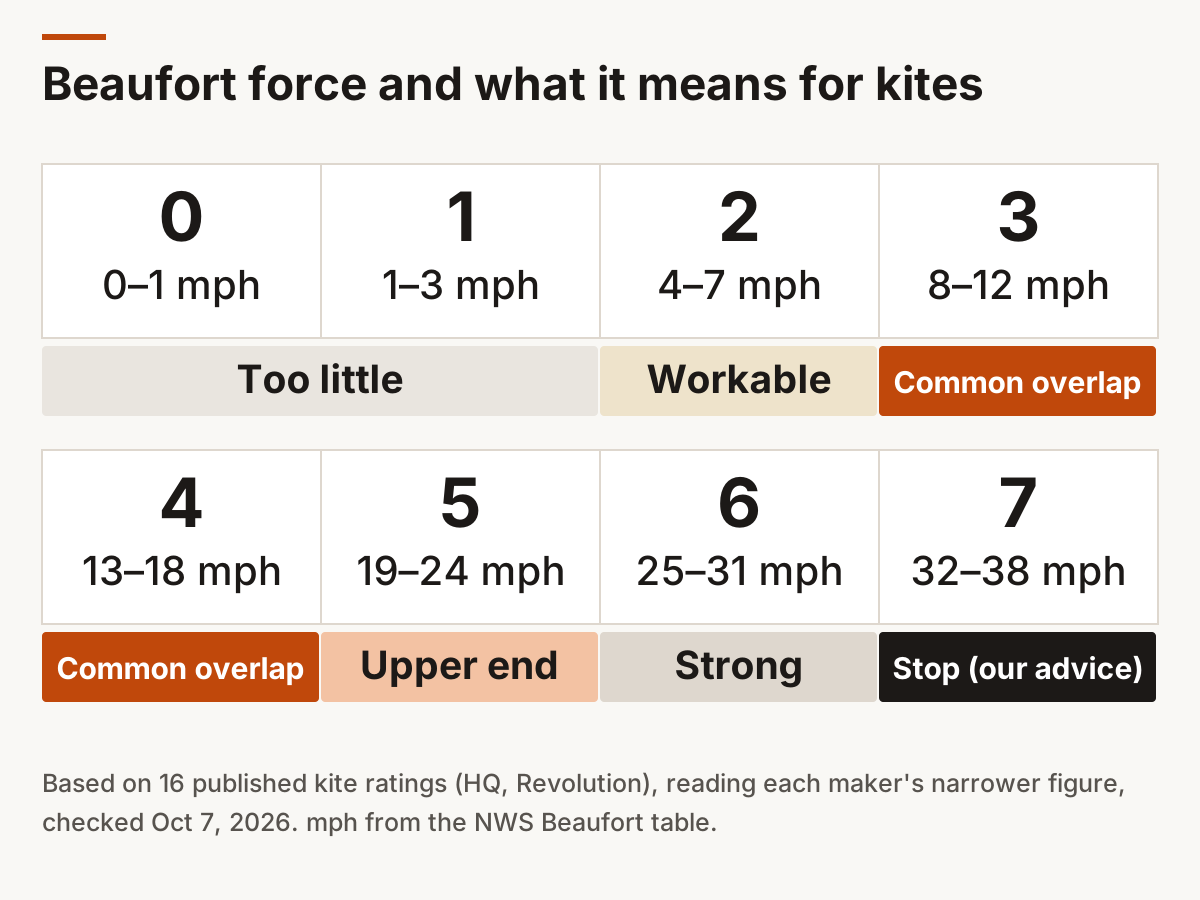
There is no single best speed, but Beaufort 3 to 4, about 8–18 mph or 13–29 km/h, is where the published ranges we compiled overlap most. Light-wind quad-line kites start lower and frameless or vented kites reach higher, so treat this band as a starting point to check against your own kite. The table counts how many of the 16 ratings cover each Beaufort force, reading each maker’s narrower figure.
| Beaufort force | mph (NWS) | How many of the 16 ratings cover it |
|---|---|---|
| 0, calm | 0–1 | 2 (light-wind quad-line kites) |
| 1, light air | 1–3 | 2 fully, 1 partly |
| 2, light breeze | 4–7 | 8 fully, 5 partly |
| 3, gentle breeze | 8–12 | 14 fully, 2 from 9 mph |
| 4, moderate breeze | 13–18 | 12 fully, 3 partly |
| 5, fresh breeze | 19–24 | 8 fully, 1 partly |
| 6, strong breeze | 25–31 | 3 fully; 1 vented sail published as “25+ mph” |
| 7, near gale | 32–38 | None confirmed |
Why not simply “more wind is better”? Lift rises with the speed of the air over the kite, as NASA’s kite pages explain, but so does the load on the frame and line. The encyclopedia entry on delta kites puts it plainly: a kite flown outside its intended wind range can become unstable or be damaged. Planning for the middle of a kite’s range leaves room for gusts at the top.
Takeaway: Start from Beaufort 3–4, then let the kite’s own published range decide whether lighter or stronger days work too.
Wind speed ranges by kite type
Light-wind quad-line kites sit lowest, entry single line and dual-line kites start around 4–7 mph, and frameless foils and a vented sail reach furthest. Several HQ product pages give a Beaufort range and an mph range that do not match, so the last column uses the narrower of the two until the maker confirms which is meant. The NWS conversion of a Beaufort figure is a unit conversion, not a separate rating.
| Kite type | Model (maker) | As published | Planning range used here (mph) |
|---|---|---|---|
| Small framed single line | Bat Black S (HQ) | 2–4 Bft (5–13 mph) | 5–13 |
| Children’s delta | Delta Stern (HQ) | 2–5 Bft (4–24 mph) | 4–24 |
| Mid-size delta | Delta Spectrum Spin (HQ) | 2–5 Bft (5–24 mph) | 5–24 |
| Large light-wind delta | Hoffmanns Canard Delta (HQ) | 1.5–4 Bft (4–18 mph) | 4–18 |
| Extra-large delta | Delta Fireworks 4 m (HQ) | 2–5 Bft (9–22 mph) | 9–22 |
| Parafoil | Orca (HQ) | 2.5–6 Bft (9–31 mph) | 9–31 |
| Dual-line framed stunt | Ecoline Quick (HQ) | 2–5 Bft (7–24 mph) | 7–24 |
| Dual-line framed stunt | Ecoline Rookie (HQ) | 2–6 Bft (4–24 mph) | 4–24 |
| Dual-line foil | Symphony Beach III 1.3 (HQ) | 2–6 Bft (6–31 mph) | 6–31 |
| Dual-line foil | Symphony Beach III 2.2 (HQ) | 2–6 Bft (4–31 mph) | 4–31 |
| Quad-line, light wind | Reflex XX (Revolution) | 0–12 mph (0–14 in the same page’s list) | 0–12 |
| Quad-line, light wind | Eagle (Revolution) | “zero to about 14 mph” | 0–14 |
| Quad-line | Reflex RX (Revolution) | 4–15 mph | 4–15 |
| Quad-line, beginner | Reflex EXP (Revolution) | 6–18 mph | 6–18 |
| Quad-line, standard sail | New York Minute, no vents (Revolution) | 3–18 mph | 3–18 |
| Quad-line, vented sail | New York Minute, three vents per side (Revolution) | 8–25+ mph | 8–25+, upper limit not stated |
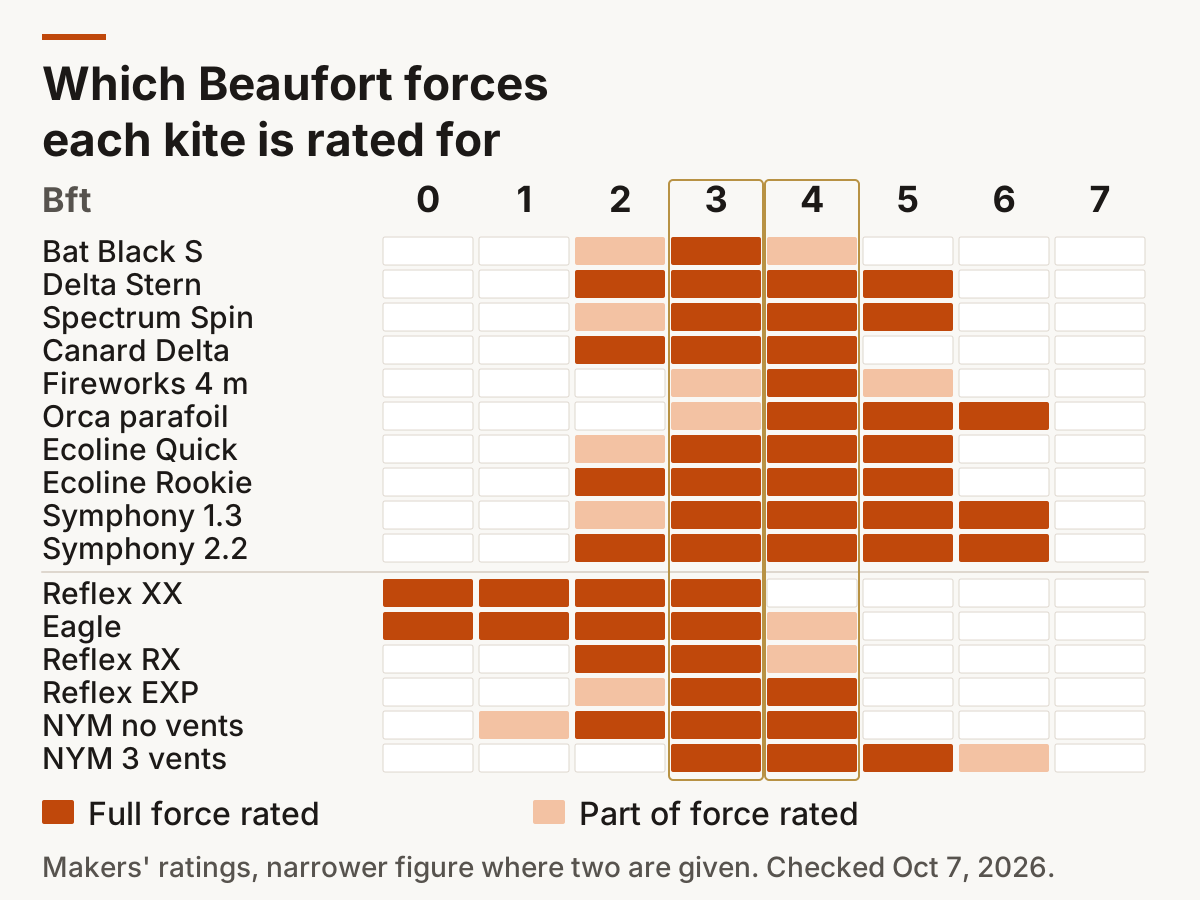
Three patterns stand out. Two light-wind quad-line kites, the Reflex XX and the Eagle, start at zero and stop at 12–14 mph, and the Reflex RX runs 4–15 mph. Entry single line and dual-line kites start between 4 and 9 mph and stop between 13 and 24 mph. The Orca parafoil, the Symphony Beach foils and the vented New York Minute sail reach furthest. The encyclopedia entry on sport kites adds that a pilot’s skill changes the usable range a great deal. The single line kite guide explains how type and size change these numbers, and the stunt kite comparison covers how vents trade light-wind lift for strong-wind handling.
Takeaway: Use the type to get the rough range, then read the exact rating of the model you own.
How to read the wind on site
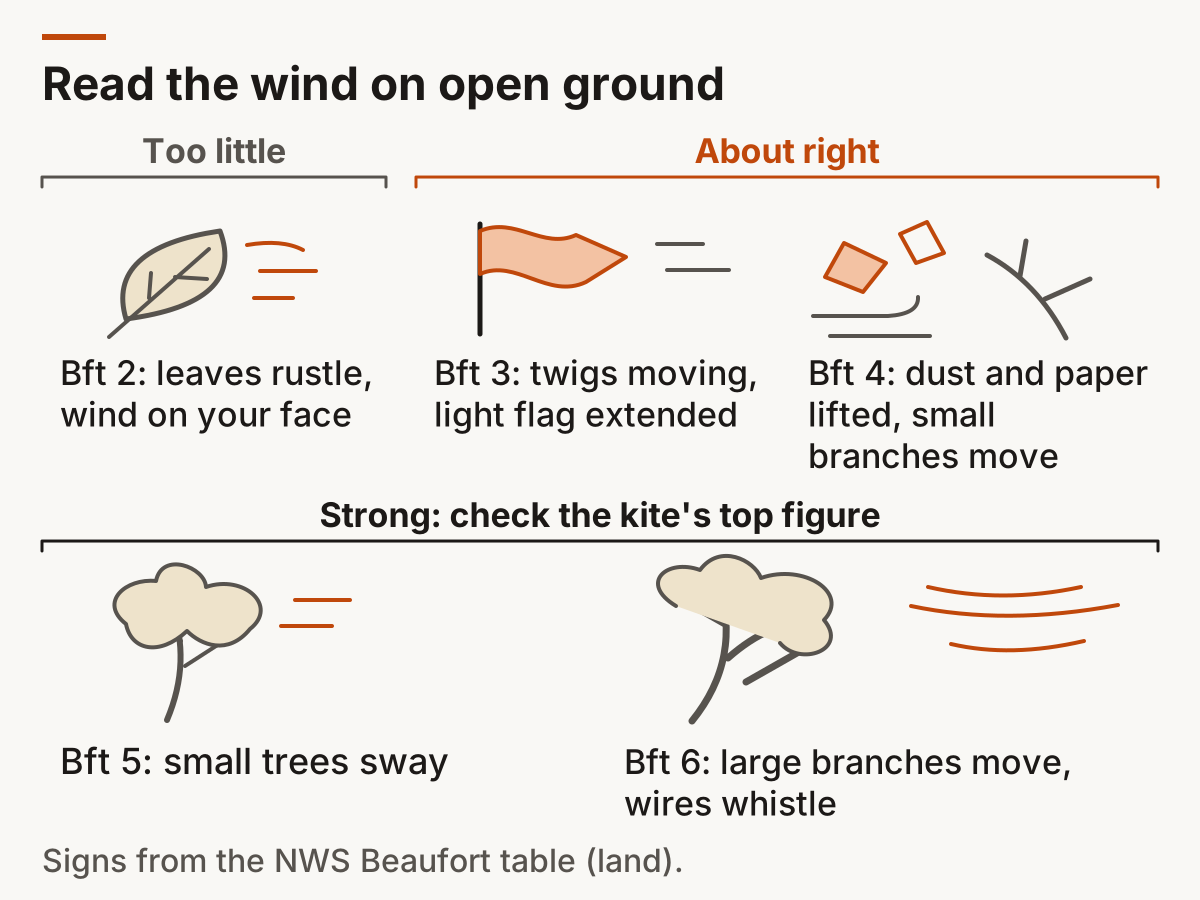
You do not need a meter to place the wind on the Beaufort scale. The NWS table pairs each force with things you can see on land, which makes a three-way check: too little, about right, or too much.
| Your call | What you see (NWS land description) | Beaufort | What to do |
|---|---|---|---|
| Too little | Smoke drifts but vanes do not move | 1 | Wait, or use a light-wind kite |
| Borderline | Wind felt on your face; leaves rustle | 2 | Try a light, rated-from-2 kite; walk back to launch |
| About right | Leaves and small twigs in constant motion; a light flag extended | 3 | Inside every range in our list from about 9 mph |
| About right | Dust and loose paper raised; small branches moving | 4 | Inside 12 of 16 ranges; light-wind quad-lines and the Bat Black S top out early |
| Strong | Small trees in leaf begin to sway | 5 | Only kites rated to Bft 5 or higher (8 of 16 fully) |
| Strong: check the top figure | Large branches moving; whistling in wires; umbrellas hard to use | 6 | Only 3 of 16 ranges cover it fully; most kites should stay packed |
| Stop (our advice) | Whole trees moving; walking into the wind is hard | 7 | No rating in our list confirms it; pack up |
Look at the open ground where the kite will fly, not at a sheltered car park. Trees, buildings and dunes slow the wind and break it into eddies; the encyclopedia entry on sport kites asks for a steady breeze “uninhibited by trees, buildings, hills, or other tall objects.”
Common mistake: Judging the wind at ground level in a sheltered spot. NASA notes that wind speed usually increases with height because the air near the surface is slowed and unsteady, so the kite meets more wind than you feel, and the open field has more than the car park.
If you are still choosing a kite for your local wind, the four-step single line kite check starts from exactly this Beaufort reading.
Takeaway: Find leaves and small branches in constant motion on open ground, and you are in the band where most kites fly.
Converting mph, knots, km/h and m/s
Kite ratings, forecasts and wind meters use four units. The conversion factors come from NIST: one mile per hour is exactly 1.609344 km/h, one knot is 1.852 km/h, and one meter per second is 3.6 km/h.
| Beaufort force | mph | knots | km/h | m/s |
|---|---|---|---|---|
| 2 | 4–7 | 4–6 | 6–11 | 1.8–3.1 |
| 3 | 8–12 | 7–10 | 13–19 | 3.6–5.4 |
| 4 | 13–18 | 11–16 | 21–29 | 5.8–8.0 |
| 5 | 19–24 | 17–21 | 31–39 | 8.5–10.7 |
| 6 | 25–31 | 22–27 | 40–50 | 11.2–13.9 |
The mph and knot columns are the NWS figures; km/h and m/s are converted from the mph values and rounded. Quick rules: knots × 1.15 ≈ mph; mph × 1.6 ≈ km/h; m/s × 2.24 ≈ mph.
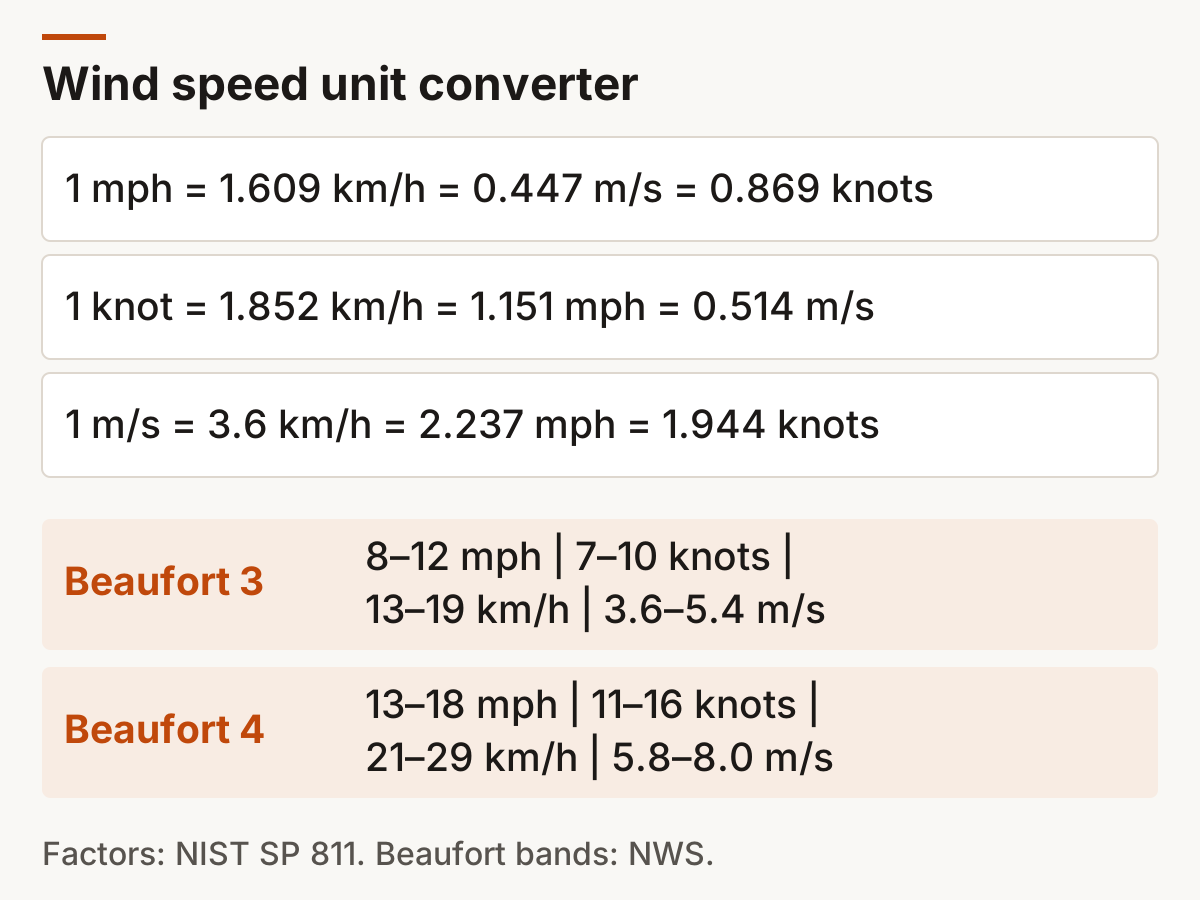
One caution when reading makers’ figures: HQ’s own Beaufort chart matches the NWS table, yet some of its product pages print mph ranges that do not line up with the Beaufort numbers beside them. The Bat Black S lists 2–4 Bft as 5–13 mph, the Delta Fireworks lists 2–5 Bft as 9–22 mph, and the Ecoline Rookie lists 2–6 Bft as 4–24 mph. When the two disagree, plan around the narrower range until the maker confirms which one is meant; the HQ ratings chart in our single line guide shows the same comparison model by model.
Takeaway: Convert everything to one unit before comparing, and when a maker’s two figures disagree, plan around the narrower one.
Why the forecast and the kite feel different
A forecast usually gives two numbers, and they mean different things. In the NWS glossary, sustained wind is observed speed averaged over two minutes, and a gust is a rapid fluctuation of 10 knots or more between peaks and lulls; check how your own forecast product defines its figures. In “10 mph gusting 25,” 10 mph is Beaufort 3 and 25 mph is Beaufort 6, and Beaufort 6 is outside most of the ranges in this guide.
Height matters too. NASA’s explanation of kite flight notes that the wind normally gets faster with altitude, because the air near the ground sits inside a slower, less steady boundary layer. That is why a kite that struggles just above the ground often settles once it is higher, and why a gust that feels moderate at head height hits harder at the top of the line.
Common mistake: Checking only the sustained figure. A kite rated to Beaufort 4 is overloaded by gusts to Beaufort 6 even when the average sits comfortably at 3.
Takeaway: Compare the gust figure, not just the average, with the top of the kite’s range.
What type of kite is best for flying in low wind?
For light air, choose a kite whose published range starts below Beaufort 2. In our list, that means light-wind quad-line kites such as Revolution’s Reflex XX (0–12 mph) and Eagle (“zero to about 14 mph”), or a large light-wind delta such as HQ’s Hoffmanns Canard Delta, rated from Beaufort 1.5 (its page gives 4 mph as the low end). The encyclopedia entry on delta kites adds that light-wind deltas can stay up on rising warm air, much as soaring birds do.
Technique helps as well. NASA explains that lift depends on the kite’s speed relative to the air, so on a light day you can walk backwards or run into the wind to launch, then let line out to reach the faster air higher up. Vented sails work against you here: Revolution says its vents improve high-wind handling “while sacrificing some light wind performance,” so fly the unvented sail. For sail fabric choices that save weight, see our ripstop fabric weight comparison.
Takeaway: In light air, fly a kite rated from Beaufort 0–1.5, launch by walking back, and get it above the slow air near the ground.
Is it ever too windy to fly a kite?
Yes. It is too windy once the gusts pass the top of your kite’s published range. No rating in our list confirms flying at Beaufort 7; the vented New York Minute is published as “8–25+ mph” without an upper figure. The earliest stops in our list are HQ’s small Bat Black S (13 mph on its narrower figure), its large light-wind Canard Delta (18 mph) and Revolution’s light-wind quad-lines at 12–15 mph.
For stronger days, the published ranges point to frameless or vented designs. HQ’s Orca parafoil and its Symphony Beach foils are rated to 31 mph, the top of Beaufort 6, and Revolution’s New York Minute with three vents per side to 25+ mph. A 1981 kitemaking article recommends heavier cloth for large and high-wind designs; see how kite fabrics compare on weight and tear figures. Larger kites also pull harder; the single line kite sizing table shows how line strength rises with span, and the stunt kite comparison covers line sets for dual-line and quad-line kites.
Some stops have nothing to do with kite ratings:
- Thunder: the NWS says there is no safe place outside when thunderstorms are near; go indoors and wait 30 minutes after the last thunder or lightning.
- Power lines: NASA warns never to fly near high-tension wires, because a kite touching them can kill the person holding the line.
- Roads, trees and houses: NASA lists all three as places not to fly.
- Heavy kites near airports: under 14 CFR §101.13, kites over 5 pounds are not to be flown within five miles of an airport boundary or more than 500 feet up, among other limits, with an exception for flying below and within 250 feet of a structure; waivers exist under §101.3. Read the official text for your case.
Takeaway: Pack up when gusts pass the kite’s top figure, when you hear thunder, or when the only open space puts the kite near wires or roads.
When this does not apply
- Kite surfing, landboarding and power kiting use traction kites with their own wind charts, sizes and safety systems; this guide does not cover them beyond the trainer-size foils in our stunt kite comparison.
- Makers’ ratings describe their own models under conditions they do not publish; another brand’s delta of the same size can differ.
- The Beaufort land signs describe open ground. Coastal sea breezes, ridges and gaps between buildings can be much stronger or gustier than the forecast for the area.
- Pilot skill shifts usable range, especially for stunt kites; the encyclopedia entry on sport kites notes that novices can struggle to keep a kite up in wind where experienced pilots perform tricks.
Takeaway: Use these tables to plan, then let your own field and the kite’s own rating make the final call.
Related reading
- Single line kites: types and how to choose — Match a one-line kite to your wind, the flier’s age and its size.
- Stunt kites compared — See how dual-line and quad-line kites differ in control and wind range.
- Ripstop nylon for kites — Compare sail fabrics by weight, stretch and coating.
- Kite Types — Browse the other kite-type guides.
Method and sources: how this chart was put together
This page compiles public information; nobody on this site measured wind or flew these kites for it. The Beaufort forces, mph and knot ranges and land descriptions come from the National Weather Service; forecast terms from the NWS glossary; unit conversions from NIST Special Publication 811; flight physics and safety rules from NASA Glenn Research Center; federal kite limits from 14 CFR Part 101. Wind ratings for the 16 models and sail options come from HQ’s (Invento’s) and Revolution Kites’ product pages, quoted as published; where a page gives a Beaufort range and an mph range that disagree, the counts and charts use the narrower one. The encyclopedia entries on sport kites and delta kites supply general descriptions, and a 1981 Kite Lines article, reprinted in 2015, supplies the point on heavier cloth. All sources were accessed on October 7, 2026, and are listed under References below.
Frequently Asked Questions
Is 12 mph wind enough to fly a kite?
Yes for most kites. Twelve mph is the top of Beaufort 3 on the National Weather Service table, and it sits inside all 16 published ratings we compiled, reading each maker's narrower figure. For the Revolution Reflex XX, rated 0–12 mph, it is the top of the range.
When not to fly a kite?
Do not fly when thunder is heard (the NWS says go indoors and wait 30 minutes after the last thunder), near power lines, roads, trees or houses (NASA), when gusts pass the kite's top rated figure, or where local rules forbid it. Federal limits also apply to kites over 5 pounds near airports.
Can you fly a kite in 20 mph wind?
Some kites, yes. Twenty mph is Beaufort 5 (19–24 mph). In our list, HQ's Delta Stern, Spectrum Spin and Fireworks deltas, its Orca parafoil, its Ecoline dual-line kites, its Symphony foils and Revolution's three-vent sail include 20 mph. The small Bat Black S, the Canard Delta and the light-wind quad-lines do not.
Can I fly a kite without wind?
Only by making your own airflow. NASA explains that lift depends on the kite's speed relative to the air, so walking or running into still air can lift a light kite. Some ultralight designs fly indoors; Revolution says skilled pilots can fly its Reflex XX indoors.
Why is kite wind speed measured in knots?
It is not always. Kite makers in our list rate in Beaufort force, mph or km/h; knots appear because many wind tables use them, such as the NOAA Storm Prediction Center's Beaufort table, while the NWS Miami table lists mph and knots. One knot is 1.852 km/h, about 1.151 mph, so a 10-knot breeze is about 11.5 mph.
Is it windy enough to fly a kite today?
Check two things. In the forecast, look for a sustained wind and gusts inside your kite's published range. On site, look for leaves and small twigs in constant motion or a light flag held out, the NWS signs of Beaufort 3. If only smoke drifts, most kites will not climb.
References & Sources
- Beaufort Wind Scale — National Weather Service, Miami
- Beaufort Wind Scale (Online Tornado FAQ) — NOAA Storm Prediction Center
- NWS glossary: sustained wind — National Weather Service
- NWS glossary: gust — National Weather Service
- Lightning Safety Overview — National Weather Service
- NIST Guide to the SI, Appendix B.8: Factors for units listed alphabetically — National Institute of Standards and Technology
- Kite Launch and Flight — NASA Glenn Research Center
- Kite Safety — NASA Glenn Research Center
- 14 CFR Part 101 — Electronic Code of Federal Regulations
- HQ Beaufort scale — Invento / HQ
- Bat Black S (product page) — Invento / HQ
- Delta Stern (product page) — Invento / HQ
- Hoffmanns Canard Delta (product page) — Invento / HQ
- Delta Fireworks 4 m (product page) — Invento / HQ
- Parafoil Kite Orca (product page) — Invento / HQ
- Ecoline Quick (product page) — Invento / HQ
- Ecoline Rookie (product page) — Invento / HQ
- Symphony Beach III 1.3 (product page) — Invento / HQ
- Revolution Reflex XX (product page) — Revolution Kites
- Revolution Reflex EXP (product page) — Revolution Kites
- New York Minute Quad Line Kite with Reflex (product page) — Revolution Kites
- Sport kite — Wikipedia
- Delta kite — Wikipedia
- Delta Spectrum Spin 2m (product page) — Invento / HQ
- Symphony Beach III 2.2 (product page) — Invento / HQ
- Revolution Eagle (product page) — Revolution Kites
- Revolution Reflex RX (product page) — Revolution Kites
- Mastering Nylon (G. William Tyrrell Jr., Kite Lines, 1981; reprinted in Kiting, Summer 2015) — Fly Market Kitemaking Supply (PDF)