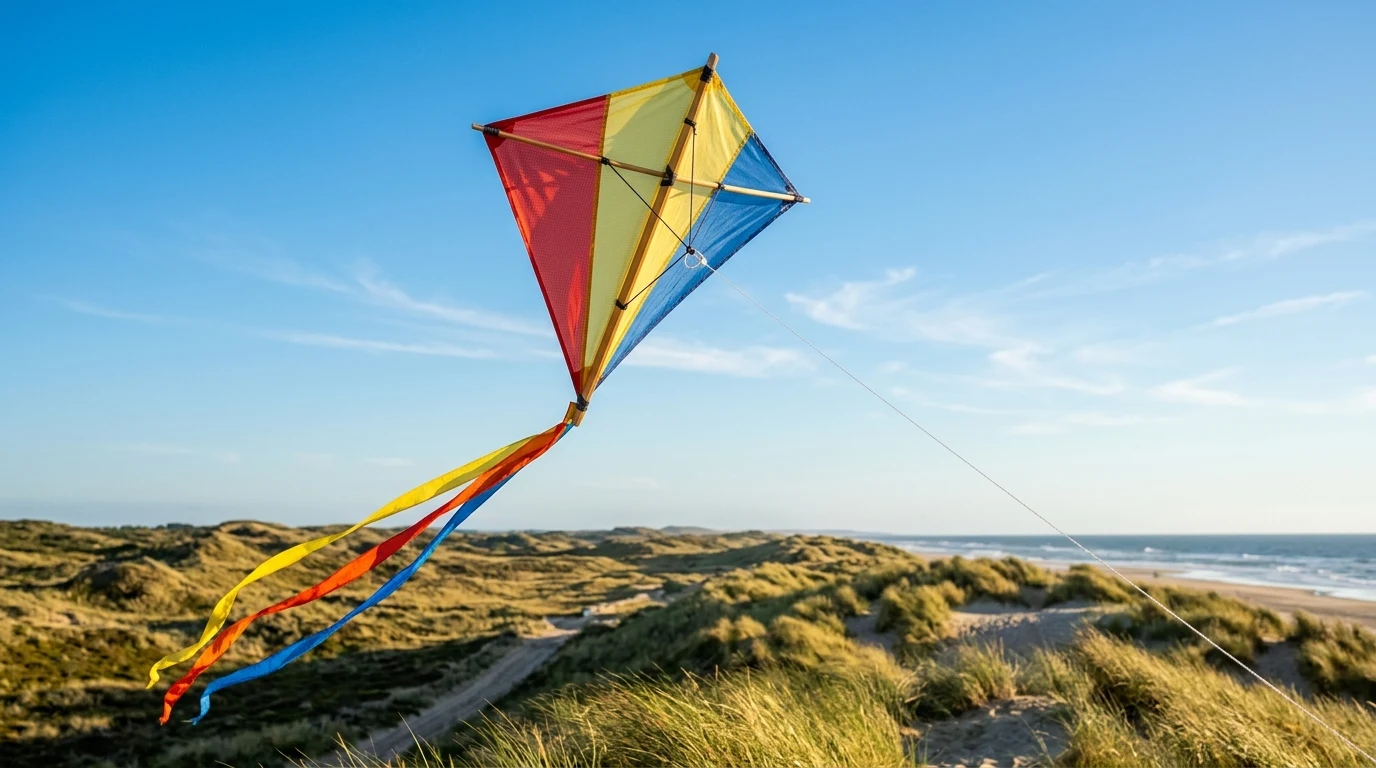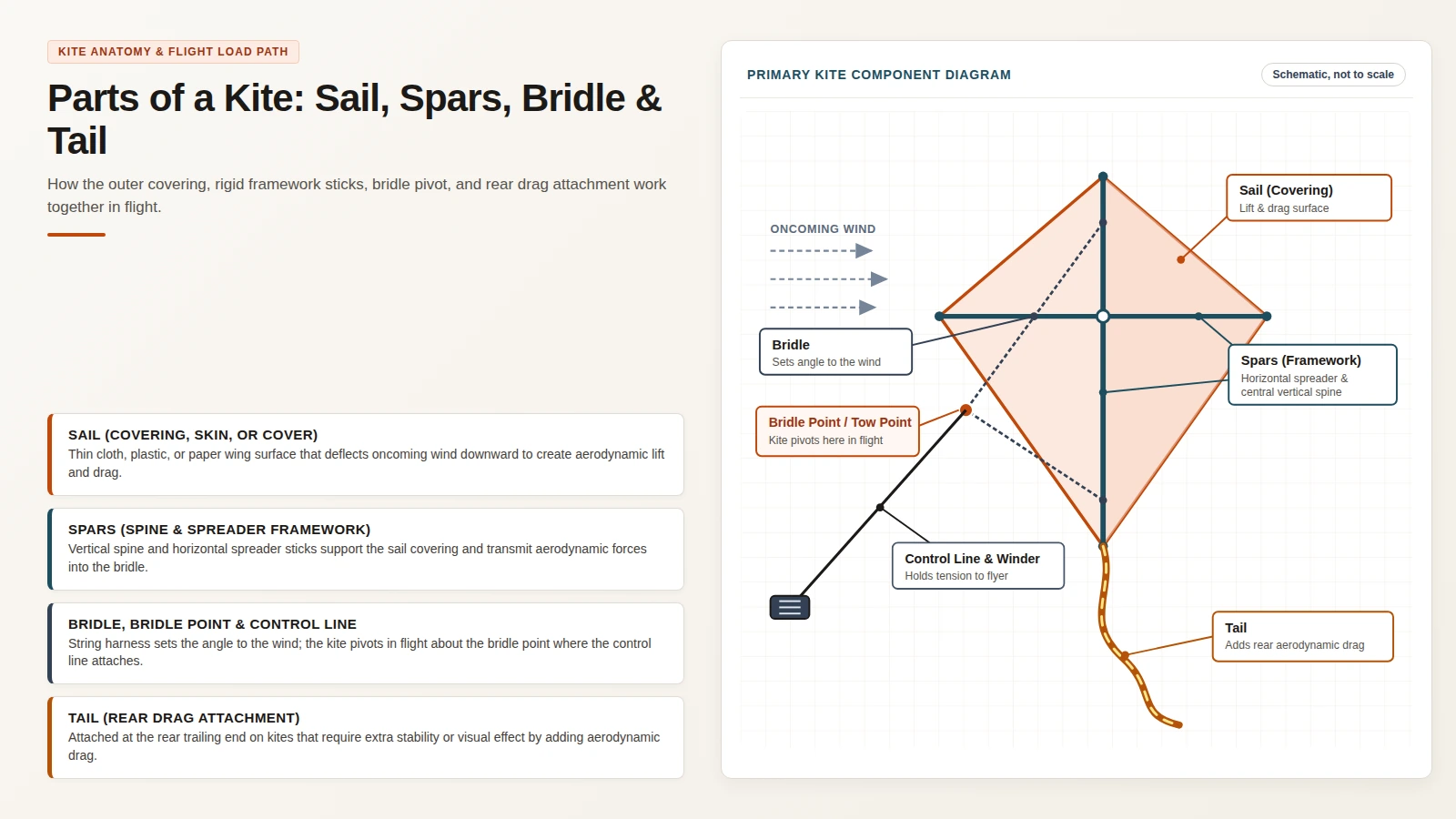
Most kites have three main components: the kite body, made up of a lightweight wood or plastic framework and an outer covering of paper, fabric, or plastic, together with a bridle or harness and a control line or tether. On NASA Glenn Research Center’s kite construction pages, the thin covering of paper, plastic, or cloth deflects the wind downward to create aerodynamic lift and drag, while the underlying framework structure transmits those aerodynamic forces to the bridle.
In American Kitefliers Association guides, spars are the sticks of wood, plastic, fiberglass, or graphite that form that framework or skeleton, with spine and spreader serving as specific names for vertical and horizontal spars. NASA Glenn notes that the control line connects to the kite by a string bridle, and the place where the bridle connects to the line is called the bridle point, about which the kite pivots in flight. On kites that use a tail, the American Kitefliers Association notes that tails help stabilize flight by adding drag at the rear, and NASA Glenn’s KiteModeler documentation states that tail length affects stability and trim by shifting the center of gravity.
What does a labeled parts of a kite diagram show?
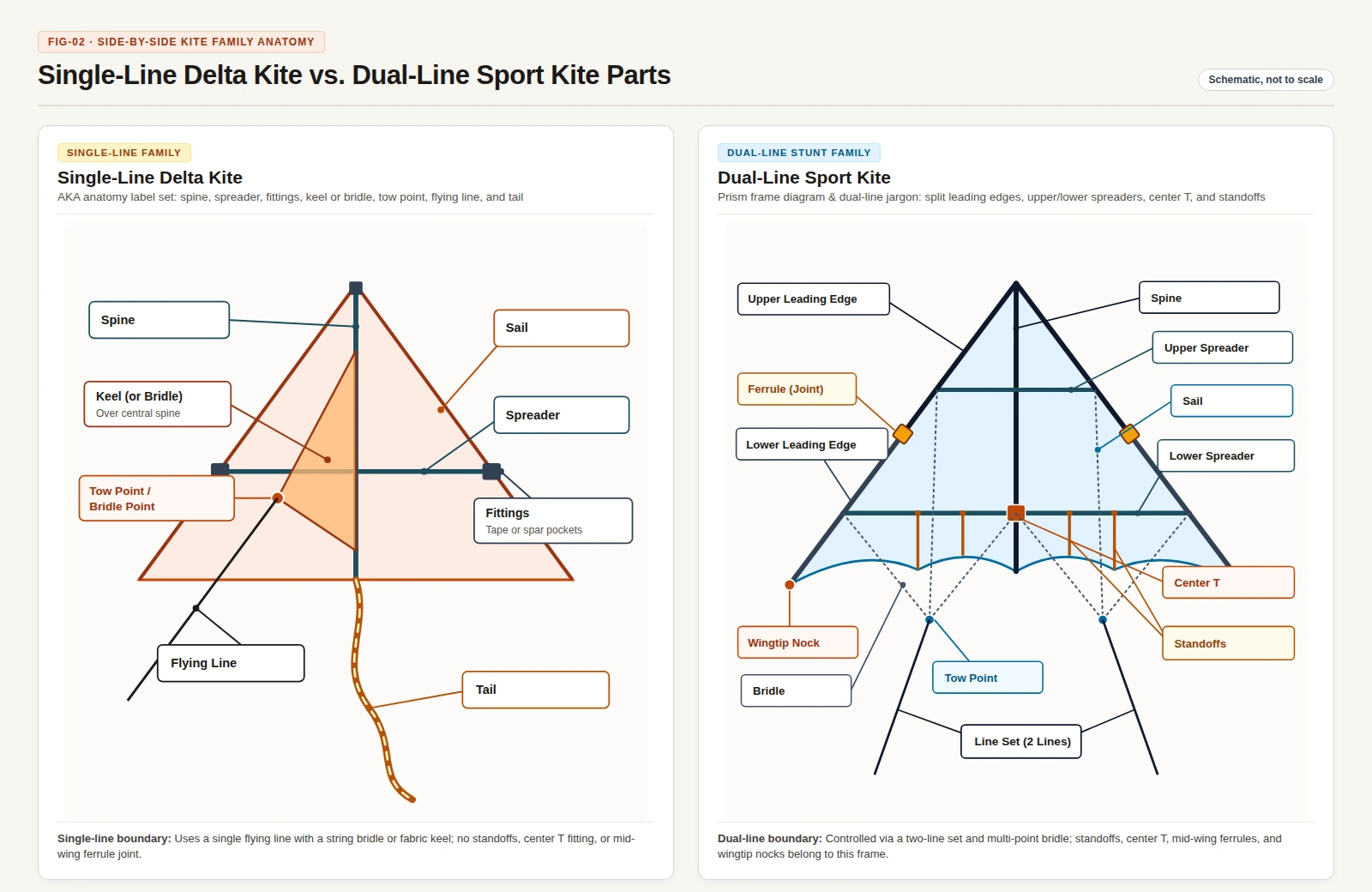
Published kite anatomy drawings label only the components that belong to the specific kite family depicted rather than placing every part name onto one universal kite. Across aerospace, association, and sport-kite manuals, three distinct diagram styles appear: cellular box frames, single-line Eddy and delta frames, and framed dual-line sport kites.
On NASA Glenn’s VirtualAero kite construction page, the figure depicts a simple box kite whose left side shows the kite in flight and whose right side exposes the inner structure made from several sticks and string. Those sticks can be light, strong wood such as balsa or bamboo or a light, strong plastic tube, arranged into four equal-length leg pieces and four two-stick cross pieces bound with string to which the surface covering attaches, although some box kites use only two cross pieces to save weight. NASA Glenn also compares that box-kite structure and covering with the Wright brothers’ 1900 aircraft.
In the American Kitefliers Association’s How to Fly a Kite manual (first edition published in 1992, copyright 1991), the anatomy section labels the front and back of an Eddy kite alongside the front and back of a delta kite, calling out back-of-framework fittings such as tape or pockets. Those single-line drawings sit alongside definitions for the sail, spars, spine, spreader, bridle, tow point, bridle point, keel, flying line, and tail.
By contrast, Prism Designs’ field-repair booklet, Don’t Panic: The kite pilot’s guide to field repairs, provides a sport-kite frame and parts diagram that labels an upper leading edge spar, lower leading edge spar, upper spreader, center T fitting, ferrule joint hidden inside the leading edge pocket, wingtip nock, outer standoff, and inner standoff. Those split leading-edge, center-T, and standoff labels belong to framed dual-line sport kites rather than single-line Eddy or delta diagrams.
How are kite parts labeled for beginners and kids?
Beginner and student kite references introduce three primary part groups—a lifting wing or kite body, a bridle, and a control line—before breaking the frame and sail edges into individual terms. NASA Glenn’s VirtualAero kite construction page tells students that flying a kite is an excellent way to gain a feel for aerodynamic forces on a heavier-than-air craft.
In the Smithsonian National Air and Space Museum story How Kites Fly (dated Apr 26, 2012, by Mike Hulslander), a kite is similarly described as a heavier-than-air object built from three main components: the kite body (which comes in many shapes and sizes), the bridle or harness, and the control line or tether that connects the kite to the flyer and helps control flight. The American Kitefliers Association’s What Is a Kite page likewise quotes three essential elements: a wing surface shaped to gain lift from the breeze, a line or tether that keeps the kite from blowing helplessly away, and a bridle that holds the face of the kite at an angle to the wind, adding that the kite needs enough stability to stay oriented when the wind changes slightly. That same association overview defines the wing or lifting surface as the combination of the kite’s sail and its spars.
For classroom instruction that may be a student’s first kite-building experience, the American Kitefliers Association’s Kites in the Classroom manual (revised edition by Glenn Davison, copyright 2002; first edition by Wayne Hosking, copyright 1992) defines the core beginner label set:
- Sail: the kite covering, usually made of fabric or paper.
- Spine: the central backbone or vertical spar of a kite.
- Spreader: a spar that opens the kite left and right.
- Leading edge and trailing edge: the forward edge of a kite and the rear edge of an airfoil as it moves forward.
- Bridle and tow point: the cord assembly with two or more legs that sets the angle of attack to the wind, and the connection point where the flying line attaches to the bridle.
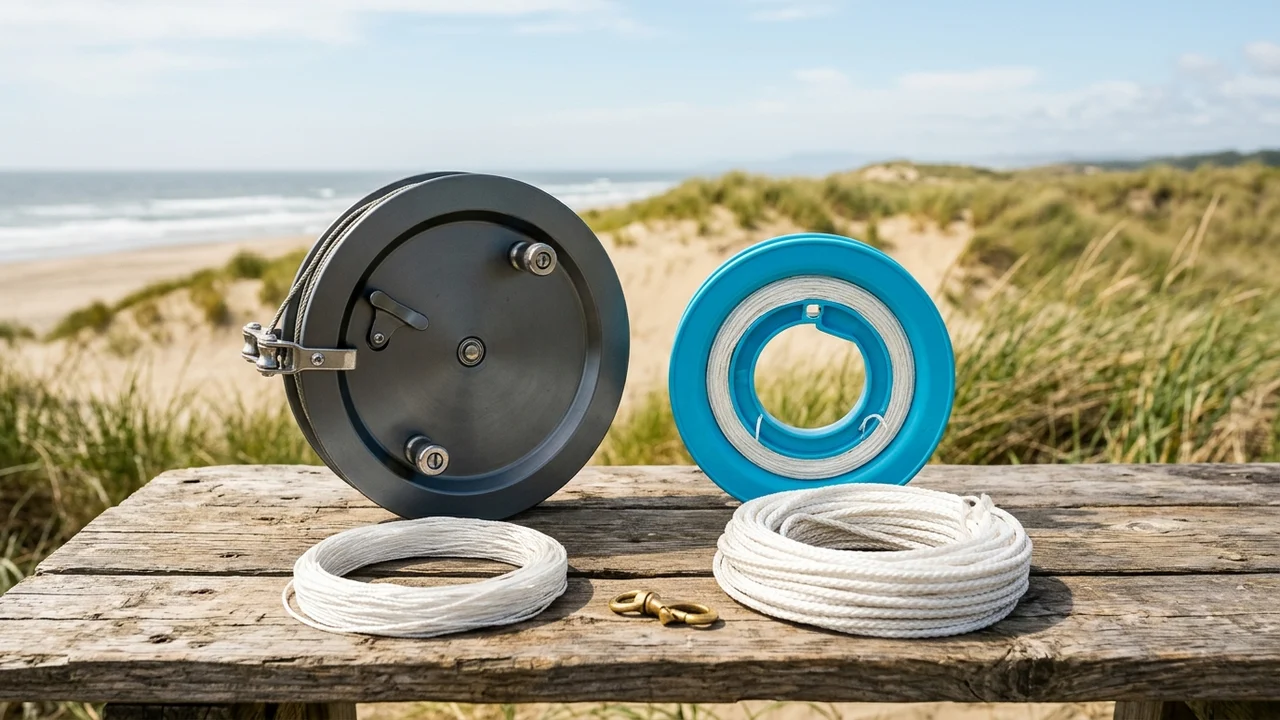
- Line and winder: the string or flying line between the kite and the anchor, and the winder or reel that holds the flying line.
What role does the tail play among the parts of a kite?
A tail attaches at the rear of kites that require extra directional drag or visual streamers, while two American Kitefliers Association glossaries differ on whether a tail adds weight alongside drag. For tail length sizing and single-line stability diagnostics, see our kite tail length and stability guide.
On the American Kitefliers Association’s What Is a Kite page, tails help stabilize kites by adding drag at the rear, though some kites do not need a tail because they are designed to be stable, and tails may also be added for artistic or visual effect in configurations that include drogues and combinations. The association’s How to Fly a Kite manual repeats that some kites are designed for stability without a tail—quoting the saying among Japanese kite makers that a good kite needs no tail—and notes that bowing the horizontal spar on a diamond-shaped two-stick kite created a dihedral, a flexed position for the wings.
Keep the two American Kitefliers Association glossary entries distinct when reading beginner manuals:
- 2002 Kites in the Classroom glossary: defines drag as total air resistance during flight (noting that a rough-surfaced tail provides more drag) and states that a tail attaches to the trailing edge of a kite to add stability by creating drag, not by adding weight.
- 1991 How to Fly a Kite glossary: defines a tail as a long piece of material fastened to a kite that adds drag and weight, as well as beauty and grace.
On the Great Canadian Kite Company’s Kite Jargon page (dated Jul 10, 2014), a tail made of ripstop or plastic is attached for visual effect or to cause drag on a single-line kite, and the term tail also describes the lower end of the spine. In NASA Glenn’s KiteModeler program—where the material panel adjusts materials for the surfaces, frame, tail, and control line—the length of the tail affects stability and trim by shifting the center of gravity.
How do the parts of a kite keep it flying in the air?
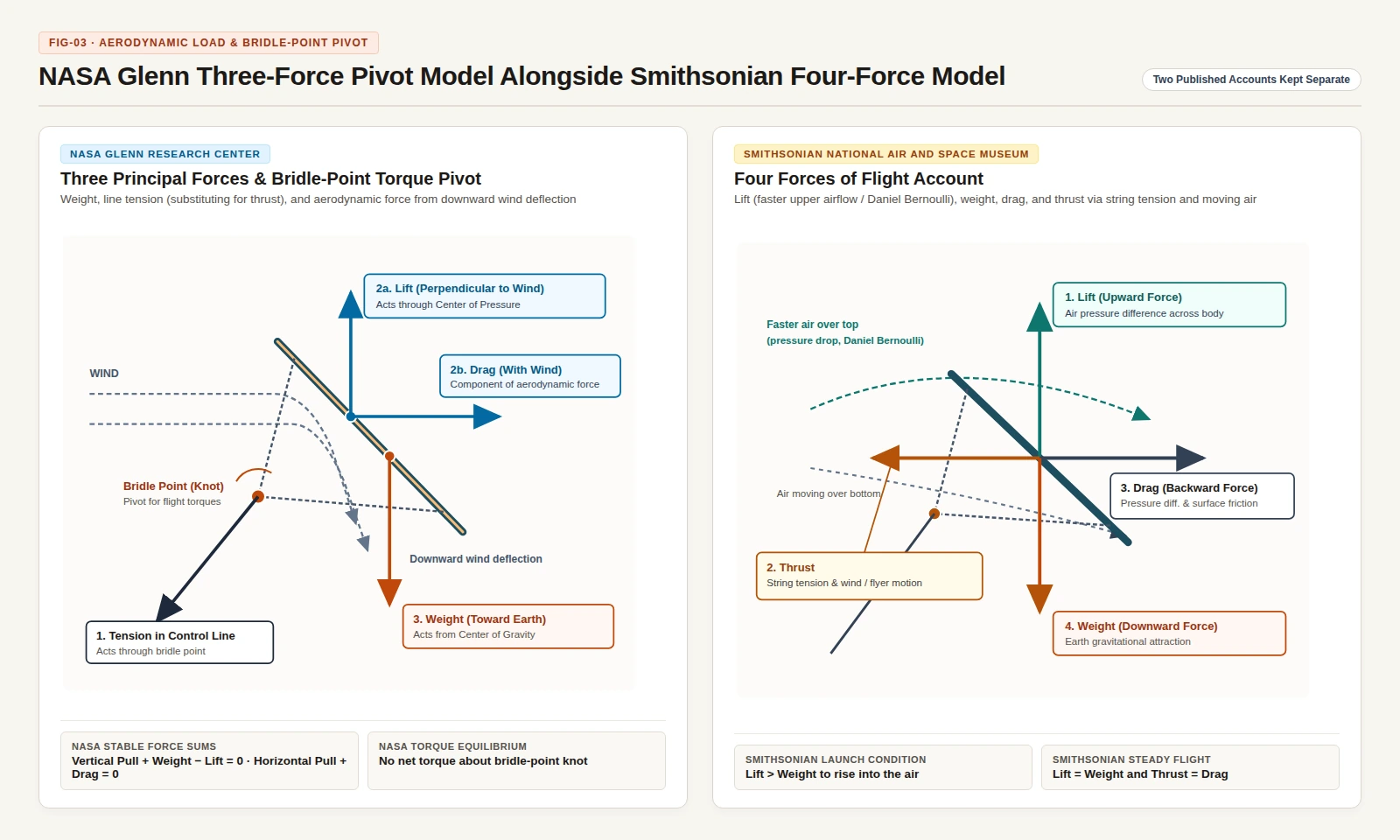
Published aerospace and museum guides describe how the sail, spars, bridle, and line balance flight through two separate models: NASA Glenn’s three-force account with torque balance around the bridle point, and the Smithsonian National Air and Space Museum’s four-force comparison to an airplane.
NASA Glenn three-force and bridle-point pivot account
On NASA Glenn’s VirtualAero and Beginner’s Guide kite construction pages (current page last updated May 13, 2021, with Nancy Hall listed as editor and NASA official), kites depend on surfaces to generate aerodynamic forces and use strong, light structures to withstand wind and weight while transmitting forces to the bridle. In flight, aerodynamic forces, part weights, and their distribution stay in delicate balance while the flyer feels control-line tension.
On NASA Glenn’s Forces on a Kite page (last updated May 13, 2021), three principal forces act on the kite—weight, tension in the line, and the aerodynamic force—matching the forces on an airliner when line tension substitutes for thrust. Weight always acts downward from the center of gravity toward the center of the earth. The aerodynamic force acts through the center of pressure and is usually broken into lift acting perpendicular to the wind and drag acting in the direction of the wind, generated as the thin paper, plastic, or cloth covering deflects wind downward. The American Kitefliers Association’s How Do Kites Fly page similarly describes flight as a balance among upward lift, downward gravity, and backward drag: when the sail sits at the proper angle, more air is deflected down from the sail than is forced up and over the kite to create lift, while the kite line prevents drag from pushing the kite backward.
NASA Glenn notes that line tension acts through the bridle point where the control line ties to the bridle string. Under Newton’s first law of motion in stable flight, the forces remain constant with zero net external force: vertically, the vertical pull plus the weight minus the lift equals zero, and horizontally, the sum of the horizontal pull and the drag must also equal zero. On NASA Glenn’s Kite Torque Equation and Kite Balance and Stability pages (both last updated May 13, 2021), aerodynamic lift from the surface must be greater than or equal to weight in order to fly, line tension opposes drag, and the kite rotates about the bridle-point knot under the torques created by weight and aerodynamic forces. In equilibrium there are no net torques about the pivot, and when a wind gust increases lift and drag, the kite rotates about the bridle point to balance the torques.
Smithsonian National Air and Space Museum four-force account
In the 2012 Smithsonian National Air and Space Museum story How Kites Fly, the kite pivots and dives about the point where the bridle connects to the control line, and the four forces of flight—lift, weight, drag, and thrust—affect kites in the same way they affect airplanes. In that account, lift is the upward force generated by differences in air pressure from air moving over the kite body, which is shaped and angled so air moving over the top moves faster than air moving over the bottom, citing Daniel Bernoulli for the pressure drop in a speeding fluid.
The Smithsonian story defines weight as the downward gravitational attraction of the Earth, drag as the backward force from front-to-back air-pressure differences and surface air friction, and thrust on an engineless kite as reliance on string tension and moving air from the wind or the flyer’s forward motion. To launch into the air, lift must be greater than weight, and for steady flight, lift must equal weight and thrust must equal drag.
Which illustrations and labels identify frame and bridle parts?
Frame labels identify the sticks and connectors that hold the sail open—or note when a soft wing has no rigid frame—while bridle labels distinguish where the bridle meets the kite from where the flying line meets the bridle. Every kite has a strong, light lifting surface called a sail (with American Kitefliers Association material lists including nylon and polyester), and on framed kites the classroom glossary defines the frame as the combination of the spars and the central spine joined by connectors called fittings. Not every kite carries a rigid frame: the classroom glossary names a parafoil kite as frameless, and the association’s What Is a Kite page states that soft kites have no spars and instead derive their structure from wind inflating the kite and its pockets.
On kites that use a bridle, the American Kitefliers Association’s What Is a Kite, How Do Kites Fly, and How to Fly a Kite guides state that the bridle connects to the kite at the bridle point or points to hold the angle of attack (or attitude), while the flying line connects to the bridle at the tow point. The flying line must be strong enough to hold the kite across wind conditions while keeping a small diameter for minimal wind-resistance drag. Some kites are supported by more than 50 bridle lines, others fly with the flying line attached directly to the framework or to a single tow point with no bridle, and commercially produced kites often have fixed flight angles with a single attachment point. On kites with a spine, a solid sail-material keel attached over the spine can substitute for a bridle, distributing pressure evenly along the spine and acting like a rudder for stability.
Note that the 1991 How to Fly a Kite glossary and NASA Glenn’s KiteModeler side view also use bridle point for the selected point or knot on the bridle where the control line attaches; in KiteModeler trim, Bridle gives total bridle string length, Knot gives the distance along the bridle string from the base of the kite to the control-line knot, and knot location has a large effect on stability because the kite pivots about it. Adjusting the bridle point or tow point changes the angle of attack, making the kite fly higher or lower. On the American Kitefliers Association’s How Do Kites Fly page, the tow point should be moved slightly towards the kite’s nose for lower wind speeds and slightly towards the kite’s tail for higher wind speeds; inspect your specific rig before moving any knot with our kite bridle adjustment identification guide.
On framed dual-line sport kites, the Great Canadian Kite Company jargon list and Prism Designs’ frame diagram label the Centre T (or center T fitting) where the spine spar and lower spreaders join. In Prism’s field-repair booklet, the spine rod seats into the nose reinforcement, and most spines are held by a velcro strap at the tail.
What kite jargon names stunt and single-line components?
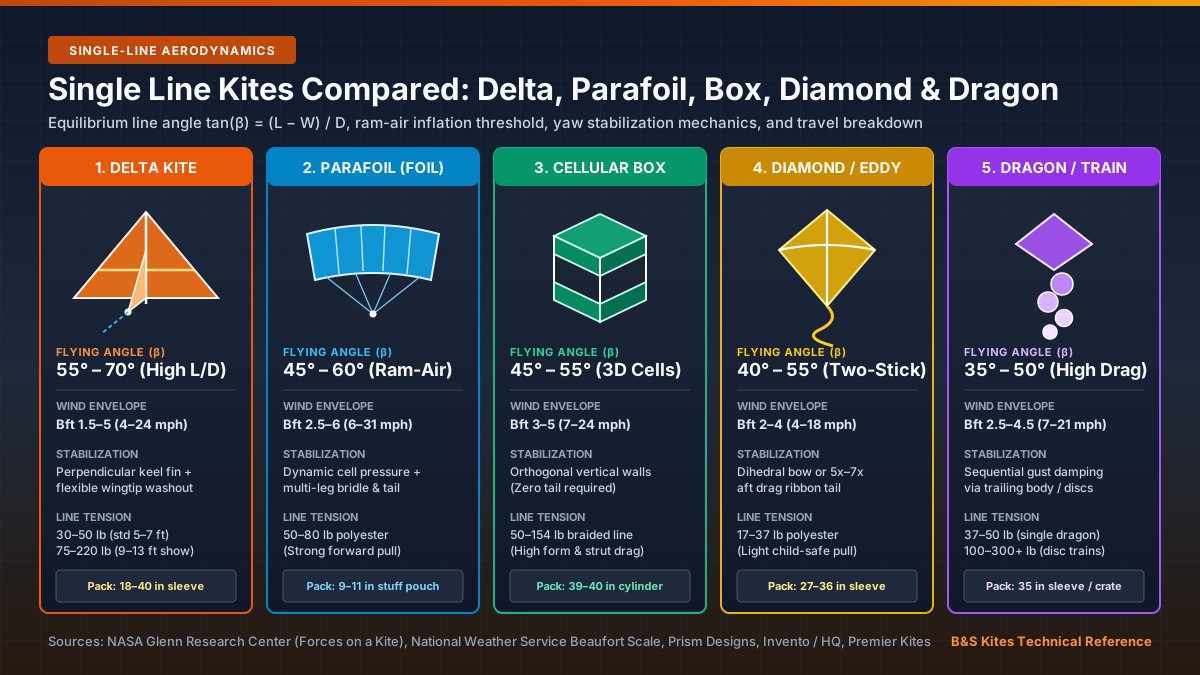
Single-line kite glossaries focus on the sail, spine, spreader, keel, flying line, tail, and winder, whereas dual-line stunt-kite terminology adds split leading edges, ferrules, standoffs, retainer fittings, wingtip nocks, line sets, and flying straps. If you need to match a broken rod, connector, or tip fitting on an existing frame, use our replacement kite spar fit checklist.
In the American Kitefliers Association’s How to Fly a Kite glossary, the sail is the material covering the framework (also called the skin or cover), a spar is a rod, stick, strut, or tube in the skeleton, the spine is a stiff vertical center support, flying line is the kite flier’s term for string connected between a kite, bridle, or keel and a hand or anchor, and a winder is the cylinder, spool, or frame that stores, lets out, and takes in line. That manual also notes that exceptions exist to general observations, instructions, and guidelines across kite designs. When the association’s How Do Kites Fly page introduces maneuverable kites, it groups dual-line, quad-line, fighter, and power kites together.
On the Great Canadian Kite Company’s Kite Jargon page, which covers kite anatomy and kite parts, dual line refers to two-line trick or stunt kites controlled by two lines (noting that quad-line stunt kites exist as well), and the sail is cloth material usually made from rip-stop nylon, polyester, or Icarex stretched over the frame skeleton of spars, with bridle lines supporting and orienting the sail and frame. Together with Prism Designs’ field-repair booklet, dual-line part terminology specifies these structural components:
- Leading edge and ferrule: the leading edge runs from the nose to the wing tip, and Prism’s booklet notes that most sport kites use two-piece leading edges joined by a connector or ferrule hidden inside the wing sleeve (leading edge pocket) about halfway down the wing and usually glued to the upper half.
- Spine and spreaders: the spine is the center rod running lengthwise down the kite, while spreaders run horizontally across the span—labeled as upper spreader and lower spreader on sport-kite diagrams—to hold the wings open.
- Stand-offs and retainer fittings: on the Great Canadian Kite Company jargon page, stand-offs are typically carbon or fibreglass rod which holds the trailing edge of the sail back from the lower spreader; Prism’s booklet notes that the thin standoff rod secures to the sail, retainer fittings connect its free end to the lower spreader, and the cap on the back of a standoff can break off.
- Wingtip nock: labeled at the outer wingtip on Prism’s diagram, where a broken wingtip nock releases tension on the leading edge.
- Line set, winders, and flying straps: a line set consists of the control lines (which come in a variety of test weights and lengths, with Prism’s booklet also covering sleeving a lineset) attached to the bridle tow point with a larkshead knot, stored on winders, and held with webbing loops called flying straps into which the flyer slides the hands.
Single-line and dual-line kite parts checklist
Use this English component reference to match each part name and alias to its kite family, structural seat, and flight role:
| Part name and documented aliases | Kite family scope | Documented seat, connection, and flight role |
|---|---|---|
| Sail, also called skin, cover, or outer covering | Framed and soft kites (single-line and dual-line) | Stretches over the framework or inflates in the wind using paper, plastic, rip-stop nylon, polyester, or Icarex to resist wind and generate lift and drag. |
| Leading edge (including upper and lower leading edge spars) | Forward edge on all airfoils; split spars on dual-line sport kites | Runs from nose to wing tip along the forward edge; most sport kites use upper and lower leading edge spars in a wing sleeve. |
| Spine | Framed single-line and dual-line kites | Central vertical backbone rod running lengthwise down the center of the kite from nose to tail. |
| Spreader (including upper spreader and lower spreader) | Framed single-line and dual-line kites | Horizontal spar opening the wings left and right; sport-kite diagrams separate an upper spreader and lower spreaders. |
| Center T fitting or frame fittings | Fittings on framed kites; Center T on dual-line sport kites | Fittings such as tape, pockets, or connectors join spars; the center T fitting joins the spine spar and lower spreaders. |
| Nose reinforcement | Framed dual-line sport kites | Reinforced forward nose seat into which the top end of the spine rod installs. |
| Trailing edge | Single-line and dual-line kites | Rear edge of the kite airfoil where classroom glossaries place tail attachment and sport-kite standoffs hold sail tension. |
| Standoff (inner and outer standoffs) | Dual-line sport kites only | Thin carbon or fibreglass rod secured to the sail with retainer fittings on the lower spreader to hold the trailing edge back; rear standoff caps can break off. |
| Bridle, bridle point, and tow point | Single-line and dual-line kites (some single-line kites omit a bridle) | String harness setting angle of attack; bridle legs meet the kite at bridle points while the control line meets the bridle at the tow point (also called the bridle-point knot pivot). |
| Flying line or line set | Flying line on single-line; line set on dual-line stunt kites | Strong, small-diameter tether holding tension to the flyer or anchor; dual-line line sets attach at tow points via larkshead knots. |
| Tail, including drogue configuration | Single-line kites that use rear drag or visual streamers | Fastens at the rear trailing edge or spine base (with tail also naming the lower spine end) in shapes including drogues; classroom and 1991 glossaries differ on weight versus drag alone. |
| Ferrule | Two-piece spars on dual-line sport kites | Connector joint hidden inside the leading edge pocket about halfway down the wing sleeve, usually glued to the upper half. |
| Wingtip nock and spine end caps | Framed dual-line sport kites | Wingtip nocks hold leading-edge sail tension at the wingtips, while spine end caps and a tail velcro strap seat the spine ends. |
| Winder (reel) and flying straps | Winders on both families; flying straps on control lines | Spool or frame used to wind, store, let out, and take in line; flying straps are webbing hand loops attached to the kite line. |
| Keel | Single-line framed kites with a spine | Solid triangle of sail material attached over the spine as a bridle substitute to distribute spine pressure and add rudder-like stability. |
Browse related airframe and stability references in the Kite Types category or view every guide on the All Guides and Articles index.
Sources
- NASA Glenn Research Center — Kite Construction (VirtualAero)
- NASA Glenn Research Center — Kite Construction, Beginner’s Guide to Aeronautics
- NASA Glenn Research Center — Forces on a Kite
- NASA Glenn Research Center — Kite Torque Equation
- NASA Glenn Research Center — Kite Balance and Stability
- NASA Glenn Research Center — KiteModeler
- Smithsonian National Air and Space Museum — How Kites Fly (Mike Hulslander, Apr 26, 2012)
- American Kitefliers Association — What Is a Kite
- American Kitefliers Association — How Do Kites Fly
- American Kitefliers Association — Kites in the Classroom, Revised Edition by Glenn Davison (copyright 2002) and First Edition by Wayne Hosking (copyright 1992)
- American Kitefliers Association — How to Fly a Kite, First Edition (published 1992, copyright 1991)
- Great Canadian Kite Company — Kite Jargon - Know your Kite Terms (Jul 10, 2014)
- Prism Designs — Don’t Panic: The Kite Pilot’s Guide to Field Repairs
References & Sources
- Kite Construction (VirtualAero) — NASA Glenn Research Center
- Kite Construction — Beginner's Guide to Aeronautics — NASA Glenn Research Center
- Forces on a Kite — NASA Glenn Research Center
- Kite Torque Equation — NASA Glenn Research Center
- Kite Balance and Stability — NASA Glenn Research Center
- KiteModeler — NASA Glenn Research Center
- How Kites Fly — Smithsonian National Air and Space Museum