Into The Wind warns never to struggle to reel in a kite because reeling in line under strong tension could damage the reel; instead, in strong winds, walk the kite down or pull the line in with gloved hands while moving around to avoid piling line in one place, then wind the line onto the reel. On the Emma Kites disc-brake kite reel, right-rotating the anti-reverse knob prevents anti-clockwise rotation so line cannot be paid out any more, and the maker warns never to activate anti-reverse when the kite line is paying out at high speed. Prism Kites warns pilots never to wrap flying line around their hands because in a gust the kite can pull hard enough for the line to cut seriously, and instructs pilots to always hold the line by its winder or appropriate handle.
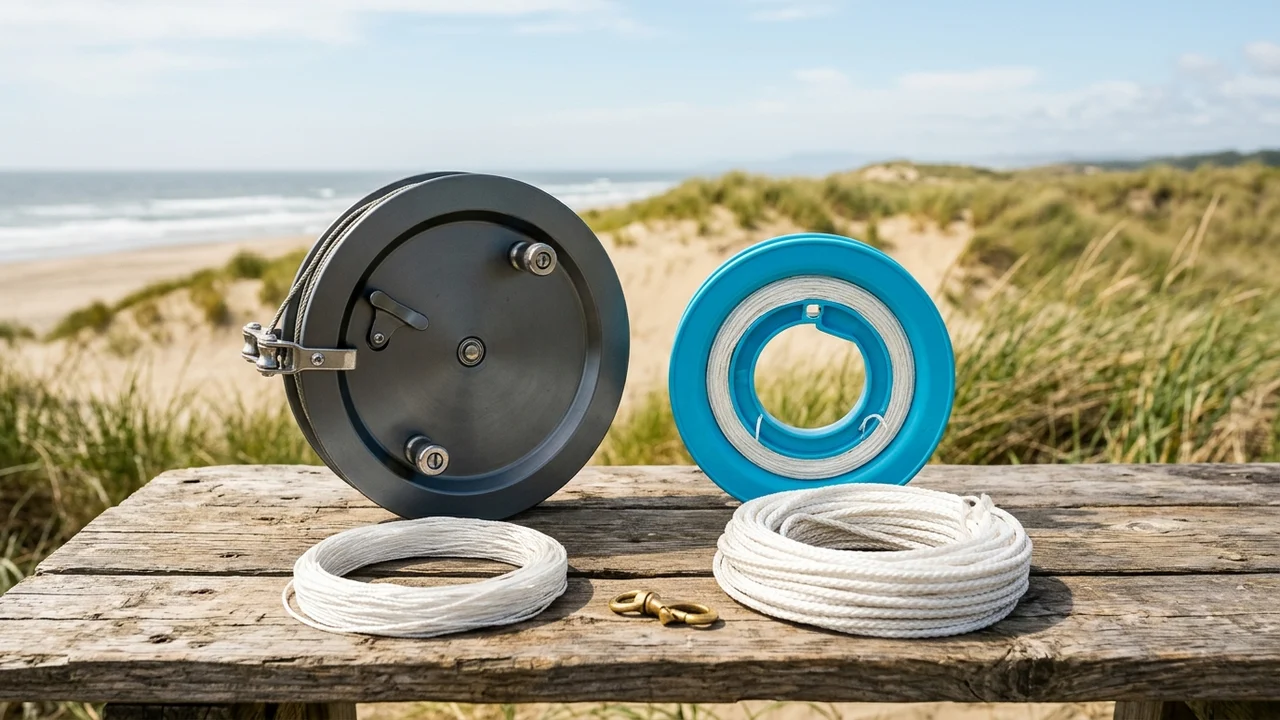
Compare the documented single-line winders, hoop spools, hardwood bobbins, and ball-bearing kite reels in the reference table below before pairing a kite string and reel with your kite.
| Winder or kite reel model | Documented structure, spool dimensions, and rated line capacity |
|---|---|
| Into The Wind Frustrationless Kite Handle | Into The Wind’s Frustrationless Kite Handle with Flying Line is a plastic kite handle with 100-ft of 18-lb soft polyester line for Tyvek sleds and make-it-yourself kites. |
| Into The Wind Kite Line on Handle | Into The Wind’s Kite Line on Handle comes pre-wound with 300ft of 30lb line on a Blue Handle, 300ft of 50lb line on a Green Handle, or 200ft of 80lb line on an Orange Handle. |
| Prism Kites Card Winder with Flying Line | The Prism Kites Card Winder with Flying Line serves as the replacement flying line for the Vertex Diamond kite, includes 200 feet of 50# braided Dacron (polyester) line, and is not suitable for dual-line kites. |
| Prism Kites Small Hoop Flying Line | The Prism Kites Small Hoop Flying Line includes 200 feet of 50# braided Dacron line on a 4 inch (100mm) hoop winder. |
| Prism Kites Medium Hoop Flying Line | The Prism Kites Medium Hoop Flying Line includes 200 feet of 50# braided Dacron line on a 5.5 inch (140mm) hoop winder. |
| Prism Kites Large Hoop Flying Line | The Prism Kites Large Hoop Flying Line includes 300 feet of 80# braided Dacron line on a 6.25 inch (160mm) hoop winder. |
| Into The Wind 6“ Kite Line Hoop Spool | Into The Wind’s blank 6“ Kite Line Hoop Spool holds 1000’ of 50-lb. line and provides 13“ of line take-in per turn. |
| Into The Wind 8“ Kite Line Hoop Spool | Into The Wind’s blank 8“ Kite Line Hoop Spool holds 1000’ of 100-lb. line and provides 17“ of line take-in per turn. |
| Into The Wind Tinkerhess Kite Line Reel | The Tinkerhess Kite Line Reel is a hardwood bobbin reel with pivoting handles and angled line guides measuring 8“ x 14“ that holds 3000’ of 50-lb. line or 1000’ of 150-lb. line with 13“ take-in per turn. |
| Emma Kites 8.7inch Blue Lockable Kite Reel Winder | The Emma Kites 8.7inch Blue Lockable Kite Reel Winder has an impact-resistant ABS plastic body, deep groove ball bearing, metal line-guide with ceramic ring, 8.7in / 22cm reel diameter, 3cm / 1.18in groove depth, 2.7cm / 1.06in groove width, 0.91lb / 414g net weight, and comes with 500ft / 155m of 120lb (1.3mm diameter) braided Dacron line. |
| Kitty Hawk Kites Premier 11“ Speedy Winder | The Premier 11“ Speedy Winder (sold as a blank winder without kite line) is molded from high-impact ABS plastic with built-in ball bearing steel raceways, a pivoting heavy gauge steel line guide, and an integrated “dead bolt” locking mechanism for parking at altitude. |
| Emma Kites 11 inch Kite Reel with Thumb Brake | The Emma Kites 11 inch Kite Reel with Thumb Brake has a magnesium alloy main body, a large integrated ball bearing, an aluminum alloy ratchet wheel with anti-reverse knob, an aluminum alloy omni-bearing line-guide, a 28 cm / 11 in diameter, 4 cm / 1.6 in groove depth, 3.8cm / 1.5 in groove width, 1.64kg / 3.62lb net weight, and pairs with 300Lb~500Lb Dacron kite line. |
| Emma Kites 12.6inch Kite Winder Reel with Disc Brake | The Emma Kites 12.6inch Kite Winder Reel with Disc Brake has a coated magnesium alloy reel body with a 12.6“ / 32cm diameter, 1.97“ / 5cm groove depth, 1.22“ / 3.1cm groove width, and an 800~1000g kite line volume. |
Hoop Spools, Card Winders, and Bearing Kite Reels: Operating Boundaries by Kite Pull
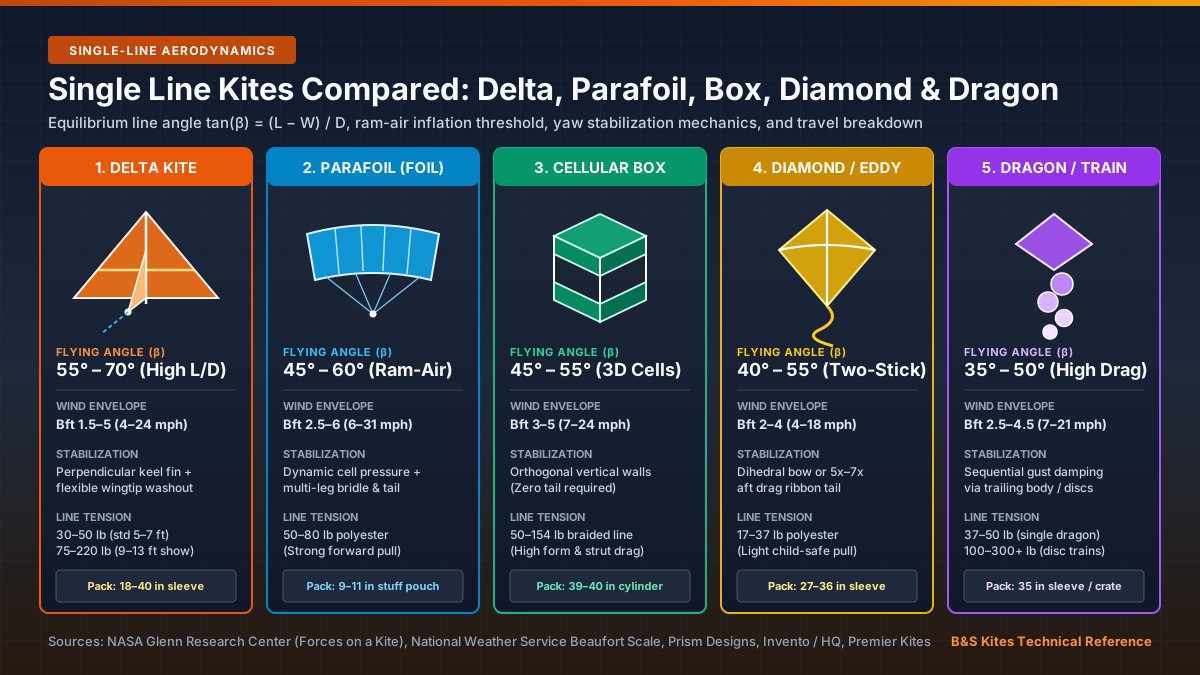
Selecting between a flat card winder, a hollow plastic hoop spool, and a ball-bearing kite reel starts with the pull of your single-line kite. For an overview of how sail shapes generate lift and pull across wind bands, see our single-line delta, parafoil, and box kite comparison.
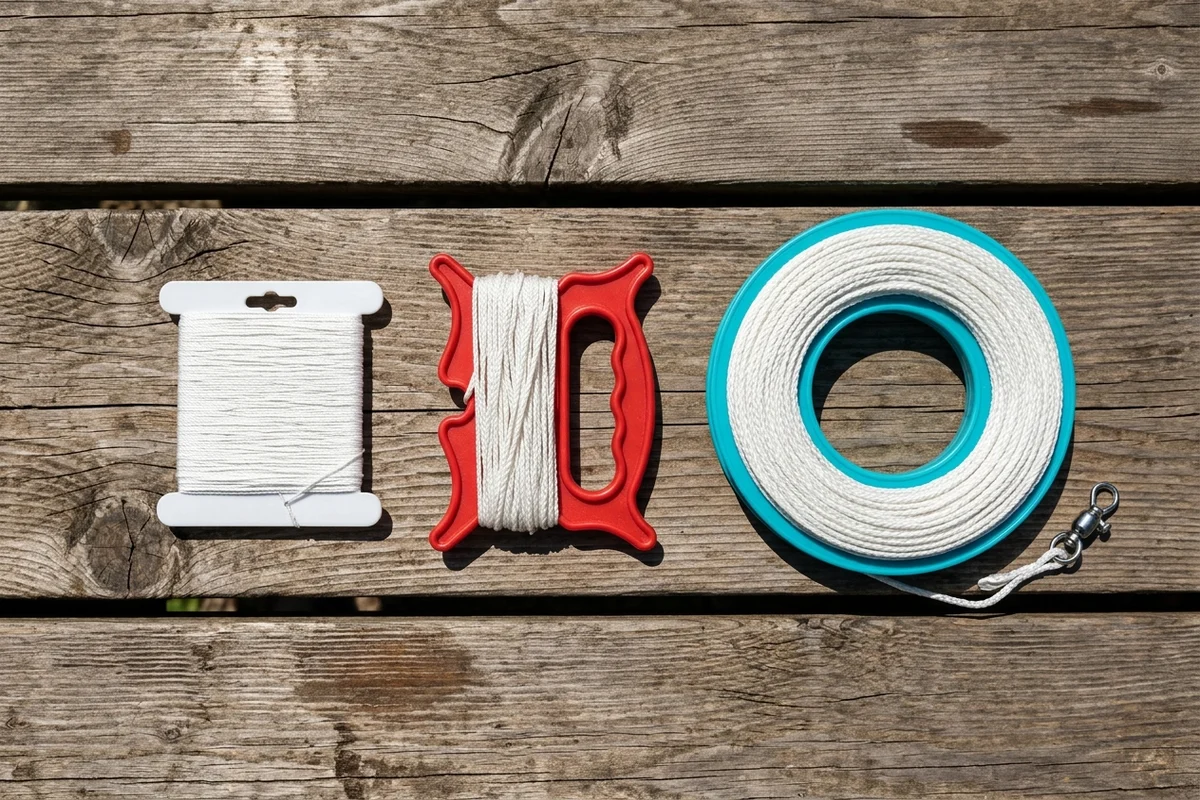
For light single-line kites, makers supply compact plastic handles, flat winders, or diameter-graded hoop spools:
- Into The Wind’s Frustrationless Kite Handle with Flying Line is a plastic kite handle with 100-ft of 18-lb soft polyester line for Tyvek sleds and make-it-yourself kites.
- Into The Wind’s Kite Line on Handle comes pre-wound with 300ft of 30lb line on a Blue Handle, 300ft of 50lb line on a Green Handle, or 200ft of 80lb line on an Orange Handle.
- The Prism Kites Card Winder with Flying Line serves as the replacement flying line for the Vertex Diamond kite, includes 200 feet of 50# braided Dacron (polyester) line, and is not suitable for dual-line kites.
- The Prism Kites Small Hoop Flying Line includes 200 feet of 50# braided Dacron line on a 4 inch (100mm) hoop winder.
- The Prism Kites Small Hoop Flying Line is the small winder included with Pocket Flyer and Pica single-line kites and is not suitable for dual-line kites.
- The Prism Kites Medium Hoop Flying Line includes 200 feet of 50# braided Dacron line on a 5.5 inch (140mm) hoop winder.
- The Prism Kites Medium Hoop Flying Line is the medium winder included with Zenith 5 and Bora 5 single-line kites and is not suitable for dual-line kites.
- The Prism Kites Zenith 5 single-line delta kite has a 64.0 in (5-foot) wing span, a 5-25 mph (8-40 kph) wind range, and includes 200’ x 50 lbs (61 m x 22.5 kg) braided polyester flying line on a hoop winder.
- The Prism Kites Large Hoop Flying Line includes 300 feet of 80# braided Dacron line on a 6.25 inch (160mm) hoop winder.
- The Prism Kites Large Hoop Flying Line makes winding in and out smooth and faster than D-Winders, is included with Zenith 7, Bora 7, and Isotope kites, and is not suitable for dual-line kites.
- The Prism Kites Zenith 7 single-line delta kite has an 84.0 in (7-foot) wing span, a 5-25 mph (8-40 kph) wind range, 80% more sail area than the Zenith 5, and includes 300’ x 80 lbs (91.5 m x 36.3 kg) polyester flying line on a hoop winder.
As single-line sail area increases to lift line laundry, windsocks, or heavy tails, manufacturers transition from small pre-wound spools to unspooled high-strength lines that require a dedicated heavy-duty winder or bearing reel:
- The Invento-HQ Delta Stern single-line kite (width 134 cm / 53 in, height 68 cm / 27 in, age 5+, wind range 2-5 Bft. / 6-38 km/h / 4-24 mph) includes a 17 kp / 37 lb., 40 m / 130 ft. polyester line on a spool.
- The Invento-HQ Parafoil Kite Orca single-line frameless kite (width 60 cm, height 200 cm, age 8+, wind range 2,5-6 Bft. / 14-49 km/h / 9-31 mph) includes a 25 kp (25 kg), 40 m polyester line on a spool.
- The Invento-HQ Delta Fireworks single-line delta kite (width 410 cm, height 195 cm, Carbon + Fiberglass 9,5 mm frame, age 14+, wind range 2-5 Bft. / 14-35 km/h / 9-22 mph) is designed to accommodate line laundry, windsocks, and tails, and recommends a 65-100 kp polyester line (not included).
Takeaway: Use flat winders and hoop spools within the maker’s paired single-line ratings, and step up to a dedicated high-capacity spool or bearing reel when a large kite specifies heavy unspooled line.
Kite Reel Drag Control vs. Anti-Reverse Ratchets and Dead-Bolt Locks
Before launching a single-line kite on a rotary kite reel, inspect whether the reel uses a stationary parking pin, a one-way ratchet pawl, or a variable friction brake.
- In reel mechanics, direct-drive reels have the spool and handle directly coupled so the handles spin as line unwinds, whereas anti-reverse reels use a dog/pawl engaging a cog wheel or a one-way clutch bearing to restrict handle movement, and friction drag systems use a coaxial stack of frictional discs (drag washers) to act as a friction brake against outgoing spool rotation when line tension exceeds the drag setting.
- In rotary multiplier reels, a deceleration mismatch between outgoing line release and spool rotational momentum causes lagging line to float off the spool in loose loops and get pulled between the spool and chassis—a spool overrun or backlash (‘bird’s nest’) controlled by axial spool-tension friction or thumb feathering.
- My-Best-Kite notes that frame-mounted kite reels braced against the body rotate on a pivot so line payout can be controlled by using a hand on the rim as a brake or via adjustable rotation friction, and use a lock to prevent more line going out once the kite is high enough.
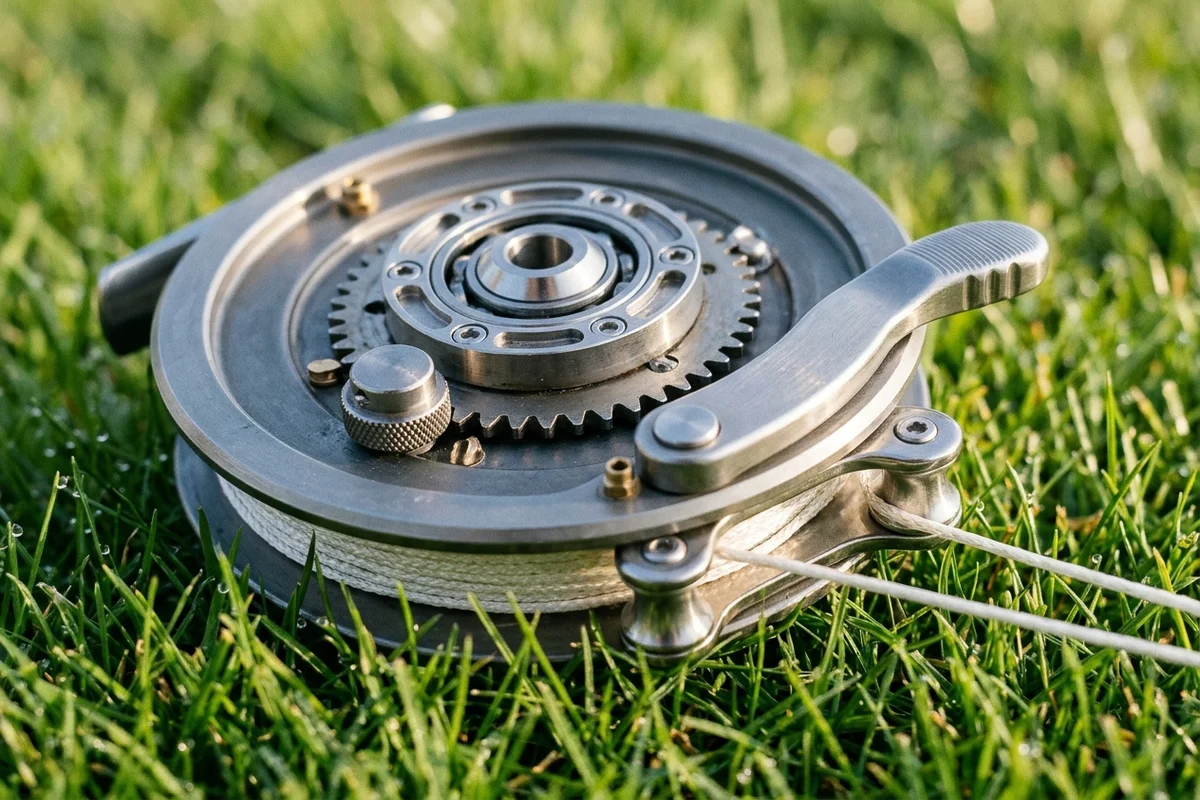
Commercial ball-bearing kite reels implement these locking and braking mechanisms across distinct hardware tiers:
- The Premier 11“ Speedy Winder (sold as a blank winder without kite line) is molded from high-impact ABS plastic with built-in ball bearing steel raceways, a pivoting heavy gauge steel line guide, and an integrated “dead bolt” locking mechanism for parking at altitude.
- The Emma Kites 8.7inch Blue Lockable Kite Reel Winder has an impact-resistant ABS plastic body, deep groove ball bearing, metal line-guide with ceramic ring, 8.7in / 22cm reel diameter, 3cm / 1.18in groove depth, 2.7cm / 1.06in groove width, 0.91lb / 414g net weight, and comes with 500ft / 155m of 120lb (1.3mm diameter) braided Dacron line.
- The locking device on the Emma Kites 8.7in ABS plastic kite reel provides 3 functions: FREE ROTATION, ANTI-REVERSE, and ABSOLUTELY LOCKED.
- The Emma Kites 11 inch Kite Reel with Thumb Brake has a magnesium alloy main body, a large integrated ball bearing, an aluminum alloy ratchet wheel with anti-reverse knob, an aluminum alloy omni-bearing line-guide, a 28 cm / 11 in diameter, 4 cm / 1.6 in groove depth, 3.8cm / 1.5 in groove width, 1.64kg / 3.62lb net weight, and pairs with 300Lb~500Lb Dacron kite line.
- The Emma Kites 12.6inch Kite Winder Reel with Disc Brake has a coated magnesium alloy reel body with a 12.6“ / 32cm diameter, 1.97“ / 5cm groove depth, 1.22“ / 3.1cm groove width, and an 800~1000g kite line volume.
- The Emma Kites disc-brake kite reel features two 3.43“ / 9cm magnesium alloy handle bars, a stainless steel 6+1 rollers line-guide (6 upper rollers in 3 rows plus 1 big lower roller guiding line to the groove), and a left brake control handle that rotates inward to brake or lower reel speed and outward to un-brake.
- On the Emma Kites disc-brake kite reel, right-rotating the anti-reverse knob prevents anti-clockwise rotation so line cannot be paid out any more, and the maker warns never to activate anti-reverse when the kite line is paying out at high speed.
Kite String Size, Strength Rating, and Spool Groove Capacity
Matching kite string and spool capacity requires checking both the breaking-strength rating and the physical cord diameter. For fiber comparisons between single-line polyester and dual-line UHMWPE, see our guide on matching single-line and dual-line kite string materials.
- Prism Kites notes that while cheap kid’s kites sometimes include stretchy nylon, cotton, or monofilament line, most quality line for single-line kites is made from polyester (Dacron). Twisted line is much more likely to twist and get tangled than braided line.
- Prism Kites recommends a flying line length of 200-300 feet for most single-line kites up to about a 7 foot wing span.
- The American Kitefliers Association (AKA) cites Federal Aviation Administration rules stating that no person may operate a moored balloon or kite more than 500 feet above the surface of the earth or within five miles of the boundary of any airport, and recommends wearing gloves to protect hands when handling strong pulling kites.
As tensile strength increases in braided Dacron line, cord diameter and linear weight increase, reducing the length of line that fits inside a given spool groove:
| Line or spool specification | Documented diameter, linear mass, and spool length capacity |
|---|---|
| Emma Kites 50Lb Braided Dacron Line | Emma Kites 50Lb 100% Dacron / Polyester braided kite line has a listed diameter of 1.0mm, a weight of 0.52 Oz/100Ft (0.48 g/m), and a recommended safe working strength of 20% of its original strength. |
| Emma Kites 120Lb Braided Dacron Line | Emma Kites 120Lb Braided Dacron Kite Line has a listed diameter of 1.3mm and a weight of 1.11 Oz/100Ft (1.03 g/m). |
| Emma Kites 200Lb Braided Dacron Line | Emma Kites 200Lb Braided Dacron Kite Line has a listed diameter of 2.0mm and a weight of 1.56 Oz/100Ft (1.45 g/m). |
| Emma Kites 300Lb Braided Dacron Line | Emma Kites 300Lb 100% Dacron / Polyester braided kite line has a listed diameter of 2.5mm, a weight of 2.29 Oz/100Ft (2.13 g/m), and a recommended safe working strength of 20% of its original strength. |
| Emma Kites 500Lb Braided Dacron Line | Emma Kites 500Lb Braided Dacron Kite Line has a listed diameter of 3.1mm and a weight of 4.81 Oz/100Ft (4.47 g/m). |
| Into The Wind Pre-Wound 6“ and 8“ Hoops | Into The Wind’s pre-wound Hoop with Kite Line offers a 6“ Hoop with 1000ft of 30lb Dacron Line, a 6“ Hoop with 1000ft of 50lb Dacron Line, a 6“ Hoop with 500ft of 80lb Dacron Line, and an 8“ Hoop with 500ft of 150lb Polyester Line. |
| Into The Wind Tinkerhess 8“ x 14“ Bobbin | The Tinkerhess Kite Line Reel is a hardwood bobbin reel with pivoting handles and angled line guides measuring 8“ x 14“ that holds 3000’ of 50-lb. line or 1000’ of 150-lb. line with 13“ take-in per turn. |
Follow these documented spooling and knot rules when loading bulk line onto a spool or kite reel, and consult our kite string bridle and pigtail attachment guide for connecting the flying line to the kite:
- Into The Wind cautions buyers of Ashaway braided Dacron Kite Line bulk rolls (sold in strengths from 20lb to 500lb) to transfer the bulk line to a flying reel before use.
- Into The Wind instructs flyers who buy bulk line to transfer it to a reel using a Slip Knot to attach it to the reel, a Clinch Knot to tie the line to a snap swivel, or a Bowline Knot if no swivel is used.
- When spooling line onto a reel, spooling should generally stop when the reel is filled 1/8 inch below its rim to avoid overfilling, and exceeding the reel’s maximum line diameter and length limits can cause tangles and negatively affect reel performance.
- When winding line onto a spool by hand, Into The Wind recommends keeping some tension on the line because loosely wound line tends to tangle, and turning the spool over from time to time to wind in the opposite direction so the line does not twist enough to tangle.
- Into The Wind advises flyers to let out line if a gust causes a kite to loop or dive and to always leave some line on the reel for unexpected gusts.
Takeaway: Check both the millimetre diameter and pound-test rating before respooling a winder or reel, leave rim clearance when spooling to prevent overfilling, and keep reserve wraps on the arbor for gusts.
Spool Hub Compression, Hoop Stress, and Tension-Relieved Retrieval
To read wind speed and gusts before launching or retrieving, check our kite flying wind speed chart, and for dual-line figure-eight storage on flat winders, see our two-line kite tangles and winding guide.
- NASA Glenn Research Center explains that inside the atmospheric boundary layer near the earth’s surface wind velocity is low and may be unsteady, whereas wind velocity and lift force increase with altitude, and pulling on the control line increases relative air velocity and lift while letting out line initially causes the kite to drop slightly due to increased line weight and decreased line tension.
- In mechanics, cylinder stress patterns with rotational symmetry include circumferential stress (or hoop stress) in the tangential direction, axial stress parallel to the axis of cylindrical symmetry, and radial stress perpendicular to the symmetry axis.
- In built-up concentric shrink-fit cylinders, outer cylinders shrunk over inner cylinders induce compressive stresses at the inner surface, and accurate models of thicker-walled cylindrical shells require radial stresses as well as hoop stresses to be considered.
- Into The Wind warns never to struggle to reel in a kite because reeling in line under strong tension could damage the reel; instead, in strong winds, walk the kite down or pull the line in with gloved hands while moving around to avoid piling line in one place, then wind the line onto the reel.
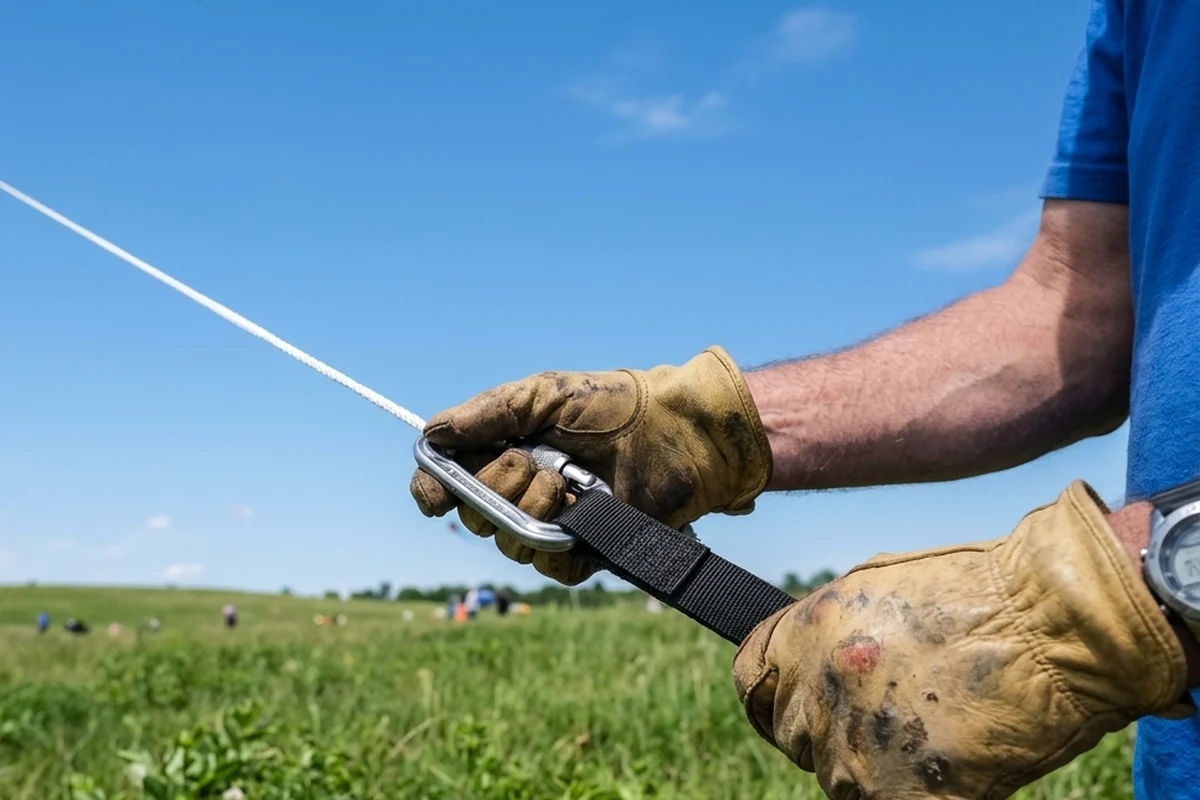
Use these documented retrieval and field safety procedures to protect both your hands and the spool arbor:
- Prism Kites warns pilots never to wrap flying line around their hands because in a gust the kite can pull hard enough for the line to cut seriously, and instructs pilots to always hold the line by its winder or appropriate handle.
- To prevent tangles, Prism Kites states that the flying line should always be either completely stored on the included winder or making a straight line from the winder to the kite, avoiding dragging line on the ground or spooling it into a pile at the flyer’s feet.
- In light or moderate breezes, the kite is retrieved by winding in line a little at a time and pausing occasionally if pulling line in causes the kite to climb or loop.
- In stronger winds or with a harder pulling kite, Prism Kites recommends walking the kite down before winding the line back onto the winder by anchoring or having a friend hold the winder, hooking the Bora bag’s carabiner over the line, and walking toward the kite.
- With a hard pulling kite, Into The Wind instructs flyers to walk it down while a friend holds the reel, placing the line under an arm or holding it with a gloved hand and walking toward the kite so it comes in without increasing apparent wind speed.
- For very large high-tension single-line kites, My-Best-Kite describes two-drum kite winches where one drum handles high-tension anchoring of the kite while a second line-storage drum winds on the retrieved line at much-reduced tension.
- The included flying line on the Bora 7 supports the kite within the advertised 5-25 mph wind range, and replacement flying lines are not covered under the kite’s warranty.
- NASA Glenn Research Center warns never to fly near trees, highways, houses, or high tension wires because a kite touching electrical lines can kill the flyer.
Takeaway: Relieve line tension by walking hard-pulling kites down with gloved hands or a carabiner before spooling the line back onto the reel.
Pre-Flight Kite Reel, Spool, and Line Compatibility Checklist
Use the inspection record below to verify compatibility across your single-line kite, braided flying line, and winder or bearing reel before launching:
| Inspection item | Compatibility check to perform | Field notes |
|---|---|---|
| Kite model and wind rating | Record the kite maker, model name, wing span, and published wind speed band | ____________________ |
| Line material and construction | Confirm braided polyester (Dacron) construction and inspect for knots or abrasion | ____________________ |
| Listed line strength and diameter | Record pound-test or kilopond rating and millimetre cord diameter | ____________________ |
| Spool or reel groove geometry | Check reel outer diameter, groove depth, groove width, and rim clearance margin | ____________________ |
| Arbor knot and leader hardware | Verify Slip Knot on the spool arbor and Clinch Knot on the snap swivel or Bowline loop | ____________________ |
| Brake vs. lock mechanism test | Test smooth friction brake modulation separately from stationary anti-reverse or dead-bolt lock | ____________________ |
| Retrieval and hand protection plan | Prepare leather gloves and a walk-down carabiner for strong-wind tension relief | ____________________ |
Explore more guides in the Kite Types category or visit the main blog index for additional single-line and multi-line technical references.
Sources
- Prism Kites — Single-Line Hoop Winders and Card Winder Product Specifications
- Prism Kites — Zenith Single-Line Delta Kite Product Specifications
- Prism Kites — Bora 7 Pilot’s Guide
- Prism Kites Flight Center — Kite Flying Basics Reference Guide
- Into The Wind — Traditional Single-Line Kites Guide
- Into The Wind — Single-Line Hoops, Winders, and Braided Dacron Line Specifications
- Into The Wind — Tinkerhess Hardwood Kite Line Reel Product Specification
- Invento-HQ — Single-Line Delta Stern, Parafoil Orca, and Delta Fireworks Product Specifications
- Emma Kites — Braided Dacron Kite Line Diameter and Strength Specifications
- Emma Kites — Lockable ABS Plastic, Thumb-Brake, and Disc-Brake Kite Reel Specifications
- Kitty Hawk Kites — Premier Speedy Winder Product Specification
- My-Best-Kite — Single-Line Kite Reels, Spools, and Multi-Drum Winches Guide
- Wikipedia — Cylinder Stress Mechanics Reference
- Wikipedia — Reel Drag, Direct-Drive, and Anti-Reverse Mechanics Reference
- American Kitefliers Association (AKA) — How To Fly A Kite Manual
- NASA Glenn Research Center — Kite Launch, Flight, and Safety Reference Guides
Frequently Asked Questions
What is the difference between a kite reel anti-reverse lock and a friction drag brake?
In reel mechanics, direct-drive reels have the spool and handle directly coupled so the handles spin as line unwinds, whereas anti-reverse reels use a dog/pawl engaging a cog wheel or a one-way clutch bearing to restrict handle movement, and friction drag systems use a coaxial stack of frictional discs (drag washers) to act as a friction brake against outgoing spool rotation when line tension exceeds the drag setting. On the Emma Kites disc-brake kite reel, right-rotating the anti-reverse knob prevents anti-clockwise rotation so line cannot be paid out any more, and the maker warns never to activate anti-reverse when the kite line is paying out at high speed.
How does kite string size and pound test affect kite spool length capacity?
Emma Kites 50Lb 100% Dacron / Polyester braided kite line has a listed diameter of 1.0mm, a weight of 0.52 Oz/100Ft (0.48 g/m), and a recommended safe working strength of 20% of its original strength. Emma Kites 500Lb Braided Dacron Kite Line has a listed diameter of 3.1mm and a weight of 4.81 Oz/100Ft (4.47 g/m). Into The Wind's pre-wound Hoop with Kite Line offers a 6" Hoop with 1000ft of 30lb Dacron Line, a 6" Hoop with 1000ft of 50lb Dacron Line, a 6" Hoop with 500ft of 80lb Dacron Line, and an 8" Hoop with 500ft of 150lb Polyester Line. The Tinkerhess Kite Line Reel is a hardwood bobbin reel with pivoting handles and angled line guides measuring 8" x 14" that holds 3000' of 50-lb. line or 1000' of 150-lb. line with 13" take-in per turn.
Why can reeling in a hard-pulling kite under high tension damage a kite reel?
In mechanics, cylinder stress patterns with rotational symmetry include circumferential stress (or hoop stress) in the tangential direction, axial stress parallel to the axis of cylindrical symmetry, and radial stress perpendicular to the symmetry axis. In built-up concentric shrink-fit cylinders, outer cylinders shrunk over inner cylinders induce compressive stresses at the inner surface, and accurate models of thicker-walled cylindrical shells require radial stresses as well as hoop stresses to be considered. Into The Wind warns never to struggle to reel in a kite because reeling in line under strong tension could damage the reel; instead, in strong winds, walk the kite down or pull the line in with gloved hands while moving around to avoid piling line in one place, then wind the line onto the reel.
How full should you wind kite string onto a reel or spool?
When spooling line onto a reel, spooling should generally stop when the reel is filled 1/8 inch below its rim to avoid overfilling, and exceeding the reel's maximum line diameter and length limits can cause tangles and negatively affect reel performance. Into The Wind advises flyers to let out line if a gust causes a kite to loop or dive and to always leave some line on the reel for unexpected gusts.