For ordinary single-line flying, start with the maker’s braided polyester recommendation; for dual-line control, check whether it specifies polyester or low-stretch Dyneema/Spectra. The wrong replacement can add tangles or dull control, so match the kite’s task and documented line set.
Match the line to the kite before choosing a breaking-strength rating.
Which material suits single-line or dual-line flying?
Prism’s flying-basics guide, checked 15 October 2026, provides the material comparisons below. Its single-line discussion calls polyester Dacron; its sport-line discussion uses the names Dyneema and Spectra. Read the actual replacement listing rather than treating a fiber name as a complete specification.
| Flying task | Material to check first | Stretch and friction tradeoff | Decision before replacing |
|---|---|---|---|
| Recreational single-line kite | Braided polyester/Dacron | An everyday single-line choice; low-stretch steering response is not the main selection task | Match the model’s line specification |
| Small, lightly pulling dual-line kite | The supplied polyester or specified alternative | Polyester costs less, but stretches more and has more friction through twists | Keep polyester if specified; confirm an alternative with the maker |
| Dual-line sport flying where control response matters | Maker-specified Dyneema/Spectra set | Lower stretch and easier sliding through twists; higher cost | Confirm the whole set, including length and strength |
Our recommendation is to make the task decision first, then fill in the specification sheet below. This prevents a familiar material name from becoming a guess about compatibility. If you still need to identify the kite’s control system, use the single-line, dual-line and quad-line comparison.
Is braided kite string better than twisted string?
For avoiding tangles, Prism recommends braided line: twisted construction is cheaper but more prone to twisting and tangling. Construction and material are separate choices. “Braided” alone does not identify the fiber or its rated strength.
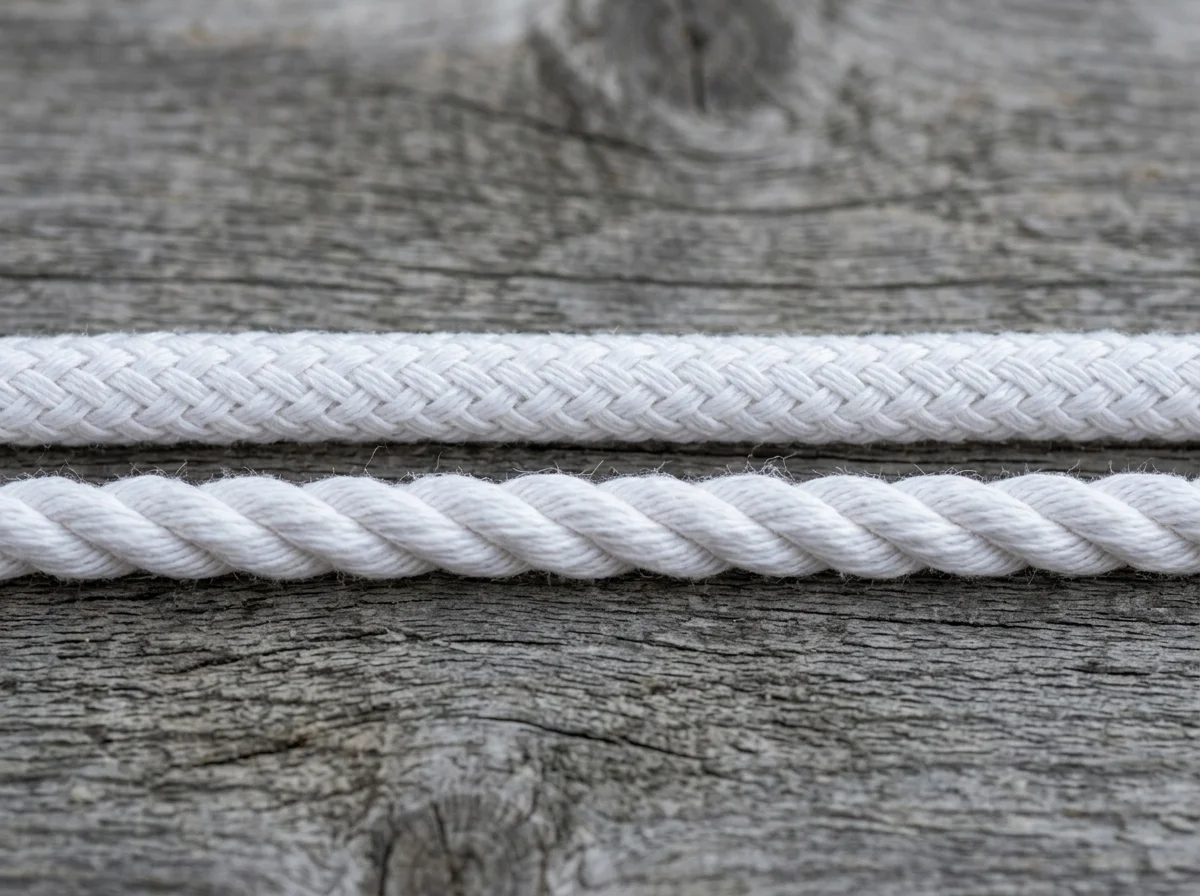
Use the close view to distinguish the structures. For the replacement decision, use the packaging or maker’s document to identify the material. Do not assign equal strength to two cords because their visible diameters look alike.
Why the exact kite model matters: a stock replacement example
Prism’s Synapse replacement-line listing, checked 15 October 2026, separates its dual-line foils by model:
| Exact model named by the maker | Stock line material | Listed length | Listed strength |
|---|---|---|---|
| Synapse 140 | Polyester | 60 ft | 80 lb |
| Synapse 170 / 200 | Dyneema | 75 ft | 150 lb |
The listing describes measured, sleeved lines with colored pigtails and a winder; wrist straps are excluded. These are replacement specifications for those models, not ratings for every foil, every child’s kite or every kite of similar size.
This example also answers a common buying mistake: a dual-line kite does not automatically require the same material as another dual-line kite. Record the full model designation before comparing replacement sets.
Copy this line-specification record before you choose
Use one record for the existing set and another for the proposed replacement. Copy values from the exact model’s current manual or replacement listing. Leave an unavailable value blank and ask the maker to confirm it.
| Field | Existing set | Proposed replacement |
|---|---|---|
| Maker, model and version | ||
| Manual or listing URL, and date checked | ||
| Number of flying lines | ||
| Fiber/material, as listed | ||
| Braided or twisted construction | ||
| Length of each flying line, with unit | ||
| Listed strength, with unit | ||
| Sleeving and end fittings | ||
| Straps, handles and winder included? | ||
| Maker’s stated use conditions | ||
| Unresolved compatibility question |
Do not turn the kite’s weight or wingspan into a pound-test formula. If the source does not state the replacement rating, this worksheet cannot supply one.
Nor should “stronger” be the only upgrade criterion. The Synapse manual, checked 15 October 2026, discusses shorter, lighter sets for reducing weight and drag in light winds, and heavier sets that change how the kite feels. Changing length, material and strength together makes the comparison harder to interpret. Ask about a specific proposed set rather than requesting simply “the strongest string.”
What should you check on a dual-line pair?
Before blaming the material, check the pair. The Synapse manual says uneven stretching can make the kite turn to one side; its troubleshooting check is that the lines match within an inch. That is the maker’s guidance for the Synapse, not a tolerance supplied here for every kite.
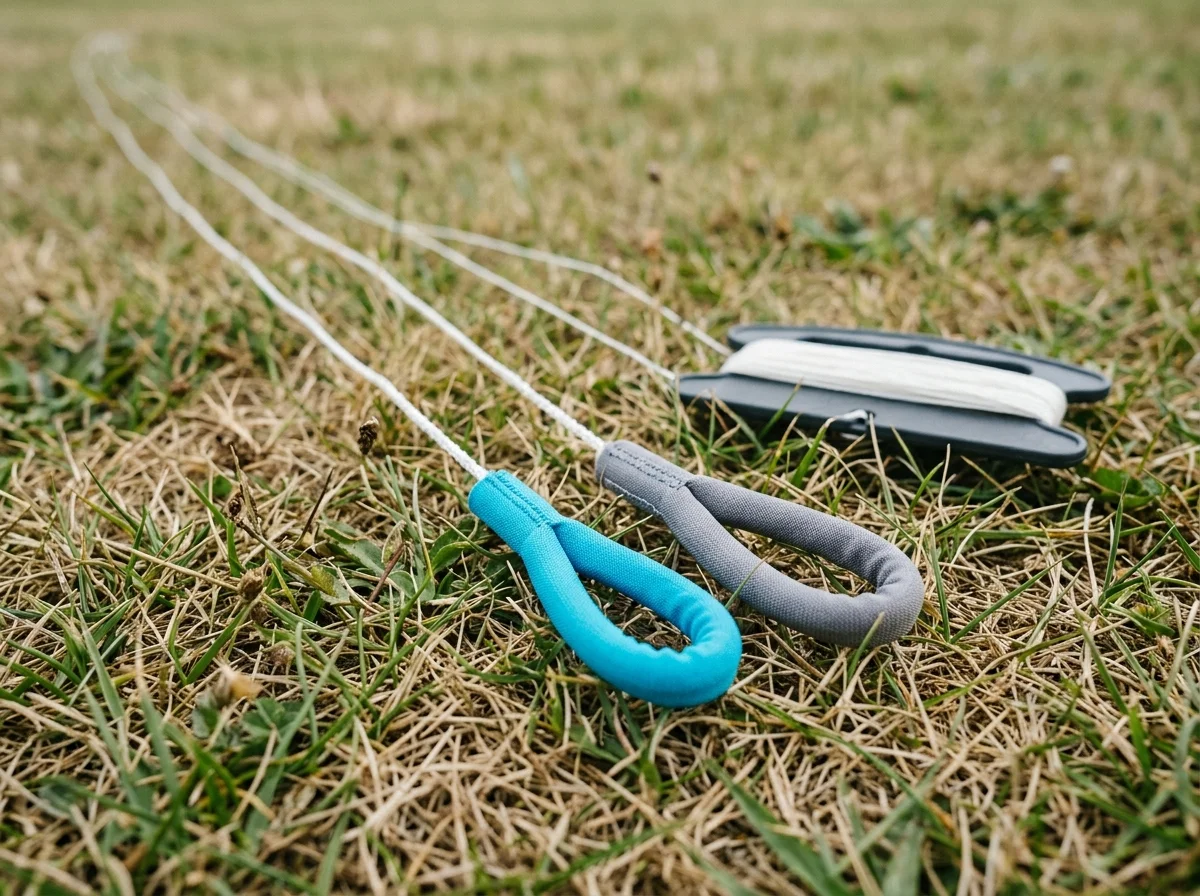
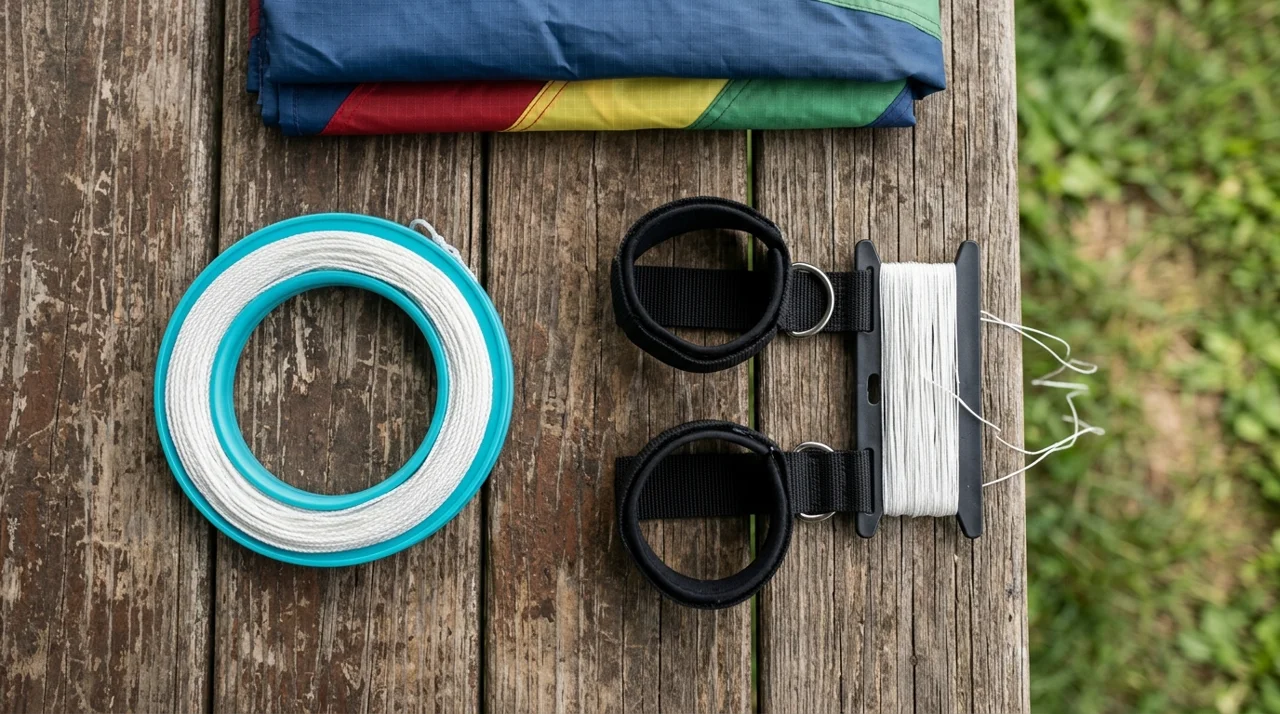
The same manual calls for clear, untwisted bridles before launch and a preflight inspection for worn flying line. Follow the model’s equalizing procedure if adjustment is needed. The photograph shows loop ends; use the manual’s procedure to compare the full lines.
Keep connection checks separate from material selection. Once you have a compatible set, the kite-string attachment guide helps identify the existing bridle fitting before choosing a connection.
Which kite string should you choose for kids?
Our recommendation is to start with the line supplied or specified for the exact kite, and check the kite’s age label and instructions with the adult supervising. A material name alone does not establish suitability for a child. If the kite is unidentified or the original set is missing, leave its replacement strength and length blank until the model can be confirmed.
For a straightforward replacement, a completed model-specific record is more useful than a “best string” ranking.
Method and sources
This guide compares public manufacturer instructions and a current replacement listing, opened on 15 October 2026. The selection matrix and blank record are editorial tools; we did not fly these kites or test line strength. Unknown models retain unknown specifications. The sources below support the material distinctions, the scoped Synapse example and its inspection checks.