Picking an undersized 50-to-62-inch dual-line kite on stretchy polyester lines when shopping for stunt kites for adults causes uncontrollable oversteering, snapped fiberglass spreaders on hard nose-first crashes, and spongy steering lag across the wind window. In dual-line aerodynamics, a compact 1.5-meter frame has low rotational moment of inertia (I = Σ m_i × r_i²), causing it to snap through 180° to 270° per second and dive into the turf before an adult’s 0.35-second visual-motor reflex can counter-steer.
If you are still deciding between two-line loops, four-line reverse hovering, and static single-line flight, start with our pillar comparison on dual-line vs. quad-line vs. single-line stunt kites. Once you commit to a kite dual line architecture, this engineering guide sizes your setup across four variables: wingspan rotational inertia (1.35 m to 2.5 m), flying line modulus and wind-window radius (60 ft to 115 ft UHMWPE Dyneema/Spectra vs. Polyester/Dacron), carbon spar construction (pultruded vs. spiral-wrapped tapered Sky Shark and Dynamic tubes), and 3-point turbo bridle tuning.
Adult dual-line wingspan tiers & line sizing at a glance
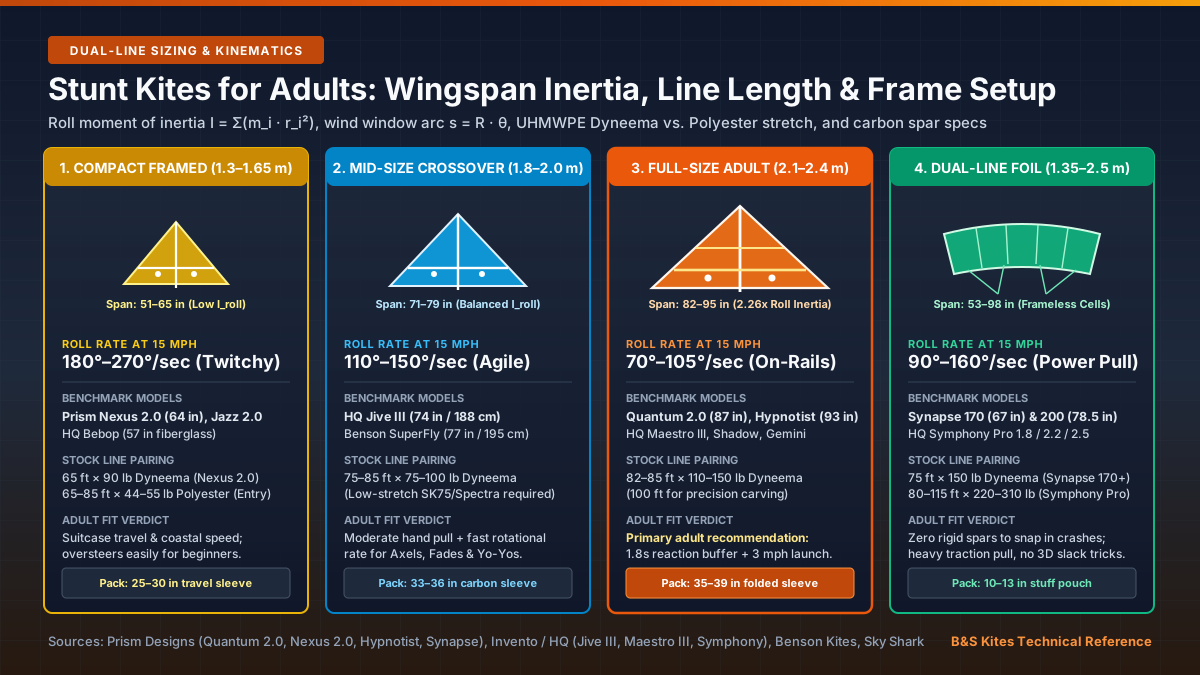
How a dual-line kite responds to a 4-inch wrist pull depends on the pairing of its wingspan tier and its flying line set. The matrix below groups adult dual-line kites into four structural classes and lists their roll rates at 15 mph (Beaufort 4), line specifications, and primary use cases.
| Sizing tier & wingspan band | Roll rate at 15 mph (ω) |
Rotational & pitch behavior | Matched line length & rating | Benchmark commercial models | Adult sizing verdict |
|---|---|---|---|---|---|
Compact / Travel Framed (1.3–1.65 m / 51–65 in) |
180°–270°/sec (360° loop in 1.3–2.0 s) |
Low tip inertia; instantaneous snap turns; oversteers easily on a 6-in adult arm pull | 65 ft × 90 lb Dyneema (sport) or 65–85 ft × 44–55 lb Polyester (entry) |
Prism Nexus 2.0 (64 in), Prism Jazz 2.0 (62 in), HQ Bebop (57 in) |
Best for 26–30 in suitcase packing and fast coastal carving; avoid polyester-line entry models for precision learning |
Mid-Size Crossover Framed (1.8–2.0 m / 71–79 in) |
110°–150°/sec (360° loop in 2.4–3.2 s) |
Balances light hand pull with enough tip mass to damp nervous inputs and pop fast rotations | 75–85 ft × 75–100 lb (35–45 kp) low-stretch Dyneema / Spectra |
HQ Jive III (74 in), Benson SuperFly (77 in) |
Ideal for lighter-weight adults or freestyle pilots wanting rapid multi-axel and yo-yo combinations |
Full-Size Adult Standard Framed (2.1–2.4 m / 82–95 in) |
70°–105°/sec (360° loop in 3.4–5.0 s) |
2.2x–3.6x higher roll inertia; tracks like it is on rails, floats in 3–5 mph air, holds deep stalls | 82–85 ft × 110–150 lb (50–68 kp) Dyneema (100 ft for team precision) |
Prism Quantum 2.0 (87 in), Prism Hypnotist (93 in), HQ Maestro III (87 in), HQ Shadow (81.5 in), Benson Gemini (84 in) |
Primary recommendation for adult beginners and freestyle flyers seeking a 1.6-second reaction buffer and repeatable trick timing |
Dual-Line Ram-Air Parafoils (1.35–2.5 m / 53–98 in) |
90°–160°/sec (varies with cell span) | Frameless ram-air cells (q = 0.5 × ρ × V²); survives hard crashes with zero spars to break; cannot do 3D slack tricks |
75 ft × 150 lb Dyneema (Synapse 170/200); 80–115 ft × 220–310 lb Dyneema (Symphony Pro) |
Prism Synapse 140 / 170 / 200, HQ Symphony Pro 1.8 / 2.2 / 2.5 |
Skip 53-in polyester entry foils; pick 1.7–2.5 m foils on Dyneema for pocket travel and heavy upper-body beach traction |
Selection Takeaway: For a first adult framed kite, step directly to the 2.1–2.4 m (82–95 in) Full-Size Standard tier on 82–85 ft Dyneema lines. If you need a zero-spar beach pack or upper-body power workout, choose a 1.7–2.2 m dual-line parafoil factory-rigged with low-stretch Dyneema.
Wingspan rotational inertia: why 2.2 m kites beat 1.5 m compact frames for adults
When an adult pulls one wrist strap rearward by 6 inches (15 cm), the differential line tension applies a roll torque (τ_steer) about the kite’s central spine. By rotational mechanics, the angular acceleration (α_roll) and steady-state roll rate (ω) are governed by the kite’s roll moment of inertia (I_roll) and aerodynamic wingtip damping (c_aero):
I_roll = Σ (m_i × r_i²)α_roll = (τ_steer − c_aero × ω) / I_roll
Here, m_i is the mass of each structural element (leading edges, lower spreaders, standoffs, connectors, and sail panels) and r_i is its perpendicular distance from the central spine axis. Because r_i is squared, moving structural mass outward along a wider wingspan increases rotational inertia quadratically, while aerodynamic roll-damping torque from the sweeping wingtips scales with wingspan to the third power (b³).
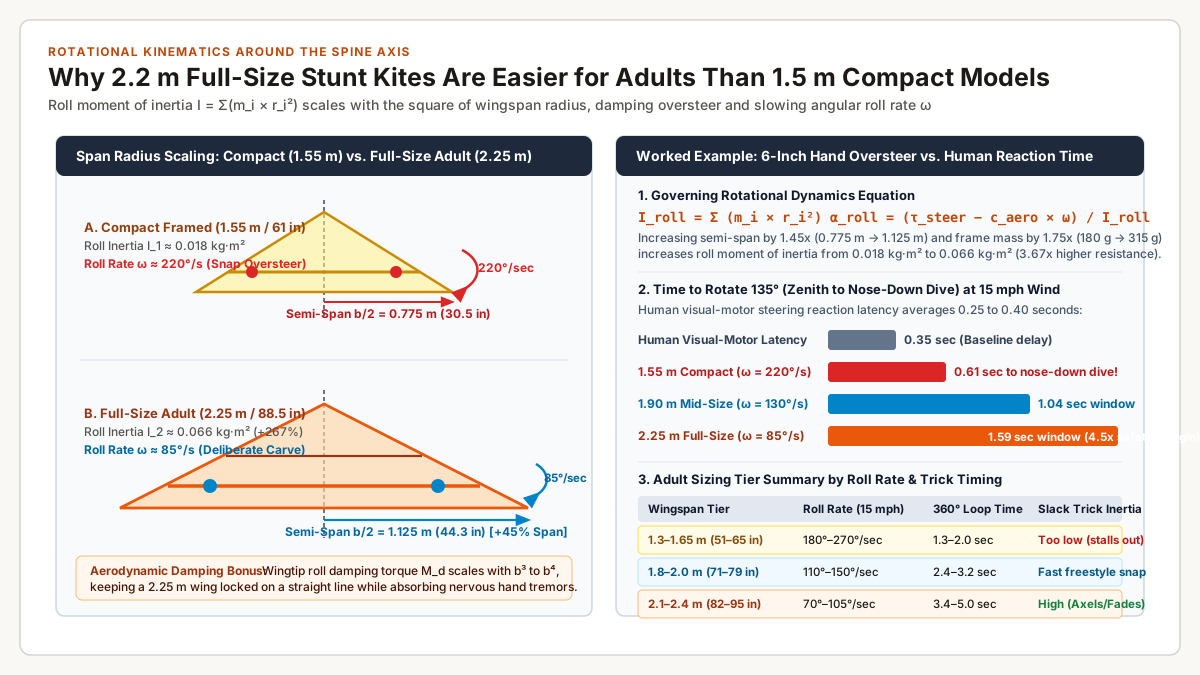
Worked numerical benchmark: 1.55 m Compact vs. 2.25 m Full-Size at 15 mph
To see why a 5-foot entry kite feels hyperactive in adult hands while a 7.5-foot sport kite feels composed, compare two framed deltas flying in the same 15 mph (22 ft/s, Beaufort 4) breeze:
- Compact Framed Kite (
b_1 = 1.55 m / 61 in, semi-spanr_tip = 0.775 m, total massM_1 = 0.180 kg / 6.3 oz):- Distributed spar and connector mass has an effective radius of gyration
r_g1 ≈ 0.316 m(41%of semi-span): I_roll,1 = 0.180 kg × (0.316 m)² =0.018 kg·m²- Under a 6-inch (
15 cm) adult hand pull in 15 mph wind, the wing snaps into a steady roll rate ofω_1 ≈ 220°/sec(completing a full360°loop in1.64 seconds). - Time to nose-down dive (
135°rotation from zenith):t_dive,1 = 135° / 220°/s =0.61 seconds.
- Distributed spar and connector mass has an effective radius of gyration
- Full-Size Adult Framed Kite (
b_2 = 2.25 m / 88.5 in, semi-spanr_tip = 1.125 m, total massM_2 = 0.315 kg / 11.1 oz):- Expanding the wingspan by
45%(1.45×) shifts the effective radius of gyration outward tor_g2 ≈ 0.458 m: I_roll,2 = 0.315 kg × (0.458 m)² =0.066 kg·m²(3.67×higher rotational inertia than the compact kite; even at identical mass, the1.45²span ratio alone increasesI_rollby2.11×).- Combined with wider wingtip aerodynamic damping, the same hand input produces a deliberate roll rate of
ω_2 ≈ 85°/sec(a360°loop takes4.24 seconds). - Time to nose-down dive (
135°rotation from zenith):t_dive,2 = 135° / 85°/s =1.59 seconds.
- Expanding the wingspan by
Human visual-motor reaction time and slack-line trick momentum
Human visual-motor reaction latency—perceiving an unintended roll angle, deciding which hand to pull, and moving the wrist—averages 0.25 to 0.40 seconds. On the 1.55 m compact kite (0.61 s to nose-down orientation), a single nervous arm pull leaves only 0.21 to 0.36 seconds of margin before the kite is pointed straight at the ground in the center of the power zone. On the 2.25 m full-size frame (1.59 s window), the pilot has more than four times the usable correction buffer (~1.24 seconds) to level the wings.
That same rotational inertia governs modern 3D slack-line freestyle tricks:
- When a pilot pops one line and throws both hands forward to trigger an Axel (a flat
360°pancake spin with the nose pitched horizontal), a Fade (hovering upside-down on its back with lines trailing over the leading edges), or a Yo-Yo (rolling360°in pitch to wrap the flying lines around the wing), the flying lines go momentarily slack. - During that slack phase, aerodynamic drive drops to zero; the kite relies entirely on stored angular momentum (
L_ang = I × ω) in its outer wingtips and spine to complete the rotation before catching the wind again. Compact<1.6 mframes lack the rotational momentum to carry through slack-line rotations, stalling mid-spin unless popped with surgical timing.
Takeaway: A 2.1–2.4 m (82–95 in) wingspan acts like a long stabilizing bar on a tightrope—slowing roll rates to 70°–105°/sec for beginners while storing the angular momentum required for slack-line freestyle tricks.
Dual-line flying line physics: UHMWPE (Spectra/Dyneema) vs. Polyester and 65–100 ft wind windows
A dual-line kite’s frame is only half of the control system; the other half is the pair of tethers connecting your wrists to the bridle. Two physical properties of a kite dual line set determine whether the wing responds crisply or feels disconnected: tensile elastic modulus (stretch under load) and line radius (R) across the wind window hemisphere. For a broader background on single-line versus multi-line cordage, see our kite string materials comparison.
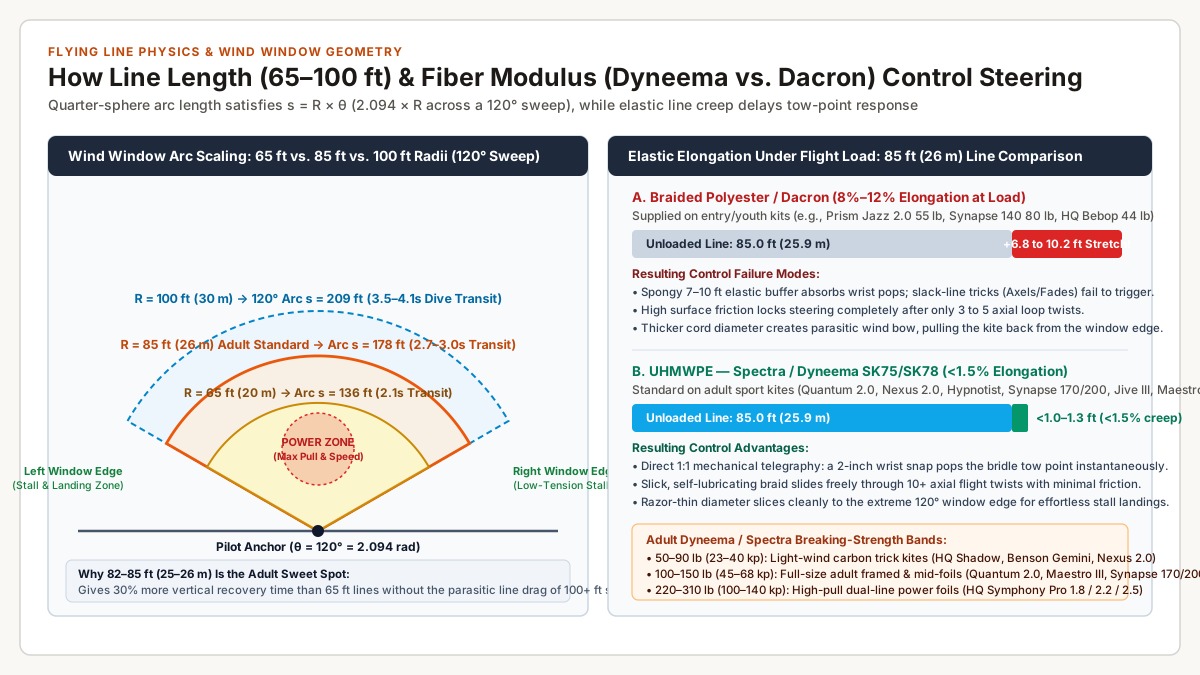
1. Worked stretch calculation: 85 ft Braided Polyester vs. UHMWPE (Spectra/Dyneema)
Entry-level youth and budget stunt kits (such as the Prism Jazz 2.0, Prism Synapse 140, and HQ Bebop) ship with braided polyester (PET / Dacron) lines to reduce retail price and cushion hard beginner jerks. Adult sport kites (such as the Prism Nexus 2.0, Quantum 2.0, Hypnotist, Synapse 170/200, HQ Jive III, and HQ Maestro III) specify Ultra-High-Molecular-Weight Polyethylene (UHMWPE)—sold under the trade names Honeywell Spectra and DSM Dyneema (SK75 / SK78).
Compare the physical elastic elongation (ΔL = L_0 × ε) on a standard L_0 = 85 ft (25.9 m) line set when the kite carves across the power zone:
- Braided Polyester / Dacron (
ε = 8% to 12%elongation under load):ΔL_poly = 85 ft × 0.08 to 0.12 =6.8 to 10.2 ft(2.1 to 3.1 m) of elastic stretch.- Control penalty 1 (Spongy steering dead-band): When you pull your right hand back 6 inches to initiate a sharp turn or pop a slack-line Axel, the polyester line stretches like a rubber band before full tension reaches the bridle tow point.
- Control penalty 2 (Axial twist binding): Polyester fibers have high surface friction. After just 3 to 5 loop rotations in the same direction, the two lines wrap around each other and bind so tightly that steering locks up until you unwind.
- Control penalty 3 (Parasitic wind drag): Polyester requires a thicker cord diameter to achieve a given pound-test rating. Wind pushing against the thick lines bows them downwind, preventing the kite from reaching the clean stall zone at the outer edge of the wind window.
- Braided UHMWPE — Spectra / Dyneema (
ε < 1.5%elongation to break;<0.8%in normal flight):ΔL_uhmwpe = 85 ft × 0.012 to 0.015 =1.0 to 1.3 ft(0.30 to 0.40 m) maximum extension at break, and only 3 to 6 inches under normal flight load.- Control advantage 1 (1:1 mechanical telegraphy): Every half-inch flick of your wrist transmits immediately to the kite’s bridle, enabling crisp square corners and instant slack-line pops.
- Control advantage 2 (10+ wrap low-friction sliding): UHMWPE is naturally slick and self-lubricating. As documented in the Prism Synapse and Quantum manuals, Spectra/Dyneema lines slide past each other with almost no added friction even with 10 or more axial twists in the lines. (To clear twists and pack lines without kinks, follow our two-line kite tangles and figure-eight winding guide.)
- Control advantage 3 (Razor-thin aerodynamic profile): Higher strength-to-diameter ratio cuts cleanly through the air, allowing the kite to fly all the way out to the
120°window edge for soft two-point landings.
2. Line length (65 ft vs. 85 ft vs. 100 ft) and wind-window arc geometry
A dual-line kite flies on the surface of a quarter-sphere downwind of the pilot with radius equal to the line length (R). Across a usable horizontal wind-window sweep of θ = 120° (2.094 radians), the arc distance (s = R × θ) and vertical dive transit time at a typical 40 mph (58.7 ft/s) power-zone kite speed scale directly with R:
Line length (R) |
120° horizontal arc (s = 2.094 × R) |
Zenith-to-ground dive time (at 40 mph kite speed) |
Primary aerodynamic effect & field requirement |
|---|---|---|---|
60–65 ft (18–20 m) |
126–136 ft (38–41.5 m) |
~2.1–2.3 seconds | Ultra-direct turn response for compact travel kites (Nexus 2.0, Synapse 140) and small parks/beaches; leaves minimal vertical altitude to recover from a steep dive |
75–85 ft (23–26 m) |
157–178 ft (48–54 m) |
~2.7–3.0 seconds | Adult all-around & freestyle standard (Quantum 2.0, Hypnotist, Jive III, Maestro III, Synapse 170/200); balances crisp pop transmission with 30% more vertical recovery height |
100–115 ft (30–35 m) |
209–241 ft (64–73 m) |
~3.5–4.1 seconds | Competition precision figures, team ballet, and large power foils (Symphony Pro 2.2 on 35 m lines); opens a vast sky canvas for slow geometric carving, though extra line drag slightly softens light-wind trick pops |
3. Matching breaking strength (50 lb to 310 lb) to kite and wind
Never use “the thickest line available” on a framed stunt kite; as a practical engineering rule of thumb, oversized line adds parasitic wind drag and catenary weight that pulls a light carbon kite out of the sky in 4–7 mph breezes. Match breaking strength (lb or kiloponds kp, where 1 kp = 2.205 lb) to your wing loading:
- 50–90 lb (
23–40 kp) Spectra/Dyneema: Light-wind (3–12 mph) precision and trick flying on ultralight or standard carbon frames (e.g., HQ Shadow, Benson Gemini / SuperFly, Prism Nexus 2.0). Minimizes line sag so the kite stays aloft in thermal puffs. - 100–150 lb (
45–68 kp) Spectra/Dyneema: Standard adult framed kites (2.0–2.4 m) flown across6–25 mph(Beaufort 2–5) and mid-size dual-line foils (Prism Quantum 2.0, Hypnotist, Synapse 170/200, HQ Jive III, HQ Maestro III). Absorbs sudden shock loads from snap stalls and power-zone pulls. - 200–310+ lb (
90–140+ kp) Dyneema: Large dual-line traction and speed parafoils (HQ Symphony Pro 1.8 / 2.2 / 2.5) where ram-air cell area generates heavy body-dragging pull in15–31 mph(Beaufort 4–6) winds.
Takeaway: Upgrade any polyester-equipped dual-line kite to 75–85 ft braided Spectra/Dyneema, and keep a lighter 50–80 lb line set alongside your 100–150 lb set if you frequently fly in 4–8 mph winds.
Frame spar engineering & dual-line stunt kite setup
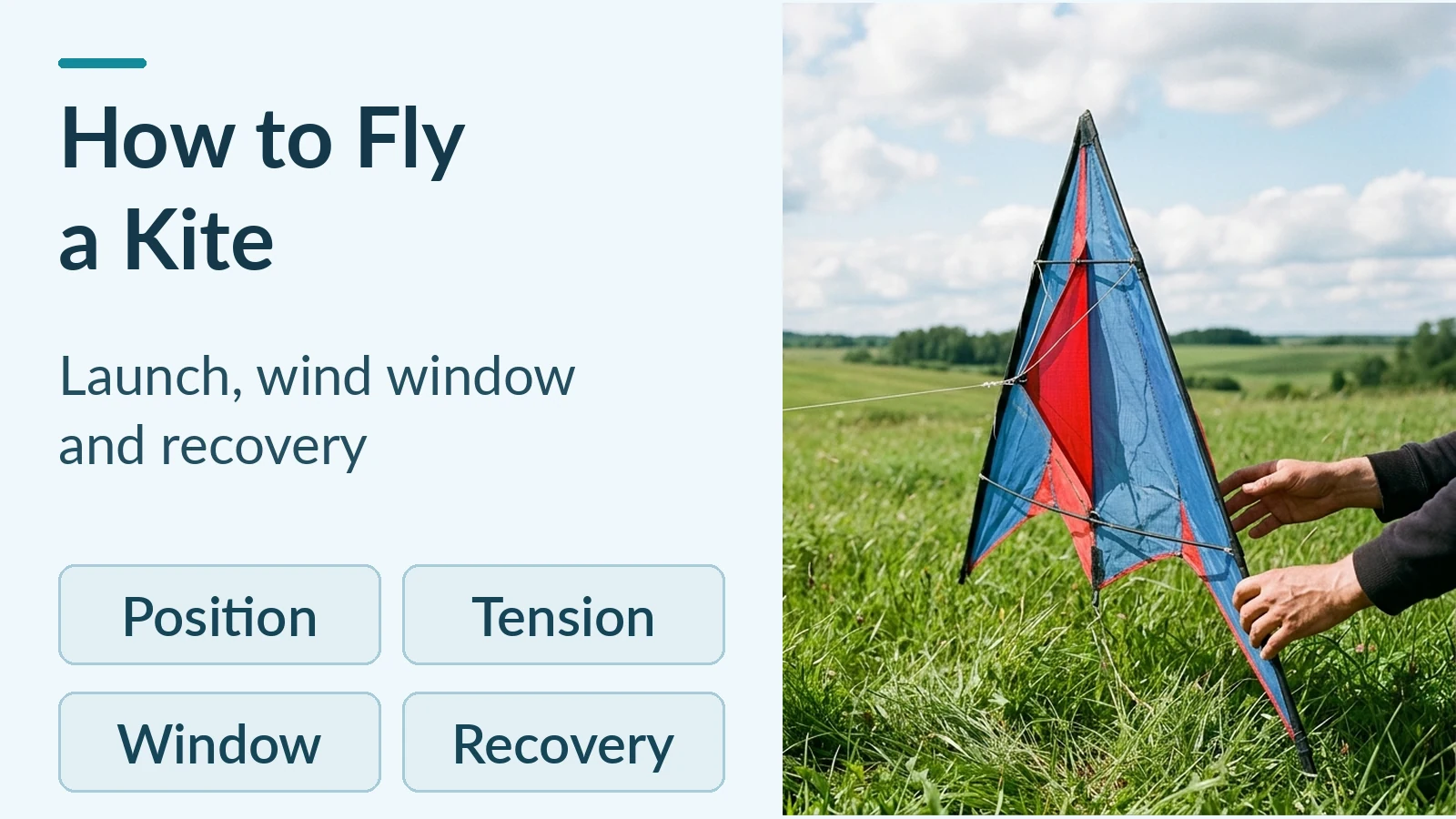
When an adult beginner nose-dives a framed kite at 35 mph, kinetic energy (E_k = 0.5 × m × V²) travels straight up the central spine and into the center T-fitting where the lower spreaders meet. Understanding how manufacturers engineer spars, ferrules, and bridles lets you choose a frame that survives early crashes and tune your dual line stunt kite setup for changing winds. For step-by-step wind window launch positioning, see how to fly a kite: launch position and wind window.
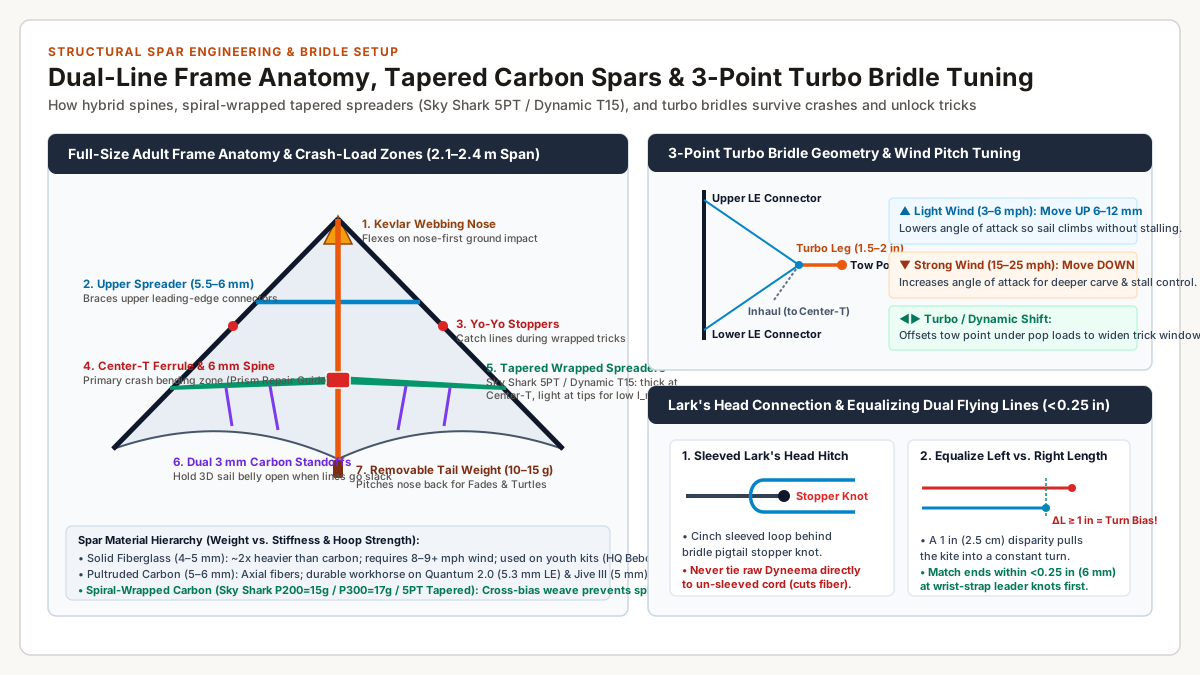
1. Spar material hierarchy: Fiberglass vs. Pultruded Carbon vs. Spiral-Wrapped Tapered Carbon
Frame material governs three performance metrics: minimum launch wind speed (covered in detail in our ideal wind speed by kite frame guide), crash flex recovery, and rotational wingtip inertia:
- Solid or Tubular Fiberglass (
4 mm – 5 mm):- Engineering profile: E-glass fibers in resin. Absorbs severe bending on hard ground strikes, but weighs roughly twice as much as wrapped carbon for equivalent stiffness and oscillates slowly after a pop.
- Where used: Youth entry models (HQ Bebop
4/5 mmfiberglass, requiring9+ mphwind to launch) or strategically blended into hybrid spines (Prism Jazz 2.0, Nexus 2.0).
- Pultruded Carbon Fiber Tube (
3.5 mm – 6 mm OD):- Engineering profile: Unidirectional carbon fibers pulled continuously through a resin bath and heated die. Delivers high axial stiffness at moderate cost, though unidirectional fibers have lower hoop strength (resistance to lengthwise splitting when levered against a hard ferrule in a crash).
- Where used: Standard leading edges and spreaders on adult sport kites (Prism Quantum 2.0
5.3 mmLE/lower spreaders, HQ Jive III5 mmcarbon, HQ Maestro III6 mmLE/spine) and upper spreaders on artisan trick kites (5.5 mmpultruded upper spreader on Benson SuperFly / Gemini).
- Hybrid Carbon-Fiberglass Spine & Kevlar Nose Webbing:
- Engineering profile: Prism’s Field Guide to Repairing Your Stunt Kite identifies the central spine and the female lower spreader socket at the center T-fitting as the primary failure points in nose-first crashes. By co-curing carbon and fiberglass in a 6 mm hybrid spine and upper spreader (used on the Prism Quantum 2.0) and stitching flexible Kevlar webbing over the nose cap, the spine flexes longitudinally on impact while rubber standoff retainers pop free to release sail tension.
- Spiral-Wrapped Mandrel Carbon — Straight & Tapered (
Sky Shark P-Series / 5PT&HQ Dynamic T12/T15):- Engineering profile: Pre-preg carbon cloth is rolled at alternating bias angles around a steel mandrel, wrapped under tension, and oven-cured. Cross-bias fibers provide exceptional hoop strength (preventing ferrule splits) and the highest stiffness-to-weight ratio in kiting.
- Straight vs. Tapered specs: Straight wrapped tubes like Sky Shark P200 (
15 g) and P300 (17 g) share a universal0.244 in(6.2 mm) internal diameter across32.5 in(82.5 cm) lengths so spars can be mixed by wind strength. Tapered wrapped lower spreaders—such as Sky Shark 3PT / 5PT / 5PT Black Diamond (on the Benson SuperFly and Gemini), HQ Dynamic T15 (on the HQ Maestro III), Dynamic T12 (on the HQ Shadow), and the wrapped lower spreaders on the Prism Hypnotist—place a wide, stiff diameter at the high-bending center T-fitting and taper down to a featherweight tip at the outer leading edge. This keeps maximum crash strength at the spine while cutting outer wingtip mass (m_iat larger_i), loweringI_rollfor effortless multi-axels. If you ever snap a rod or ferrule, use our replacement kite spar fit checklist to measure OD/ID before ordering.
2. Dual-line stunt kite setup: 3-point turbo bridle, Lark’s Head knots, and line equalization
Even a $300 competition carbon frame will spin uncontrollably or stall on launch if the bridle and flying lines are rigged asymmetrically. Follow this three-step field setup protocol before every launch:
- Inspect the 3-Point Static or Turbo Bridle & Set Wind Pitch:
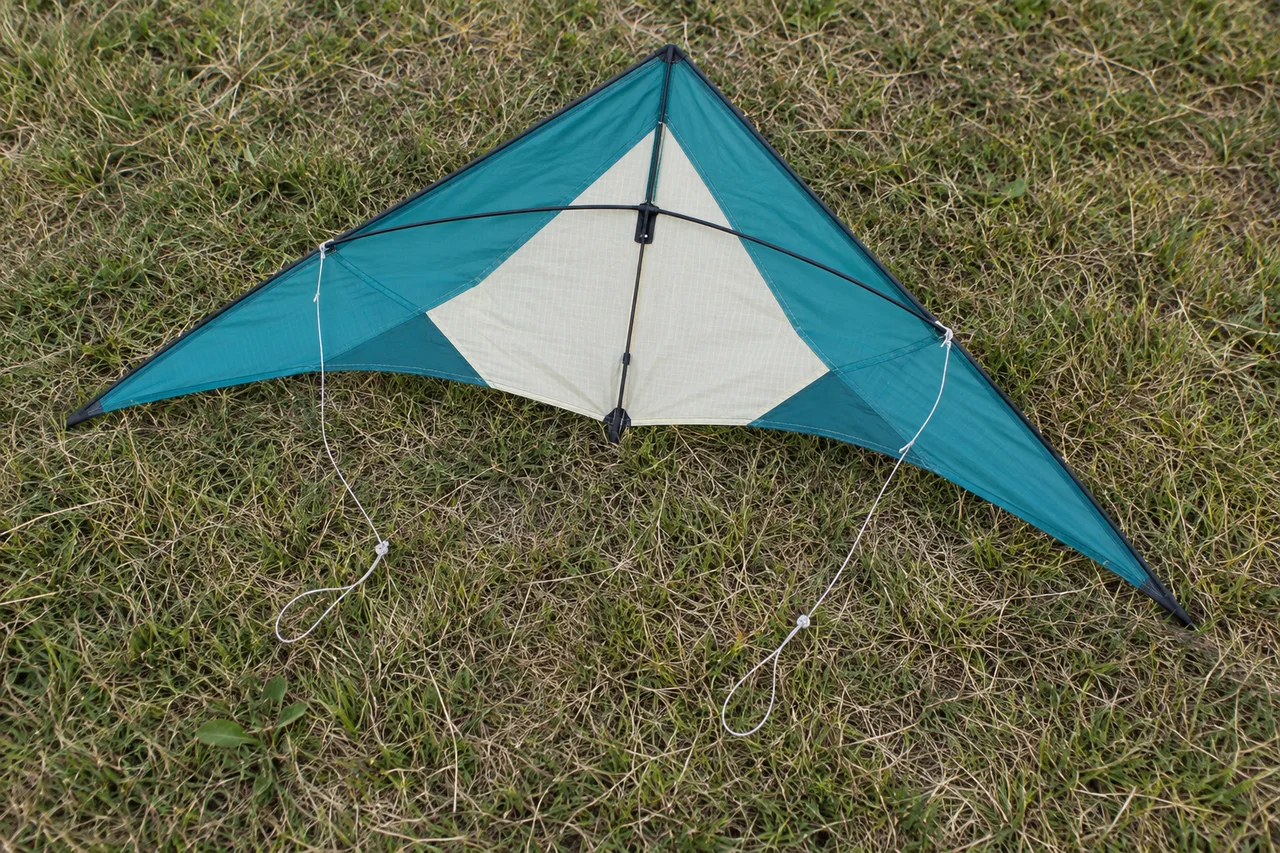
- A standard 3-point bridle joins an upper outhaul leg (to the upper leading-edge connector), a lower outhaul leg (to the lower spreader connector), and an inhaul leg (to the center T-fitting).
- Most adult sport kites (Prism Nexus 2.0, Quantum 2.0, Hypnotist, HQ Maestro III) use a 3-point turbo bridle or dynamic bridle (popularized by designer Andy Wardley), which adds a short
1.5 to 2.5 in(38–64 mm) turbo leg between the three-leg junction and the tow point pigtail. Under gusts or one-handed trick pops, the turbo leg allows the tow point to pivot outward and rearward automatically, smoothing turn entry and widening the slack-line trick window. - Pitch tuning rule: In light wind (
3–6 mph), shift the tow-point Prusik knot UP toward the nose by0.25 to 0.5 in(6–12 mm) (matching left and right reference marks) to reduce the angle of attack so the kite climbs smoothly. In strong wind (15–25 mph), shift the tow point DOWN toward the tail by0.25 to 0.5 into increase angle of attack, slow forward speed, and deepen carve pull. Always log factory baseline marks first using our kite bridle adjustment identification guide.
- Attach Sleeved Flying Lines with a Lark’s Head Knot:
- Form a Lark’s Head (cow hitch) loop inside the protective braided sleeve at the end of each flying line and cinch it snugly behind the stopper knot on the kite’s bridle pigtail (color-coded Red/Left and Blue/Right on Prism sets).
- Critical fiber rule: Never tie bare, un-sleeved Spectra or Dyneema directly onto a bridle line; under a 100 lb power-zone snap load, ultra-thin UHMWPE acts like a friction saw and slices through unreinforced cord. See our bridle and pigtail string attachment guide for visual knot checks.
- Equalize Left and Right Line Lengths Within
<0.25 in(6 mm):- As emphasized in the Prism Synapse and Into The Wind stunt guides, a 1-inch (
2.5 cm) disparity between left and right flying lines forces the kite into a constant turn toward the shorter line—a symptom beginners frequently misdiagnose as a warped frame or bad bridle. - Field equalization check: Pass a ground stake through both wrist straps, walk out the full
65 to 100 ftlines, pull both kite-end loops taut side by side, and inspect the alignment. If one line is longer, shift the adjustment knot inside the wrist-strap heavy leader cord (or tie an overhand shortening knot in the longer leader) until both sleeved loops match within0.25 inches(6 mm).
- As emphasized in the Prism Synapse and Into The Wind stunt guides, a 1-inch (
Takeaway: Equalize your flying lines at the wrist-strap leaders before touching the factory bridle, and rely on small 6–12 mm tow-point shifts to adapt your pitch to light or heavy wind.
Commercial adult stunt kite specifications & benchmark matrix (11 models)
The table below compiles verified manufacturer specifications across 11 commercial dual-line models spanning compact travel frames, mid-size crossovers, full-size adult precision/freestyle kites, and frameless dual-line ram-air parafoils. To convert mph ratings into Beaufort numbers and on-field visual wind indicators, see our kite flying wind speed chart.
| Brand & model | Sizing tier & architecture | Wingspan (in / cm) |
Published wind range (mph / Bft) |
Frame spar construction | Stock flying line set | Packed length | Adult sizing & progression verdict |
|---|---|---|---|---|---|---|---|
| Prism Jazz 2.0 | Compact Entry Framed | 62 in (157 cm) |
5–25 mph (Bft 2–5) |
Hybrid carbon / fiberglass spine & spreaders | 85 ft × 55 lb braided Polyester |
26 in (66 cm) |
Tough crash trainer, but fast 200°+/s roll rate and stretchy polyester lines limit adult precision |
| Prism Nexus 2.0 | Compact Travel Sport Framed | 64 in (162.5 cm) |
4–22 mph (Bft 2–5) |
3.5 mm carbon LE, 5 mm carbon lower spreaders, 5 mm glass spine/upper spreader |
65 ft × 90 lb low-stretch Dyneema |
30 in (76 cm) |
Best compact suitcase-friendly framed kite; includes real Dyneema lines and 3-point turbo bridle |
| Prism Quantum 2.0 | Full-Size Adult All-Around Framed | 87 in (221 cm) |
3–25 mph (Bft 1.5–5) |
5.3 mm pultruded carbon LE/lower spreaders, 6 mm hybrid spine/upper spreader, Kevlar nose |
85 ft × 150 lb low-stretch Dyneema |
36 in folded / 60 in full |
Benchmark adult beginner framed kite: high roll inertia slows turns while hybrid spine survives hard impacts |
| Prism Hypnotist | Full-Size Adult Trick / Freestyle Framed | 93 in (236 cm) |
4–25 mph (Bft 2–5) |
Pultruded carbon LE/spine + spiral-wrapped carbon lower spreaders, dual standoffs, yo-yo stoppers | 85 ft × 150 lb low-stretch Dyneema |
36 in (91 cm) |
Nearly 8-ft span delivers maximum pitch inertia and wrapped-spreader snap for Axels, Fades, and Yo-Yos |
| HQ Bebop | Compact Youth / Light Entry Framed | 57 in (145 cm) |
9–24 mph (Bft 2.5–5) |
4 mm & 5 mm solid fiberglass |
65 ft (20 m) × 44 lb Polyester |
25 in (63 cm) |
Heavy fiberglass frame needs 9+ mph breeze and 57 in span is overly twitchy for adult beginners |
| HQ Jive III | Mid-Size Adult All-Around / Trick Framed | 74 in (188 cm) |
4–24 mph (Bft 2–5) |
5 mm carbon + hybrid composite frame |
82 ft (25 m) × 100 lb (45 kp) Dyneema |
33 in (84 cm) |
Agile European crossover bridging compact and full-size; ships ready-to-fly with 25 m Dyneema lines |
| HQ Maestro III | Full-Size Adult Freestyle Framed | 87 in (220 cm) |
6–25 mph (Bft 2–5) |
6 mm pultruded carbon + tapered wrapped Dynamic T15 lower spreaders, Mylar panels, tail weight |
82 ft (25 m) × 110 lb (50 kp) Dyneema |
38 in (97 cm) |
Full-size freestyle workhorse combining 6 mm spine toughness with tapered T15 spreaders and removable tail ballast |
| HQ Shadow | Full-Size Light-Wind Trick Framed | 81.5 in (207 cm) |
3.5–15 mph (Bft 2–4) |
4 mm carbon + tapered wrapped Dynamic T12 lower spreaders |
Rec. 75–82 ft × 50–100 lb Dyneema |
35 in (89 cm) |
Dedicated inland light-wind trick machine; floats in 4 mph thermals but must be grounded above 15 mph |
| Benson SuperFly / Gemini | Pro Artisan Competition Freestyle Framed | 77 in (195 cm) / 84 in (214 cm) |
3–18 mph (Bft 1.5–4) |
Sky Shark P200/P300 wrapped LE/spine + Sky Shark 5PT / 5PT Black Diamond tapered spreaders | Kite-only (flown on 75–100 ft × 50–90 lb Spectra) |
36–39 in (91–99 cm) |
Reference UK artisan trick kites demonstrating how mixed Sky Shark P-series and 5PT spars optimize rotational balance |
| Prism Synapse 140 / 170 / 200 | Frameless Dual-Line Parafoil | 53 in (140) / 67 in (170) / 78.5 in (200) |
6–25 mph (140) / 5–25 mph (170) / 4–25 mph (200) |
Frameless ram-air ripstop nylon cells | 60 ft × 80 lb Polyester (140) vs. 75 ft × 150 lb Dyneema (170 & 200) |
10–11 in (25–28 cm) pouch |
Adults should skip the 140 (polyester lines, twitchy 53 in span) and buy the 170 or 200 to get 150 lb Dyneema lines |
| HQ Symphony Pro 1.8 / 2.2 / 2.5 | Frameless Dual-Line Speed & Power Parafoil | 71 in (1.8 m) / 87 in (2.2 m) / 98 in (2.5 m) |
4–31 mph (Bft 2–6) |
Frameless ram-air ripstop nylon + sewn Dyneema bridle | 80–115 ft × 220–310 lb Dyneema |
11–13 in (28–33 cm) pouch |
High-speed beach carving and heavy upper-body traction pull up to 31 mph with zero rigid spars to break |
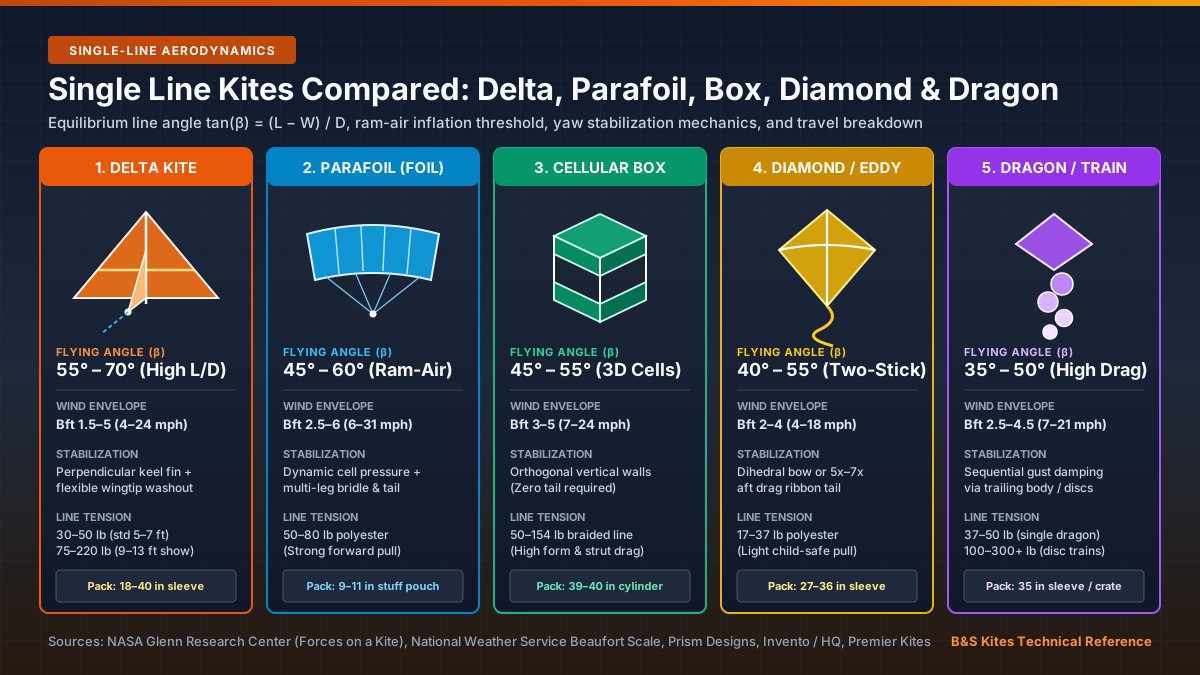
(For buyers who decide they prefer passive overhead flight without active two-hand steering, compare these against our single-line delta, parafoil, box, diamond, and dragon comparison.)
Takeaway: Verify the stock line material in the manufacturer’s listing before buying—models like the Prism Quantum 2.0, Nexus 2.0, Synapse 170/200, and HQ Jive III/Maestro III include low-stretch Dyneema out of the bag, whereas entry models like the Jazz 2.0, Synapse 140, and Bebop ship with high-stretch polyester.
Step-by-step adult buyer & setup checklist
Match your local flying field, travel constraints, and progression goals to one of these four verified configurations:
- First-Time Adult Pilot Wanting Forgiving Precision & Crash Durability (
3–25 mph):- Recommended setup: Prism Quantum 2.0 (
87 in / 221 cm) on stock85 ft × 150 lbDyneema lines, or HQ Jive III (74 in / 188 cm) on82 ft × 100 lbDyneema. - Why it works: The
2.2 mwingspan slows roll velocity to~85°/sec, giving you a 1.6-second correction window, while the6 mmhybrid carbon-fiberglass spine and Kevlar nose absorb early ground strikes.
- Recommended setup: Prism Quantum 2.0 (
- Adult Progression Into 3D Slack-Line Freestyle Tricks (Axels, Fades, Turtles, Yo-Yos):
- Recommended setup: Prism Hypnotist (
93 in / 236 cm) or HQ Maestro III (87 in / 220 cm) for durable all-around trick learning; Benson SuperFly (77 in) or Benson Gemini (84 in) on75–85 ft × 75–90 lbSpectra for advanced artisan freestyle. - Why it works: Spiral-wrapped tapered lower spreaders (
Dynamic T15/Sky Shark 5PT Black Diamond), dual standoffs, tail ballast, and leading-edge yo-yo stoppers maintain sail geometry and momentum when the lines go slack.
- Recommended setup: Prism Hypnotist (
- Inland Park Flyer Dealing With Light 3–10 mph Thermal Winds:
- Recommended setup: HQ Shadow (
81.5 in / 207 cm) paired with a dedicated light-wind75 ft × 50–75 lbSpectra/Dyneema line set, with the bridle tow point shifted0.25 in(6 mm) UP toward the nose. - Why it works: The
4 mmcarbon and taperedDynamic T12frame cuts total mass so the wing climbs in3.5–4 mphpuffs where heavy fiberglass or parafoil kites sit on the grass.
- Recommended setup: HQ Shadow (
- Backpack / Carry-On Traveler or High-Wind Beach Power Flyer (
6–31 mph):- Recommended setup: Prism Synapse 170 (
67 in) or 200 (78.5 in) on75 ft × 150 lbDyneema for moderate pull, HQ Symphony Pro 2.2 (87 in) or 2.5 (98 in) on220–310 lbDyneema for heavy workout traction, or Prism Nexus 2.0 (64 in,30 inpack length) if you want a suitcase-sized framed carbon delta. - Why it works: Frameless parafoils stuff into a
10–13 inpouch, fit inside any airline carry-on bag, and survive 30 mph beach impacts with zero rigid rods to fracture.
- Recommended setup: Prism Synapse 170 (
Takeaway: Match your wingspan and spar architecture to your local wind band first, then confirm that your flying lines are equalized within 0.25 in (6 mm) before launch.
Related reading in Kite Types and Materials
- Stunt Kites Explained: Dual-Line vs Quad-Line vs Single-Line Kites — Pillar overview comparing two-line, four-line, and single-line control architectures.
- Which Kite String Is Best? Match the Line to the Kite — Deep dive into braided polyester versus low-stretch Dyneema replacement specs.
- Kite Bridle Adjustment: Identify the Setup Before You Tune — How to record factory tow-point baselines before adjusting pitch or inhaul knots.
- How to Attach Kite String: Find the Bridle, Clip or Pigtail — Step-by-step Lark’s Head connection guide for knotted pigtails.
- Two-Line Kite Tangles: Flight Twists, Packing and Winding — Clearing axial flight wraps and figure-eight winder storage.
- Where to Buy Replacement Kite Spars Online — Measuring carbon and fiberglass spar diameters, lengths, and ferrules.
- Browse all Kite Types guides — Complete archive of single-line and multi-line kite engineering guides.
- Browse Materials and Care — Fabric, spar, and line maintenance tutorials.
Frequently Asked Questions
Why is a 2.2-meter full-size stunt kite easier for adult beginners than a 1.5-meter compact kite?
Rotational moment of inertia around the central spine scales with the square of wingspan radius (I = Σ m_i × r_i²). Expanding a dual-line delta from 1.55 m (61 in) to 2.25 m (88.5 in) increases roll inertia by more than threefold while adding wingtip aerodynamic damping. At 15 mph, a 1.55 m kite rolls at roughly 220°/sec—turning from zenith into a nose-down dive in 0.61 seconds, barely above human visual-motor reaction time (0.25–0.40 seconds). A 2.25 m kite slows the roll rate to ~85°/sec, giving an adult pilot a 1.59-second correction window.
What flying line length and material should adults use on a dual-line stunt kite?
For all-around adult sport and freestyle flying, pair a 2.0 to 2.4 m framed kite with 75 to 85 ft (23 to 26 m) of braided UHMWPE line (Honeywell Spectra or DSM Dyneema SK75/SK78) rated at 90 to 150 lb test. At 85 ft, low-stretch Spectra/Dyneema elongates less than 1.5% (1.0 to 1.3 ft) under load, whereas entry-level braided polyester (Dacron) stretches 8% to 12% (6.8 to 10.2 ft), creating a spongy dead-band that absorbs wrist-snap trick inputs and binds after 3 to 5 axial loop twists.
Should an adult buy a framed carbon delta stunt kite or a frameless dual-line parafoil?
Choose a framed carbon delta (such as the Prism Quantum 2.0, HQ Maestro III, or HQ Jive III) if you want crisp straight-line tracking, light-wind launches down to 3–4 mph, vertical stall landings, and 3D slack-line freestyle tricks (Axels, Fades, Turtles, Yo-Yos). Choose a frameless dual-line ram-air parafoil (such as the Prism Synapse 170/200 or HQ Symphony Pro 1.8/2.2/2.5) if you want an 11-inch stuff-pouch travel pack, heavy upper-body power pull up to 31 mph, and zero rigid spars to break on hard beach impacts.
What is the difference between pultruded carbon and spiral-wrapped Sky Shark or Dynamic tapered spars?
Pultruded carbon tubes draw unidirectional carbon fibers through a heated resin die, yielding low-cost axial stiffness suited to standard 5–6 mm leading edges and spines, but lower hoop strength against lengthwise splitting at ferrules. Spiral-wrapped carbon tubes (such as Sky Shark P200/P300 and tapered Sky Shark 5PT or HQ Dynamic T15 spreaders) roll pre-preg carbon cloth at alternating bias angles around a steel mandrel. Tapered wrapped lower spreaders place a thick wall at the high-load center T-fitting and taper to a lightweight tip at the outer wing, resisting ferrule splits while lowering rotational inertia.
How do you fix a dual-line stunt kite that constantly pulls or turns to one side?
Before adjusting the kite's factory bridle knots, equalize the flying lines. As noted in the Prism Synapse and Quantum manuals, even a 1-inch (2.5 cm) length discrepancy between left and right lines creates a continuous turn toward the shorter line. Stake both wrist straps evenly on the ground, walk to the kite ends under equal tension, and align the sleeved loops. Shift the adjustment knot inside the wrist-strap leader cord until both line ends match within 0.25 inches (6 mm).
References & Sources
- Quantum 2.0 Dual-Line Sport Kite Specifications — Prism Designs
- Nexus 2.0 Dual-Line Sport Kite Specifications — Prism Designs
- Hypnotist Freestyle Sport Kite Specifications — Prism Designs
- Jazz 2.0 Dual-Line Sport Kite Specifications — Prism Designs
- Synapse 140 Dual-Line Parafoil Specifications — Prism Designs
- Synapse 170 Dual-Line Parafoil Specifications — Prism Designs
- Synapse 200 Dual-Line Parafoil Specifications — Prism Designs
- Synapse Replacement Flying Lines (Polyester vs. Dyneema Specs) — Prism Designs
- Kite Flying Basics — Line Materials, Wind Window and Knots — Prism Designs
- Synapse Pilot's Guide — Equalizing Flying Lines and Troubleshooting — Prism Designs
- A Field Guide to Repairing Your Stunt Kite (Spars, Ferrules, Bridles & Lines) — Prism Designs
- Stunt Kites 101 — Setting Up Your Kite and Stunt Kite Lines — Into The Wind
- Benson SuperFly Freestyle Kite & Sky Shark Frame Specifications — Benson Kites
- Benson Gemini Dual-Line Trick Kite Specifications — Benson Kites
- Sky Shark Wrapped Carbon Fiber Tubes (P-Series & Tapered PT/Black Diamond) — Sky Shark Tubes
- Dynamic and Turbo Stunt Kite Bridle Design — Andy Wardley
- Symphony Beach III 2.2 Dual-Line Foil Specifications — Invento / HQ
- Beaufort Wind Scale — National Weather Service, Miami