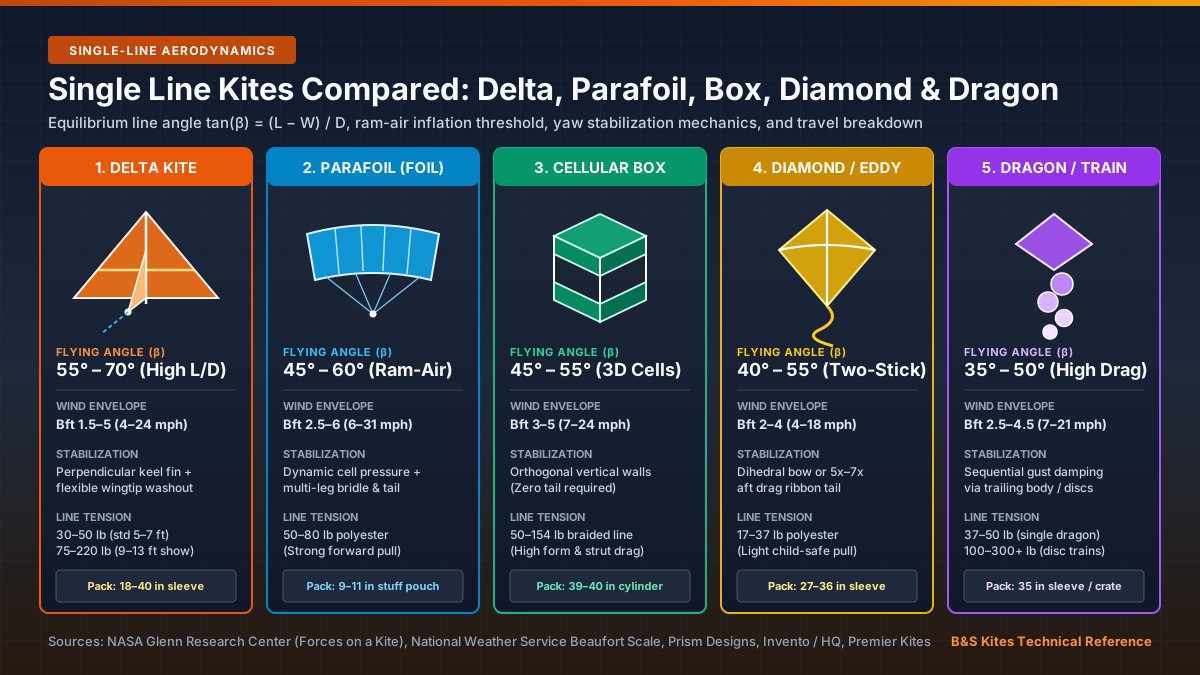
Picking the wrong single line kite architecture for your local wind regime causes deflated ram-air cells in light thermal breezes, snapped fiberglass cross-struts during inland lulls, or excessive line pull on under-rated string. While all single line kites fly on a single tether without dual-line steering handles, the five core structural families—delta, parafoil (ram-air soft foil), cellular box, diamond (Eddy two-stick), and dragon or articulated train kites—generate lift and damp yaw oscillations through fundamentally different aerodynamic mechanisms.
If you are still matching a starter kite to a child’s age label or basic wind check, start with our pillar guide on single line kite types and how to choose one. This engineering comparison breaks down the five architectures by equilibrium flying angle (tan(β) = (L − W) / D), minimum wind threshold, coastal laminar versus inland turbulent recovery, tail drag requirements, and packed breakdown length across 12 commercial models.
Five single-line kite architectures compared side by side
Every single line kite balances four forces in flight: aerodynamic lift (L), aerodynamic drag (D), gravitational weight (W), and tether tension (T). How the sail and frame are arranged determines the lift-to-drag ratio (L/D), which sets how steeply the kite climbs overhead and how it reacts when a gust or lull hits.
| Architecture | Structural principle | Equilibrium line angle (β) |
Published wind band (Beaufort / mph) | Coastal laminar flight behavior | Inland turbulent rotor survival | Tail & ballast requirement | Typical line pull & test rating |
|---|---|---|---|---|---|---|---|
| Delta | Triangular single-surface sail with swept leading-edge spars, central spine, spreader, and perpendicular keel fin | 55°–70° (Highest L/D) |
Bft 1.5–5 (4–24 mph; light-wind carbon models from 4 mph) | Climbs steeply overhead with light hand tension in sea breezes and thermals | Flexible outer wingtips spill gusts; sharp rotors above rated speed can cause a nose-tuck without a tail | None in laminar wind; optional ribbon tail or trailing flap damps choppy inland yaw | Low to moderate (30–50 lb for 5–7 ft; 75–220 lb for 9–13 ft lifters) |
| Parafoil (Soft Foil) | Frameless double-surface wing with open leading-edge cells inflated by dynamic air pressure (q = 0.5 × ρ × V²) and multi-leg bridle |
45°–60° (High C_l, moderate bridle drag) |
Bft 2.5–6 (6–31 mph; needs ≥6–9 mph to pressurize cells) | Steady, strong forward pull; handles fresh-to-strong coastal winds up to 31 mph | Highest crash survival; zero rigid spars to break, cells deform in rotors and auto-reinflate | Short-span foils include a 15–20 ft ribbon tail to damp lateral dutch-roll oscillations | Moderate to heavy forward pull (50–80 lb polyester even on compact foils) |
| Cellular / Box (Hargrave) | 3D rigid truss of four longitudinal struts braced by diagonal cross-spars supporting two separated lifting/side sail bands | 45°–55° (High multi-plane lift, high strut drag) | Bft 3–5 (7–24 mph; mesh variants rated from Bft 2) | Tracks rock-steady without a tail in steady 10–20 mph beach winds | Vulnerable to sudden lulls; heavier 3D frame stalls rapidly when wind drops, risking cross-strut breakage on hard turf | No tail required; orthogonal vertical walls act as passive weathercock fins | Heavy, truck-like pull (50–154 lb braided line) |
| Diamond / Eddy (Two-Stick) | Vertical spine crossed by a single horizontal spreader (either flat sail with tail or bowed dihedral sail) | 40°–55° (Low-to-moderate L/D) |
Bft 2–4 (4–18 mph; small framed variants to Bft 5) | Easy hand launch in gentle breezes with light pull suited to young flyers | Flat diamonds spin or loop when gusts shift the center of pressure ahead of gravity | Mandatory 5x–7x tail on flat diamonds for aft drag; optional on bowed Eddy below 12 mph | Light pull (17–37 lb polyester line) |
| Dragon / Train | Framed lead sail or sculpted head followed by a long ribbon body or interconnected disc sails along shared backbone lines | 35°–50° (Lowest L/D due to skin and segment drag) |
Bft 2.5–4.5 (7–21 mph steady wind) | Long trailing body or train segments undulate cleanly when wind stays above 8 mph | Articulated segments absorb gusts sequentially like a shock absorber, but lulls drop the tail into trees or grass | Trailing body or disc train acts as the stabilizing drag anchor | Low on single dragon sails (37–50 lb); extreme on multi-disc centipede trains (100–300+ lb) |
Selection Takeaway: Choose a delta when you need steep overhead flight in light 4–10 mph breezes, a frameless parafoil when you want indestructible pocket travel and 10–30 mph gust resilience, or a cellular box kite when you have steady 10–20 mph coastal air and enjoy three-dimensional truss assembly.
Aerodynamic physics of line angle, pull, and catenary sag
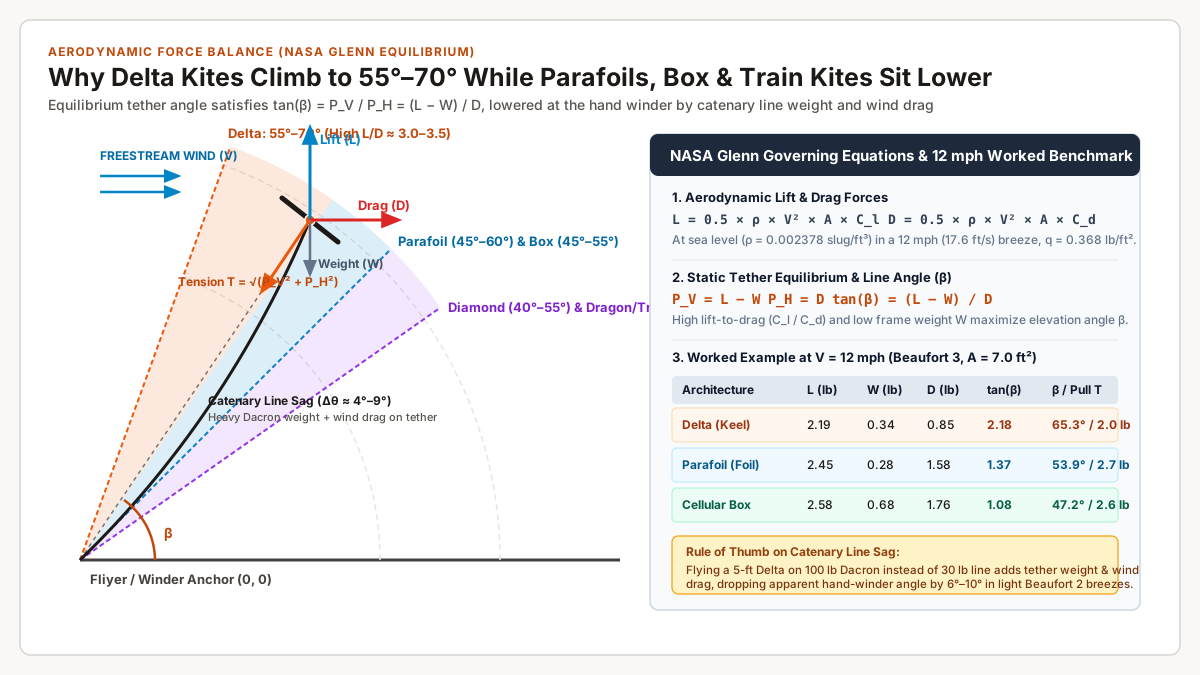
Why does a 7-foot delta park nearly overhead at 65°, while a cellular box kite or dragon kite on the same beach sits downwind at 45°? NASA Glenn Research Center’s Forces on a Kite and Kite Lift and Drag Equations model a single line kite in static flight as a four-force equilibrium system around the bridle tow point.
Aerodynamic lift (L) acts perpendicular to the freestream wind, while aerodynamic drag (D) acts parallel to the wind direction:
L = 0.5 × ρ × V² × A × C_lD = 0.5 × ρ × V² × A × C_d
Here, ρ is air density (0.002378 slug/ft³ or 1.225 kg/m³ at sea level), V is wind velocity relative to the sail, A is effective sail planform area, and C_l and C_d are the lift and drag coefficients determined by the kite’s trim angle of attack (α) and geometric aspect ratio.
For the kite to hover stationary in the sky, the control line tension (T) at the bridle attachment point must balance both the vertical and horizontal aerodynamic forces:
- Vertical force balance:
P_V = L − W(vertical tension equals aerodynamic lift minus kite gravitational weightW) - Horizontal force balance:
P_H = D(horizontal tension equals total aerodynamic and parasitic dragD) - Equilibrium elevation angle (
β):tan(β) = P_V / P_H = (L − W) / D - Total bridle line tension (
T):T = √(P_V² + P_H²) = √((L − W)² + D²)
Worked numerical benchmark: Delta vs. Parafoil vs. Box at 12 mph
To see how structural geometry translates directly into flying angle and hand pull, compare three kites with the same A = 7.0 ft² (0.65 m²) effective lifting area flying at sea level in a steady 12 mph (17.6 ft/s, Beaufort 3) breeze. At 17.6 ft/s, dynamic wind pressure is q = 0.5 × 0.002378 × 17.6² = 0.368 lb/ft²:
- Delta Kite (
W = 0.34 lb,C_l = 0.85,C_d = 0.33):- Lift
L = 0.368 × 7.0 × 0.85 = 2.19 lb - Drag
D = 0.368 × 7.0 × 0.33 = 0.85 lb - Vertical net force
P_V = 2.19 − 0.34 = 1.85 lb tan(β) = 1.85 / 0.85 = 2.18→ Equilibrium bridle angleβ = 65.3°- Total line tension
T = √(1.85² + 0.85²) =2.04 lb
- Lift
- Ram-Air Parafoil (
W = 0.28 lb,C_l = 0.95,C_d = 0.61including multi-leg bridle, intake mouth, and 15-ft ribbon tail):- Lift
L = 0.368 × 7.0 × 0.95 = 2.45 lb - Drag
D = 0.368 × 7.0 × 0.61 = 1.57 lb - Vertical net force
P_V = 2.45 − 0.28 = 2.17 lb tan(β) = 2.17 / 1.57 = 1.38→ Equilibrium bridle angleβ = 54.1°- Total line tension
T = √(2.17² + 1.57²) =2.68 lb(31%higher pull than the delta at the same area)
- Lift
- Hargrave Cellular Box Kite (
W = 0.68 lbwith four struts and four cross-spreaders,C_l = 1.00,C_d = 0.68across internal struts and orthogonal panels):- Lift
L = 0.368 × 7.0 × 1.00 = 2.58 lb - Drag
D = 0.368 × 7.0 × 0.68 = 1.75 lb - Vertical net force
P_V = 2.58 − 0.68 = 1.90 lb tan(β) = 1.90 / 1.75 = 1.09→ Equilibrium bridle angleβ = 47.4°- Total line tension
T = √(1.90² + 1.75²) =2.58 lb
- Lift
How catenary line sag lowers the angle at your hand winder
The equation tan(β) = (L − W) / D defines the tether angle right at the kite’s bridle clip. Along a 200-to-300-foot flying line, two additional forces act on the string itself: the gravitational weight of the braided line and the crosswind aerodynamic drag on the cylinder of string exposed to the breeze. Together, they bow the tether into a downward catenary curve.
As a practical engineering rule of thumb, flying a light 5-foot delta in a 6 mph breeze on oversized 100 lb test Dacron line instead of matched 30 lb line increases tether weight and wind drag enough to create 6° to 10° of catenary sag between the bridle and the hand winder. Matching line diameter and breaking strength to your architecture prevents premature stalling; see our single-line vs. dual-line kite string materials guide and bridle or pigtail attachment checklist for exact knot and line pairings.
Takeaway: High lift-to-drag ratio and low frame mass put delta kites at 55°–70°, whereas bridle and cell drag hold parafoils and cellular box kites at 45°–60° while generating stronger forward tension on the line.
Delta vs. parafoil deep dive: stability, wind threshold, and travel breakdown
Most buyers narrowing down a single line kite ultimately compare a framed delta against a frameless parafoil. While both rank among the most reliable single-line designs sold today, their failure modes lie at opposite ends of the wind scale.
1. Minimum wind threshold: Beaufort 1.5–2 vs. Beaufort 2.5–3
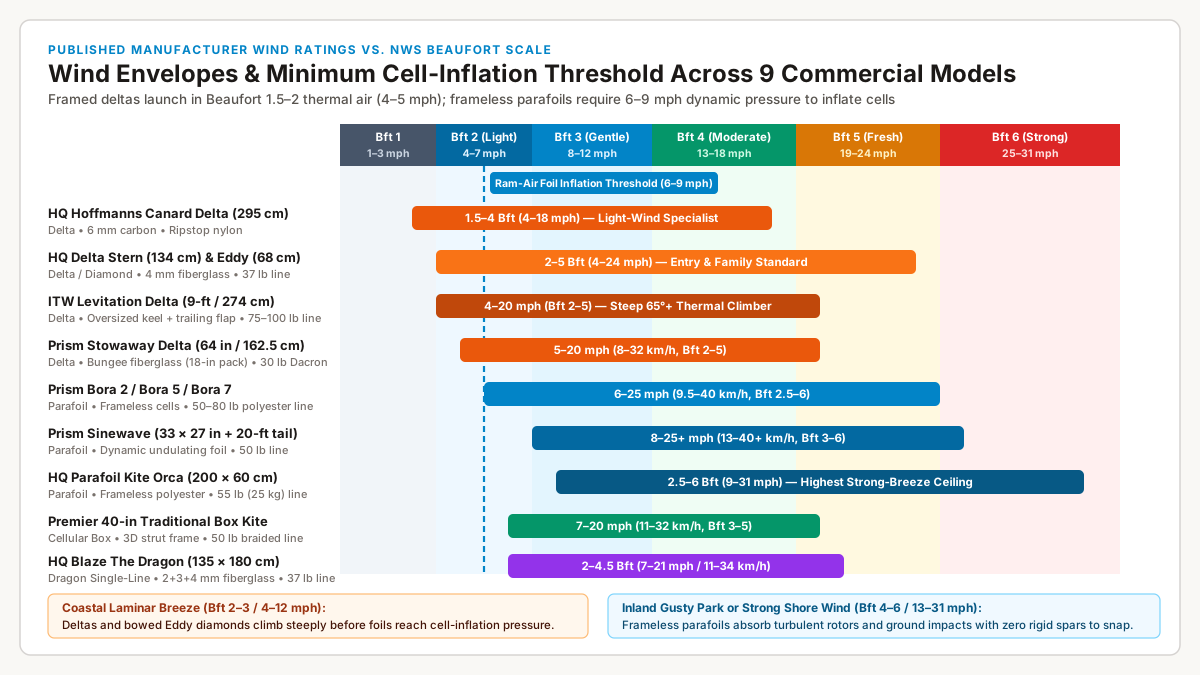
A delta kite’s rigid leading-edge spars and cross-spreader hold its triangular sail taut before any wind blows. Because the wing shape is mechanically fixed, a light-wind delta such as the 295 cm carbon-framed HQ Hoffmanns Canard Delta launches in Beaufort 1.5 (4 mph) air, and standard fiberglass deltas such as the HQ Delta Stern (134 cm), Into The Wind Levitation Delta (7-ft and 9-ft), and Prism Stowaway Delta (64 in) climb reliably at Beaufort 2 (4–5 mph).
A frameless parafoil has no rigid rods. Instead, open air intakes along the leading edge rely on freestream dynamic pressure (q = 0.5 × ρ × V²) to inflate internal fabric cells formed by ripstop ribs between the upper and lower skins. Below a threshold breeze of 6 to 9 mph (Beaufort 2.5 to 3), internal cell pressure cannot overcome fabric weight and bridle tension: the wingtips fold inward and the foil drifts down. Once wind speed crosses 8–10 mph, however, models like the Prism Bora series (6–25 mph), Prism Sinewave (8–25+ mph), and HQ Parafoil Orca (9–31 mph / Bft 2.5–6) lock into a rigid pressurized airfoil that thrives in fresh-to-strong winds where lightly framed deltas over-flex. To check how frame stiffness alters the upper wind limit, see ideal wind speed by kite frame.
2. Coastal laminar climb vs. inland turbulent rotor recovery
Aerodynamic stability works differently on a flat ocean beach than in a tree-lined inland park:
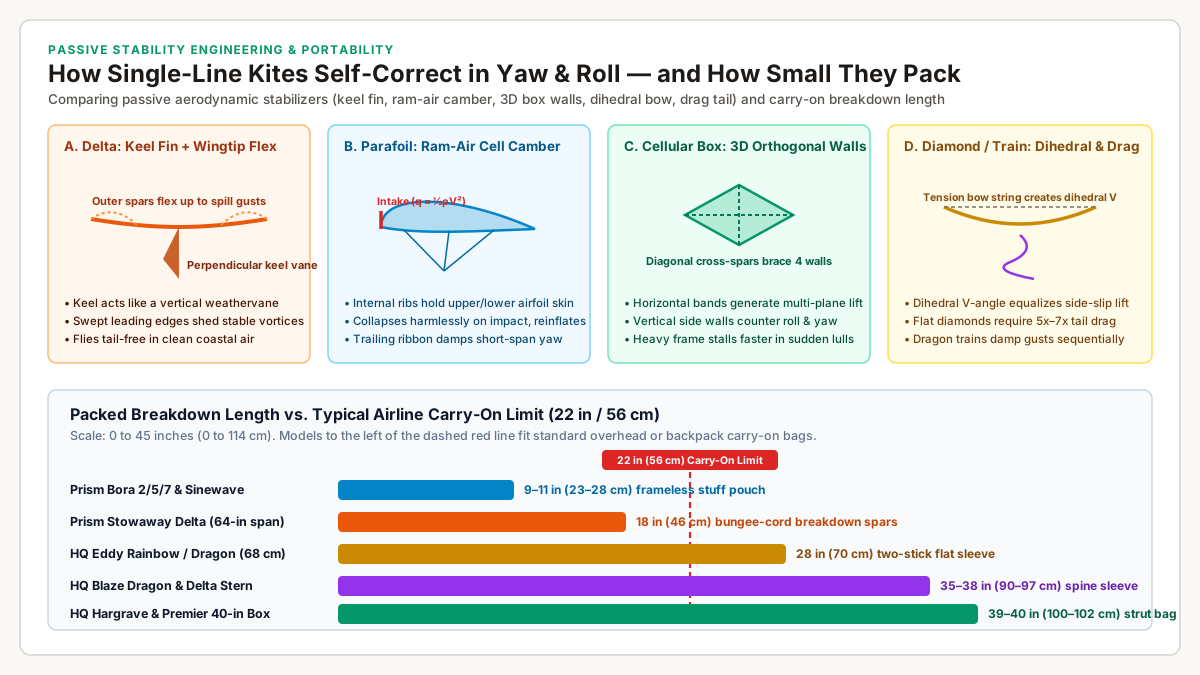
- Delta kites use a keel fin and wingtip washout: Beneath the central spine, a perpendicular fabric triangle—the keel—acts like a vertical tail fin on an aircraft, keeping the nose pointed into the wind while distributing tow force along the spine. The leading-edge spars stop short of the nose tip and flex upward and rearward during a gust, creating aerodynamic washout that spills excess pressure. In smooth coastal laminar flow, a delta locks into a silent overhead hover without a tail. In gusty inland parks behind trees or buildings, however, a sharp vertical rotor can momentarily unload one wingtip or push the nose under; clipping a 10-to-20-foot ribbon tail to the rear spine loop adds aft drag that prevents lateral dives.
- Parafoils use multi-leg bridles and crash-proof cell reinflation: Because a compact single-line parafoil has a relatively low aspect ratio and high forward traction, short-span foils can develop a rhythmic side-to-side yaw oscillation (“dutch roll”) in turbulent gusts. Manufacturers counter this by pairing the multi-leg bridle with a long streaming tail—for example, the integrated ribbon tail on the Prism Bora 2/5/7 or the 20-foot removable undulating tail on the Prism Sinewave. If a violent park rotor slams a parafoil into the ground, there are zero fiberglass or carbon spars to snap; as soon as wind hits the leading edge, the cells reinflate and climb back into the wind window.
3. Travel breakdown: ferruled spars vs. pocket stuff pouch
If you are packing a kite into a daypack or an airline carry-on bag (typically capped at 22 × 14 × 9 in / 56 × 36 × 23 cm), frame architecture dictates packed length:
- Frameless parafoils (
9–11 in/23–28 cm): The Prism Bora 2 packs into a9 × 4 × 1.5 inpouch, the Bora 5 and Bora 7 pack into11 × 4.5 × 1.5 in, and the Sinewave fits a10 × 5.5 × 2 inbelt pouch. - Bungee-corded travel deltas (
18 in/46 cm): Standard 5-foot deltas use a full-length central spine that packs to36–40 in(91–102 cm). The Prism Stowaway Delta replaces one-piece spars with shock-corded fiberglass sections (like tent poles), folding a64-inch(162.5 cm) wingspan into an18-inch(46 cm) sleeve that fits diagonally inside a carry-on suitcase.
Takeaway: Pick a delta if your sessions frequently include light 4–8 mph morning or thermal breezes; pick a parafoil if you want a zero-spar pocket kite for 8–25+ mph coastal breezes or rough inland parks.
Cellular box, diamond (Eddy), and dragon/train trade-offs
Beyond deltas and parafoils, three classic single-line architectures solve specialized visual and aerodynamic problems.
Cellular / box kites (Hargrave & traditional multi-cell)
Invented by Lawrence Hargrave in 1893 for meteorological lifting, the cellular box kite arranges two separated rectangular bands of sail fabric around four longitudinal struts braced by diagonal cross-spars. When flown on edge with one corner pointing toward the ground:
- Orthogonal weathercock stability: Both the upper/lower lifting surfaces and the vertical side walls are angled into the airflow. If a gust yaws or rolls the box, the leeward vertical panels immediately experience a higher angle of attack, generating a strong restoring moment that snaps the kite back on track without any tail.
- High tractive pull vs. lull sensitivity: Multi-plane surface area gives models like the Invento / HQ Hargrave Box Kite (
100 × 100 cm, supplied with70 kp / 154 lbline) and the Premier Kites 40-inch Traditional Box Kite (20 × 40 in,50 lbline) a deep, steady pull in 8 to 20 mph (Beaufort 3–5) winds. However, the 3D strut framework weighs roughly twice as much as a delta of the same span and creates significant internal strut drag. If an inland wind lull drops below7 mph, airflow through the rear cell stalls and the box descends rapidly. If a hard landing snaps a diagonal cross-strut, consult our replacement kite spar fit checklist.
Diamond / Eddy kites (two-stick flat vs. bowed dihedral)
The classic diamond kite crosses a vertical spine with a single horizontal spreader at roughly 25%–33% of the spine length from the nose. Two distinct aerodynamic variants share this silhouette:
- Flat diamond with mandatory tail: A flat two-stick diamond has no dihedral angle and no keel. When a gust strikes, the center of pressure shifts ahead of the center of gravity, causing the kite to spin in tight loops. A ribbon or streamer tail—typically 5x to 7x the spine length—is mandatory to supply aerodynamic drag behind the tail tip (not dead weight) so the nose stays pointed upward.
- Bowed Eddy diamond: Developed by William Abner Eddy in 1890, a true Eddy kite uses a tension string across the horizontal spreader to bow the wings rearward into a shallow dihedral V-angle. When the kite rolls to one side, the lower wing presents a flatter face to the wind and generates more lift than the raised wing, righting the kite automatically. Entry-level diamonds like the HQ Eddy Rainbow / Eddy Dragon (
68 × 68 cm, ratedBft 2–5 / 4–24 mph) include a ribbon tail so beginners get predictable stability even when park winds turn gusty above 12 mph.
Dragon, centipede, and articulated train kites
Single-line dragon kites fall into two structural categories that behave very differently on the line:
- Framed dragon with a long articulated fabric tail: Models such as the HQ Blaze The Dragon (
135 cmwide by180 cmlong, framed in2 + 3 + 4 mmfiberglass, ratedBft 2–4.5 / 7–21 mph) use a delta- or diamond-style framed head wing trailed by a long ripstop polyester ribbon body. The long tail provides heavy aft skin-friction drag that locks the head steady in choppy air, though the extra drag lowers the flying angle to 35°–50° and requires at least7 mphof breeze so the tail does not drag across the ground. - Modular centipede and stack trains: Traditional Chinese centipede (Chuan) kites and western stack trains link 10 to 100+ individual disc or diamond sails along two or three shared backbone lines. As a wind gust travels down the train, each segment pitches sequentially like a mechanical shock absorber, averaging out turbulent spikes so the lead head remains stationary. Because tractive drag accumulates across every disc, even a compact 5-to-10-meter recreational train requires
80–150 lbbraided line, while festival trains exceed200–300 lbpull and require anchored ground handling.
Takeaway: Pick a cellular box kite for tail-free geometric stability in steady 10–20 mph breezes, a diamond/Eddy for light-pull family flying in 4–15 mph air, or a dragon kite when visual sky presence matters more than a steep overhead line angle.
Commercial model specifications & benchmark table
The table below compiles published manufacturer specifications across 12 single line kites spanning all five architectures. All wind ranges, frame diameters, sail fabrics, packed dimensions, and line ratings come directly from Prism Designs, Into The Wind, Invento / HQ, and Premier Kites catalog listings. For fabric weight and coating differences between ripstop nylon and ripstop polyester sails, see our ripstop nylon vs. polyester kite fabric guide.
| Brand & model | Architecture | Wingspan / dimensions | Published wind range (Beaufort) | Frame material | Sail material | Packed length / pouch | Supplied or recommended line |
|---|---|---|---|---|---|---|---|
| Prism Stowaway Delta | Delta (Travel breakdown) | 64 in (162.5 cm) span | 5–20 mph / 8–32 km/h (Bft 2–5) | Bungee-corded fiberglass | Ripstop nylon + Mylar laminate | 18 in (46 cm) travel sleeve | 200 ft × 30 lb braided Dacron included |
| Into The Wind Levitation Delta (7-ft / 9-ft) | Delta (Thermal / KAP lifter) | 7 ft: 84 × 37 in; 9 ft: 108 × 55 in | 7 ft: 5–20 mph; 9 ft: 4–20 mph (Bft 2–5) | Fiberglass (carbon on Light variant) | 40D ripstop nylon, oversized keel + flap | 36–44 in breakdown sleeve | 50–75 lb Dacron (7 ft); 75–100 lb (9 ft) |
| HQ Delta Stern | Delta (Entry standard) | 53 in (134 cm) span | 4–24 mph (Bft 2–5) | 4 mm fiberglass | Polyester | ~38 in (97 cm) spine sleeve | 130 ft (40 m) × 37 lb (17 kp) polyester included |
| HQ Hoffmanns Canard Delta | Delta (Light-wind canard) | 116 in (295 cm) span | 4–18 mph (Bft 1.5–4) | 6 mm carbon | Ripstop nylon | Ferruled breakdown sleeve | 50–90 lb low-stretch Dacron (sold separately) |
| HQ Delta Fireworks 4 m | Delta (Large show lifter) | 161 in (410 cm) span | 9–22 mph (Bft 2–5) | Carbon + fiberglass hybrid | Ripstop polyester | Multi-piece ferruled sleeve | 143–220 lb (65–100 kp) polyester recommended |
| Prism Bora 2 / Bora 5 / Bora 7 | Parafoil (Soft foil) | Bora 2: 24 × 18 in; Bora 5: 32 × 24.5 in; Bora 7: 49 × 32 in | 6–25 mph / 9.5–40 km/h (Bft 2.5–6) | Frameless (ram-air cells) | Ripstop polyester + streaming tail | 9–11 in (23–28 cm) stuff pouch | Bora 2/5: 200 ft × 50 lb; Bora 7: 300 ft × 80 lb included |
| Prism Sinewave | Parafoil (Undulating foil) | 33 × 27 in (84 × 69 cm) + 20 ft tail | 8–25+ mph / 13–40+ km/h (Bft 3–6) | Frameless all-fabric cell foil | Ripstop polyester | 10 × 5.5 × 2 in (25 cm) waist pouch | 200 ft × 50 lb polyester on hoop winder included |
| HQ Parafoil Kite Orca | Parafoil (Medium foil) | 79 in long × 24 in wide (200 × 60 cm) | 9–31 mph (Bft 2.5–6) | Frameless | Polyester | Compact stuff bag | 55 lb (25 kg) polyester line included |
| HQ Hargrave Box Kite (Rainbow Mesh) | Cellular / Box | 39 × 39 in (100 × 100 cm) | 4–24 mph / 6–38 km/h (Bft 2–5) | 3 mm + 4 mm fiberglass struts | Ripstop polyester + mesh | ~39 in (100 cm) strut bag | 197 ft (60 m) × 154 lb (70 kp) polyester included |
| Premier 40-in Traditional Box Kite | Cellular / Box | 20 × 40 in (50 × 102 cm) | 7–20 mph / 11–32 km/h (Bft 3–5) | Fiberglass / dowel 3D truss | Ripstop nylon / polyester | ~40 in (102 cm) cylinder sleeve | 300 ft × 50 lb braided line recommended |
| HQ Eddy Rainbow / Eddy Dragon | Diamond / Eddy | 27 × 27 in (68 × 68 cm) | 4–24 mph / 6–38 km/h (Bft 2–5) | 4 mm fiberglass crossed spars | Ripstop polyester + ribbon tail | ~28 in (70 cm) flat sleeve | 130 ft (40 m) × 37 lb (17 kp) polyester included |
| HQ Blaze The Dragon | Dragon (Long-tail framed) | 53 in wide × 71 in long (135 × 180 cm) | 7–21 mph / 11–34 km/h (Bft 2–4.5) | 2 + 3 + 4 mm fiberglass | Ripstop polyester | ~35 in (90 cm) sleeve | 130 ft (40 m) × 37 lb (17 kp) polyester included |
Takeaway: Match both the lower and upper ends of the published wind range to your field—if your local breeze regularly sits at 4–6 mph, a Bft 2.5–6 parafoil will stay uninflated on the grass while a Bft 1.5–5 delta climbs overhead.
Step-by-step selection checklist by flying environment
Use these four field profiles to select the right single-line architecture and line rating before buying:
- Light thermal or morning coastal breeze (
4–10 mph/Beaufort 1.5–3):- Best architecture: Mid-to-large Delta (such as the Into The Wind 7-ft or 9-ft Levitation Delta or HQ Hoffmanns Canard Delta) or a bowed Eddy diamond.
- Why it works: Rigid spars hold the sail open at zero wind speed so a single backward step launches the kite through the slow ground boundary layer into cleaner air aloft.
- Line pairing: Use light, low-drag 30–50 lb braided Dacron (for 5–7 ft spans) to minimize catenary line sag.
- Inland park with trees, buildings, and gusty rotors (
8–22 mphwith lulls and shifts):- Best architecture: Frameless ram-air parafoil with a stabilizing tail (Prism Bora 5/7 or Sinewave) or a mid-size delta with a 15-ft ribbon tail clipped to the spine loop.
- Why it works: Tree lines shed swirling vortices that abruptly shift wind direction and speed. A parafoil absorbs sudden pressure spikes without snapping rods, and if a rotor drives it into hard turf, zero spars can break. If you fly a framed kite in choppy air and notice consistent pulling to one side, inspect the tow point using our kite bridle adjustment identification guide.
- Backpack, bike, or airline carry-on travel (
packed length ≤ 22 in / 56 cm):- Best architecture: Pocket parafoil (
9–11 inpouch) for6–25 mphwinds, or a shock-corded travel delta like the Prism Stowaway Delta (18 insleeve) when you also want5 mphlight-wind coverage. - Why it works: Eliminates 38-to-44-inch spar tubes that require oversize luggage handling.
- Best architecture: Pocket parafoil (
- Steady beach breeze (
10–22 mph/Beaufort 3–5) or line-laundry lifting:- Best architecture: Hargrave cellular box kite (for tail-free 3D stability), large 9-to-13-ft delta (for steep
65°camera or spinner lifting), or large parafoil (Bora 7 / HQ Orca). - Why it works: Steady laminar sea breezes keep box cells and ram-air intakes continuously pressurized without lulls.
- Best architecture: Hargrave cellular box kite (for tail-free 3D stability), large 9-to-13-ft delta (for steep
Takeaway: Start with your site’s ground turbulence and minimum wind threshold, then filter by packed sleeve length and hand tension.
Scope boundaries and safety rules
- Single-line vs. multi-line control: All five architectures covered here fly on a single tether and maintain a passive equilibrium angle in the wind window. Kites steered actively across the sky with left and right control lines follow different aerodynamic loading rules; see dual-line vs. quad-line vs. single-line stunt kites compared.
- Sustained wind vs. peak gusts: The National Weather Service defines sustained wind as a two-minute average and gusts as rapid fluctuations of at least 10 knots (
11.5 mph) between peaks and lulls. Always check a kite’s top Beaufort rating against the forecast gust speed using our kite flying wind speed chart. - Federal airspace limits (14 CFR Part 101): Under US federal aviation regulations (
14 CFR §101.7and§101.13), no person may operate any kite in a manner that creates a hazard to persons or property, and kites weighing more than 5 pounds (2.27 kg)—which includes large festival centipede trains and heavy lifter deltas—may not be flown within 5 miles of an airport boundary, higher than 500 feet above ground level, within 500 feet of cloud base, or when ground visibility is under 3 miles. - Electrical and storm hazards: Never fly any kite near overhead power lines, roads, or approaching thunderstorms. Wet or dirty flying line conducts high-voltage electricity, and the National Weather Service lightning rule requires moving indoors immediately when thunder is heard and waiting 30 minutes after the last thunder before resuming flight.
Related reading in Kite Types and Materials
- Single Line Kites: Types and How to Choose One for Kids or Adults — Complete 4-step buyer match covering age labels, starter spans, and launch basics.
- Best Wind Speed for Flying a Kite: A Chart by Kite Type — Convert mph, knots, and km/h forecasts into Beaufort forces with visual land signs.
- Ideal Wind Speed by Kite Frame, Not by a Single Number — See how fiberglass, carbon, and frameless wings respond at the edges of their wind bands.
- Which Kite String Is Best? Match the Line to the Kite — Why single-line kites use braided polyester/Dacron rather than low-stretch Dyneema stunt line.
- How to Fly a Kite: Launch Position, Wind Window and Stall Recovery — Step-by-step launch mechanics and stall recovery in rough ground air.
- Browse all Kite Types guides — Full archive of single-line and stunt kite comparisons.
Frequently Asked Questions
Why does a delta kite fly at a steeper angle than a parafoil or box kite?
According to NASA Glenn Research Center's force equilibrium equation, the tangent of the flying line elevation angle equals lift minus kite weight divided by aerodynamic drag: tan(beta) = (L - W) / D. A delta kite combines a low-weight frame and a clean single-surface triangular wing with a perpendicular keel fin, yielding a high lift-to-drag ratio that parks the kite at 55 to 70 degrees. Parafoils add multi-leg bridle and cell-intake drag, while cellular box kites add 3D strut and multi-plane interference drag, bringing their equilibrium angles down to 45 to 60 degrees.
Is a delta kite or a parafoil better for gusty inland parks?
A frameless ram-air parafoil handles choppy inland rotors and hard ground impacts with zero rigid spars to break, automatically reinflating once airflow resumes, provided the wind stays above its 6 to 9 mph (Beaufort 2.5 to 3) cell-pressurization threshold. When inland park winds drop to light 4 to 7 mph (Beaufort 2) thermal puffs, a framed delta with a ribbon tail added to the spine launches and stays aloft when a soft parafoil collapses.
Do cellular box kites and delta kites require tails for stability?
Neither architecture requires a tail in steady, laminar coastal winds. A delta relies on its perpendicular fabric keel acting like a vertical weathervane alongside flexible outer wingtips that twist upward to spill gusts. A Hargrave or traditional cellular box kite uses four orthogonal vertical side panels that generate strong restoring yaw and roll forces whenever the frame sideslips. Only in gusty inland turbulence does clipping a light drogue or ribbon tail to a delta's spine help damp sudden lateral dives.
Which single line kites fit inside a standard 22-inch airline carry-on bag?
Frameless ram-air parafoils such as the Prism Bora 2, Bora 5, Bora 7, and Sinewave pack into 9 to 11 inch (23 to 28 cm) stuff pouches because they contain no rigid rods. Among framed kites, travel-specific models with shock-corded breakdown spars—such as the 64-inch wingspan Prism Stowaway Delta—fold down into an 18-inch (46 cm) sleeve that fits diagonally in carry-on luggage, whereas standard one-piecespine deltas and 40-inch cellular box kites pack into 37 to 40 inch (95 to 102 cm) tubes.
How does flying line weight affect the angle of a single line kite?
Overly thick or heavy braided Dacron line introduces gravitational weight and wind drag along the tether itself, pulling the line into a downward catenary sag curve. Even when the kite maintains a 60-degree equilibrium angle at the bridle tow point, heavy line can drop the apparent line angle measured at the hand winder by 6 to 10 degrees in light winds and pull the kite toward an early stall.
References & Sources
- Kites (Beginner's Guide to Aeronautics) — NASA Glenn Research Center
- Forces on a Kite — NASA Glenn Research Center
- Kite Lift and Drag Equations — NASA Glenn Research Center
- Kite Launch and Flight — NASA Glenn Research Center
- Beaufort Wind Scale — National Weather Service, Miami
- Stowaway Delta Single-Line Kite Specifications — Prism Designs
- Bora Parafoil Series (Bora 2, Bora 5, Bora 7) Specifications — Prism Designs
- Sinewave Single-Line Parafoil Specifications — Prism Designs
- Kite Flying Basics — Line Materials and Construction — Prism Designs
- Delta Stern (Product Page) — Invento / HQ
- Hoffmanns Canard Delta (Product Page) — Invento / HQ
- Delta Fireworks 4 m (Product Page) — Invento / HQ
- Parafoil Kite Orca (Product Page) — Invento / HQ
- Delta kite — Wikipedia
- Parafoil — Wikipedia
- Box kite — Wikipedia