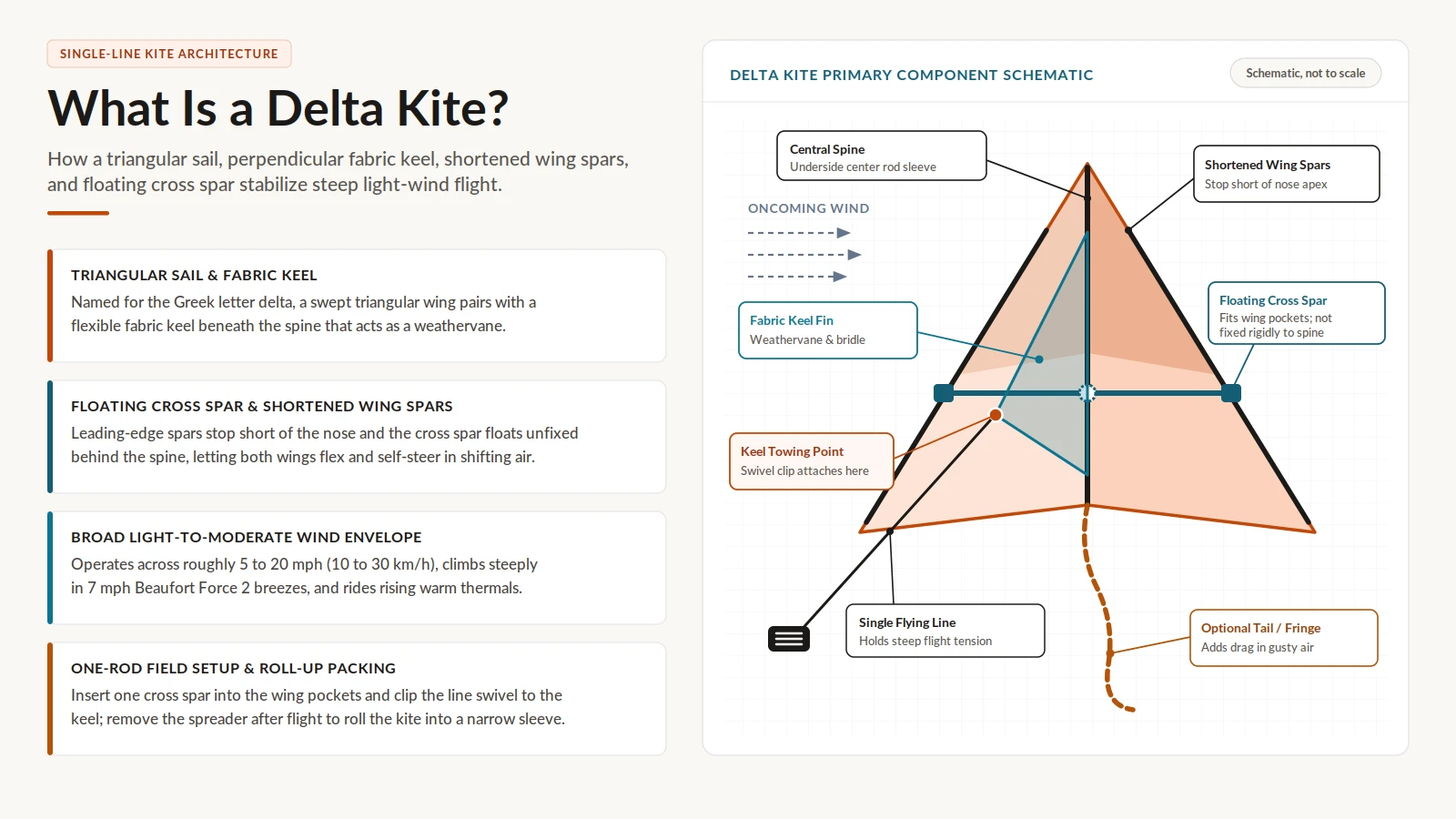
A delta kite is a triangular single-line kite named after the Greek letter delta, built around a swept sail, central spine, shortened lateral wing spars, a floating cross spar, and a perpendicular fabric keel. Because its semi-flexible frame spills gusts and self-centers automatically, a delta kite launches easily and climbs steeply across 5 to 20 mph winds.
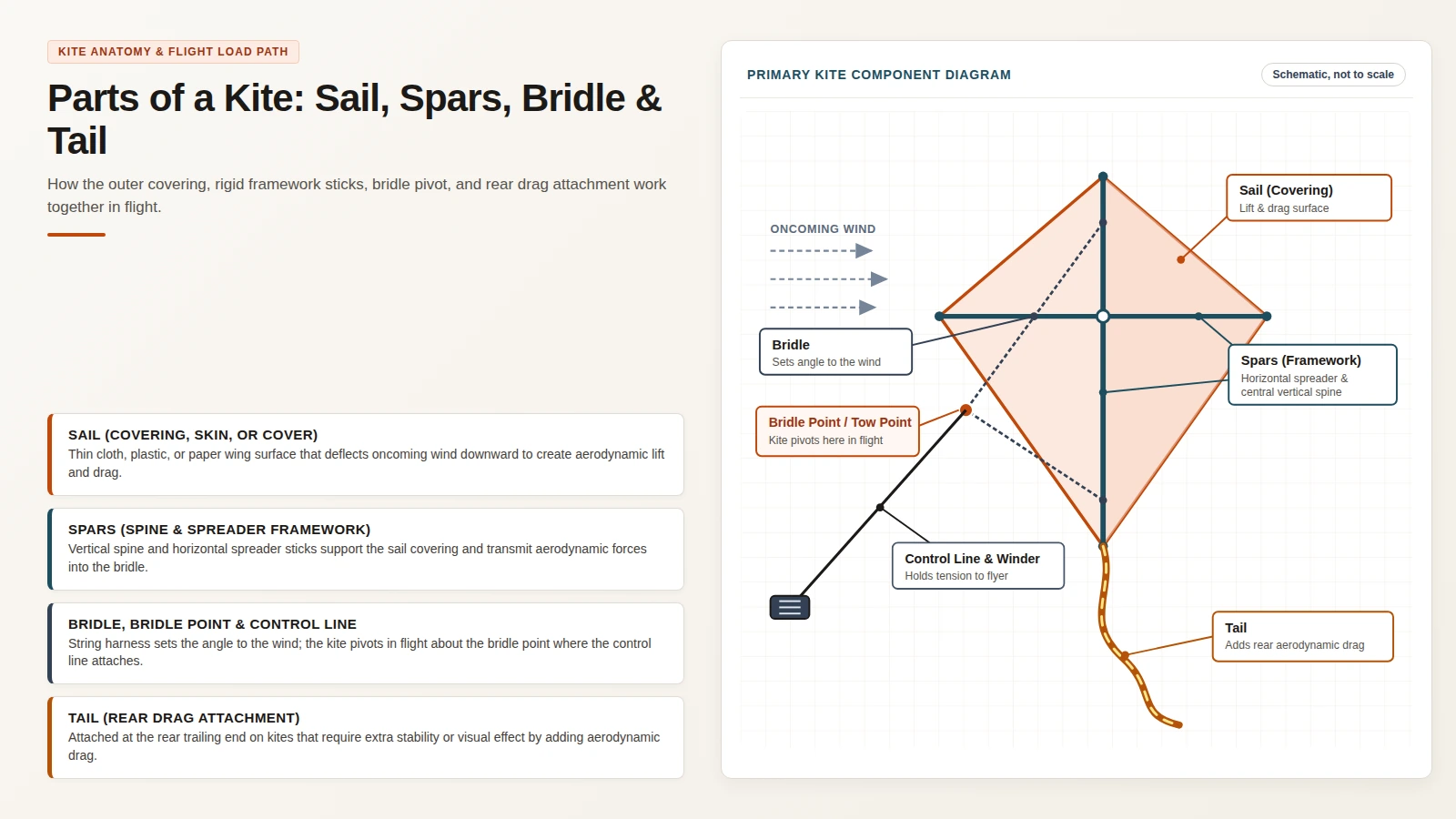
That structural simplicity separates single-line deltas from soft ram-air foils and rigid cellular boxes. If you want a side-by-side matrix across all five single-line families, read our delta, parafoil, and box kite comparison, or review general kite nomenclature in parts of a kite.
What does a delta kite diagram show about the keel and cross spar?
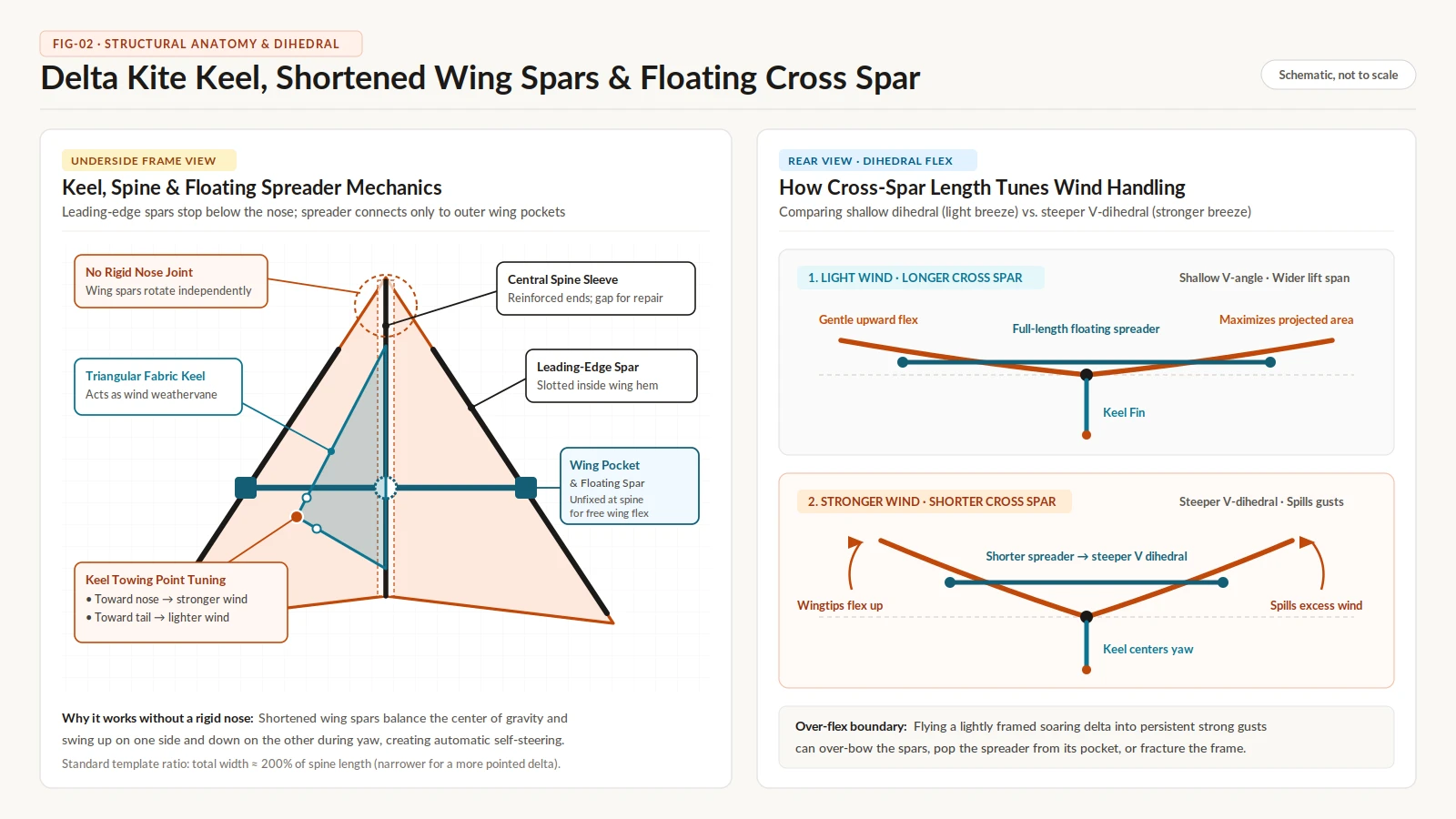
A delta kite diagram highlights two self-stabilizing features: a flexible triangular fabric keel along the bottom of the central spine, and a floating cross spar spanning between outer wing pockets without locking to the spine. Paired with shortened leading-edge spars, these elements let both wings flex and self-steer continuously in shifting wind.
How the floating cross spar and shortened wing spars self-steer
Unlike rigid framed aircraft wings, a single-line delta kite is deliberately semi-flexible. As KitePlans notes in its classic Delta design documentation, the cross spar (also called the spreader) connects to the outer edges of the wings but is not rigidly fixed to the central spine, allowing both wings to adapt freely to changing airflow.
Equally critical is the nose layout. Both KitePlans and kite maker Dan Leigh document that the lateral leading-edge wing spars stop short of the nose apex rather than meeting in a rigid nose fitting. Because there is no rigid joint at the nose, each wing spar can rotate independently: when the kite yaws about a vertical axis, inertia swings one wing spar upward and the other downward, creating a self-correcting steering action while balancing the center of gravity.
Why the fabric keel replaces a multi-leg string bridle
Beneath the central vertical spine, most delta kites attach a perpendicular triangular panel of sailcloth called the keel. The keel serves two simultaneous functions:
- Weathervane alignment: Acting like a vertical vane beneath the center line, the keel keeps the kite pointed steadily into the oncoming wind even when direction shifts.
- Built-in bridle and towing point: On many deltas, the keel itself acts as the bridle with a reinforced ring or grommet at the keel tip where the flying line clips on. Because a sewn keel point cannot slide like a knotted string harness, designers locate the towing point toward the tail for light-wind models or closer to the nose for stronger-wind builds, or punch multiple attachment holes for limited field tuning.
| Delta component | Structural placement | Aerodynamic function | Typical material or adjustment |
|---|---|---|---|
| Triangular sail | Stretched across spine and outer wing hems | Generates primary lift and responsive bird-like glide | Ripstop nylon on standard models; lightweight spinnaker fabric for light-wind builds |
| Central spine | Sewn underside sleeve running nose to tail | Carries longitudinal load and anchors the fabric keel | Fiberglass rod or tube, hardwood dowel, or carbon spar |
| Shortened wing spars | Slotted into outer leading-edge hems, stopping below the nose | Frame wing edges while rotating independently to self-steer | Fiberglass, wood, or carbon fiber tube; shorter than outer wing edge |
| Floating cross spar (spreader) | Inserted into left and right outer wing pockets behind the spine | Holds wing width open while letting wings flex into a V-dihedral | Shorter spar creates steeper V-dihedral for stronger breezes |
| Fabric keel fin | Perpendicular triangle sewn under the central spine | Acts as a wind vane and structural bridle towing point | Single grommet or multiple tow holes; forward for stronger wind, aft for light wind |
| Tail or trailing fringe | Attached to spine end, wingtips, or unrestrained trailing edge | Adds aft drag to damp yaw in choppy or variable breezes | Optional single center tail, paired wingtip tails, or sewn fabric fringe |
Why is a delta kite good for beginners and kids?
Delta kites are commonly recommended as general-purpose kites for beginners because they assemble quickly, lift reliably in gentle breezes, and recover smoothly from wind shifts without demanding active steering. Small to standard-sized deltas keep hand pull comfortable for children and casual flyers, while still climbing steeply overhead when heavier kites stay grounded.
Four practical traits explain why families and first-time flyers start with a delta rather than a flat diamond or rigid box:
- Forgiving launch in light air: Because the frame holds the triangular wing open before wind hits the sail, a gentle breeze is enough to lift a standard delta straight from your hand.
- Built-in gust forgiveness: Independent outer wing spars and a floating spreader allow the sail to flex upward and shed uneven puffs instead of spinning into the ground.
- Simple stabilizing options: Although well-proportioned deltas can fly tailless in steady air, many beginner models add a central tail, short wingtip tails, or an unrestrained trailing-edge fringe that functions as a row of short stabilizing tails rather than mere decoration.
- Easy carry and storage: Removing the single cross spar lets the entire kite roll into a compact, narrow bundle that slides into a protective sleeve.
Size still matters when buying for children. Small to standard-sized deltas suit novice flyers, whereas larger deltas around 6 feet (2 m) wide and above generate considerable pull in moderate to strong winds and are generally recommended for experienced flyers carrying long tails or line decorations. For broader age-and-type matching across all starter designs, see our guide to single line kite types, and check kite tail length and stability when flying in choppy inland parks.
Is 7 mph wind strong enough to fly a delta kite?
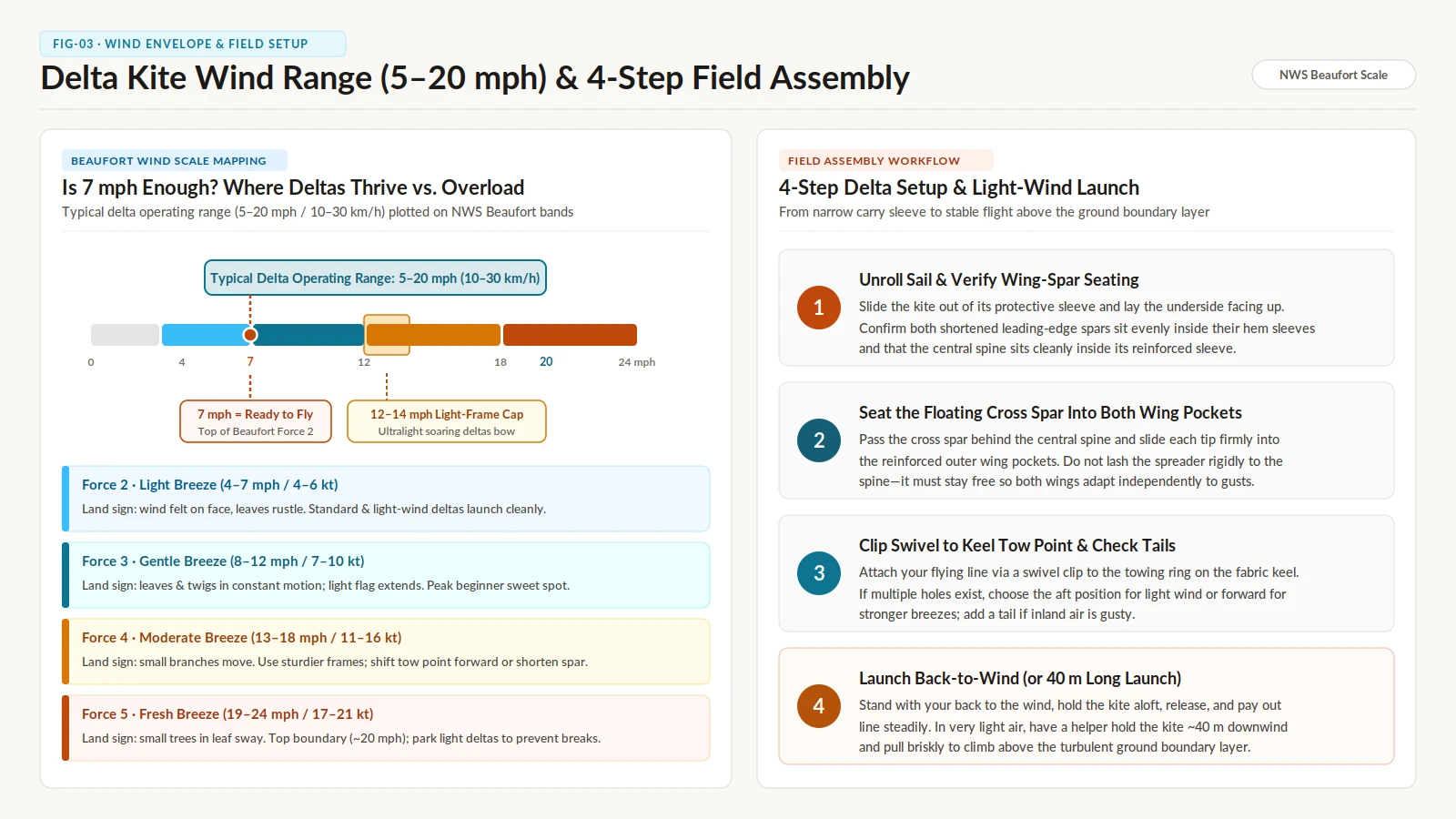
Yes, 7 mph wind is strong enough to fly a standard or light-wind delta kite cleanly. On the National Weather Service Beaufort Wind Scale, 7 mph sits at the top of Force 2 (Light Breeze, 4 to 7 mph), which falls comfortably inside the typical 5 to 20 mph (10 to 30 km/h) operating range of delta kites.
Visual cues on land help verify wind strength at the park without carrying a meter:
| NWS Beaufort Force | Wind speed (mph / knots) | Official land observation | Delta kite flight behavior and frame guidance |
|---|---|---|---|
| Force 2 (Light Breeze) | 4 to 7 mph (4 to 6 knots) | Wind felt on face; leaves rustle; ordinary vanes moved by wind | Standard and light-wind deltas launch and climb steadily; 7 mph is comfortably flyable |
| Force 3 (Gentle Breeze) | 8 to 12 mph (7 to 10 knots) | Leaves and small twigs in constant motion; wind extends light flag | Ideal all-around range for beginners; steady overhead hover with light-to-moderate tension |
| Force 4 (Moderate Breeze) | 13 to 18 mph (11 to 16 knots) | Raises dust and loose paper; small branches are moved | Lightly framed soaring deltas over-flex; use sturdier frames, shorter cross spar, or forward tow point |
| Force 5 (Fresh Breeze) | 19 to 24 mph (17 to 21 knots) | Small trees in leaf begin to sway; crested wavelets on inland waters | Reaches the upper 20 mph typical delta boundary; park light-wind deltas to prevent structural damage |
Climbing above the ground boundary layer and riding thermals
Surface breezes at grass level often feel weaker and choppier than the air just above the treetops. NASA Glenn Research Center’s kite flight guide explains that wind velocity near the earth’s surface is low and unsteady inside the atmospheric boundary layer, while velocity and lift normally increase and stabilize once the kite gains altitude.
In steady flight, NASA Glenn’s kite force model shows that vertical pull plus kite weight balances lift, while horizontal pull balances aerodynamic drag. Because a lightweight delta carries high lifting area for low frame drag, it climbs at an unusually steep angle and can even soar in rising warm thermal lift when surface breeze fades, letting skilled flyers gain height when heavier kite types descend.
Where light-wind deltas fail in strong gusts
Every delta kite has an upper wind boundary dictated by its spar stiffness and sail area. Wikipedia notes that delta kites can become unstable or sustain structural damage when flown outside their intended wind range, so light-wind designs belong in gentle breezes while stronger-built models handle moderate to strong winds.
Historical testing illustrates how quickly ultralight frames hit that wall. Dan Leigh’s archive quotes a Winter 1974 Kite Tales report describing how three lightly framed experimental soaring deltas were battered and bowed by incessant 12 to 14 mph winds. Pushing a light-wind delta into persistent strong gusts bends the floating spreader excessively, risks popping the spar tips out of their wing pockets, and can fracture thin spars or the spine. When wind moves into Force 4 or Force 5, match your frame stiffness carefully using our guide on ideal wind speed by kite frame.
How does delta kite assembly work at the field?
Assembling a delta kite takes moments because the spine and lateral wing spars stay inside their sewn hems during transport. Unroll the sail from its sleeve, insert the floating cross spar into both outer wing pockets behind the spine, clip your flying line swivel to the keel towing point, and launch back-to-wind.
Follow this repeatable field setup and pre-flight check before every launch:
- Unroll and check spar seating: Lay the kite underside up on open grass and confirm the central spine sits cleanly inside its reinforced underside sleeve while both shortened leading-edge spars sit evenly inside their outer wing hems. Many quality plans leave short sleeve gaps so damaged spars can be removed and replaced quickly; if a rod has cracked or slipped, inspect tolerances with our replacement kite spar fit checklist.
- Seat the floating cross spar in both wing pockets: Pass the horizontal spreader behind the central spine and slide each rounded tip completely into its reinforced left and right wing pocket. Avoid lashing or taping the cross spar tightly to the spine, because locking that crossing defeats the semi-flexible dihedral action.
- Attach the flying line via a swivel clip: Clip your line swivel directly to the reinforced towing ring on the fabric keel. If your keel includes multiple attachment holes, pick the position closer to the tail in light breezes or closer to the nose in brisk wind.
- Launch back-to-wind or run a long launch: Stand with your back to the wind, hold the kite aloft so airflow catches the sail, release, and pay out line steadily as it climbs. In very light breezes where ground-level air is sluggish, KitePlans recommends a long launch: ask a helper to hold the kite roughly forty metres downwind, pull line in briskly as they release to create relative airflow, and pay out line once the kite climbs above the boundary layer.
For more launch positioning drills and stall recovery in patchy park wind, follow our kite launch and wind window guide.
How do delta kite dimensions and wing angle change wind handling?
Delta kite dimensions, width-to-spine proportion, cross-spar length, and keel tow-point placement work together to determine lift, line pull, and gust tolerance. Wider, lighter spans maximize light-wind climb, while narrower proportions, shorter spreaders with steeper V-dihedral, and forward towing points trade low-end lift for stronger-wind stability.
Commercially manufactured deltas typically span from roughly 1 metre (3 feet) upward, with kite retailers reporting approximately 2 metres (6 feet) as the most commonly sold and widely used wingspan. In standard design templates such as DT Online’s construction layout, most dimensions derive as percentages of central spine length—for example, a 1200 mm spine paired with an initial total width of 200 percent of spine length (twice the spine), which builders can narrow to produce a more pointed wing.
Aerodynamic geometry explains why those proportions matter. NASA Glenn’s kite geometry definitions define aspect ratio as wingspan squared divided by frontal projected area, noting that higher-aspect-ratio wings achieve a higher lift-to-drag ratio and greater aerodynamic efficiency. Meanwhile, builders checking keel balance traditionally suspend the kite upside down from one finger on a temporary bridle until the tail hangs at an angle of 20 to 30 degrees to the floor before finalizing keel shape.
| Geometry or tuning variable | Common measurement or adjustment | Aerodynamic effect | Best flying role or wind band |
|---|---|---|---|
| Compact to standard wingspan | Roughly 1 metre (3 feet) to 2 metres (6 feet) | Moderate sail area and manageable line pull | General-purpose flying, beginners, and family outings |
| Large lifter wingspan | Around 6 feet (2 m) wide and above | High lift capacity paired with considerable pull in moderate to strong winds | Experienced flyers lifting multiple tails, windsocks, or line decorations |
| Width-to-spine proportion | Roughly 200 percent of spine length (twice a 1200 mm spine) | Higher aspect ratio raises lift-to-drag efficiency; narrowing makes a more pointed wing | Wide proportions for light thermal lift; narrower shapes for brisker wind |
| Cross-spar length | Shorter spreader vs. full-length spreader | Shorter cross spar lets wings fold into a steeper V-dihedral | Full-length for gentle breezes; shorter spreader for stronger, gustier air |
| Keel towing point | Shifted aft toward tail vs. forward toward nose | Alters trim angle of attack relative to center of pressure | Aft tow point for light winds; forward tow point for stronger winds |
| Bridle balance hang check | Tail hanging at 20 to 30 degrees to the floor when suspended upside down | Confirms practical angle-of-attack range during custom keel layout | Baseline verification when building or checking a custom delta keel |
Where did the delta kite come from, and how high can one fly?
Texas architect Wilbur E. Bill Green invented the delta kite in the mid-1940s after working out its keeled structure while sailing, building his first prototype in 1945 and earning a 1957 US patent. High-altitude efficiency remains its hallmark: a triangular-box delta holds the single-kite world altitude record of 16,009 feet (4,880 m).
Delta history is frequently confused with hang gliders, yet Dan Leigh’s historical archive and Wikipedia clarify a crucial mechanical divide. Francis Rogallo’s 1951 patent covered a flexible wing with no keel and no wing spars, whereas Bill Green’s Gayla keeled deltas entered production well before rigid frames were added to Rogallo parachutes—and a rigid Rogallo wing with spars locked at the nose cannot self-steer as a tailless single-line kite.
Key milestones shaped the modern ripstop delta:
- 1945 to 1957: Wilbur Green built his first prototype in 1945 after copying a keeled Chinese bird kite, refined the tailless keeled plastic Gayla design, and received the keeled-kite patent in 1957 before retiring and selling Gayla in 1961.
- 1963 to 1974: Al Hartig introduced his cloth Valkyrie delta in 1963 (with the name delta gaining wide adoption around 1966), and Bob Ingraham published his influential step-by-step construction guide in the Spring 1974 issue of Kite Tales, standardizing ripstop nylon soaring deltas.
- 23 September 2014 altitude record: A team led by Robert Moore flew a 129 square feet (12 square metres) Dunton-Taylor triangular-box delta measuring 9.2 feet (3 m) high by 19.6 feet (6 m) wide on 40,682 feet (12,400 m) of Dyneema line to a world-record altitude of 16,009 feet (4,880 m) above ground level in western New South Wales, Australia.
Field safety and legal altitude boundaries
Because delta kites climb steeply and reach impressive heights quickly, pick an open flying site well clear of overhead power lines, roads, railways, and airports, and do not fly during thunderstorms.
In the United States, federal aviation rules under 14 CFR § 101.1 apply Part 101 restrictions to any kite weighing more than 5 pounds flown on a rope or cable. Under 14 CFR § 101.13, covered moored kites may not be operated more than 500 feet above the surface of the earth, less than 500 feet from the base of any cloud, where ground visibility is less than three miles, or within five miles of an airport boundary. Check full altitude and airspace rules in our guide on how high you can fly a kite before flying large lifter deltas on long spools.
Frequently Asked Questions
What is a delta kite?
A delta kite is a single-line, triangular-winged kite named after the Greek letter delta. It combines a large triangular sail, a central spine, two shortened lateral wing spars, a floating cross spar fitted into outer wing pockets, and a perpendicular fabric keel underneath for stable, steep flight in light winds.
Is 7 mph wind strong enough to fly a delta kite?
Yes. Seven mph sits at the top of Beaufort Force 2 (Light Breeze, 4 to 7 mph on the National Weather Service Beaufort Wind Scale) and comfortably inside the typical 5 to 20 mph (10 to 30 km/h) delta kite operating range.
Why is the cross spar not attached to the spine on a delta kite?
Leaving the cross spar unfixed at the central spine keeps the delta kite semi-flexible so both wings can adapt freely to shifting air currents. Combined with shortened leading-edge spars that stop below the nose, this floating arrangement lets the wings flex upward into a stabilizing dihedral V-shape during gusts.
What size delta kite is best for beginners?
Small to standard-sized delta kites (roughly 1 metre or 3 feet up to about 2 metres or 6 feet in wingspan) are well suited to novice flyers because they assemble quickly and generate manageable pull. Larger variants around 6 feet (2 m) wide and above pull harder in moderate to strong winds and are better reserved for experienced flyers carrying tails or line decorations.
Does a delta kite need a tail to fly?
A well-balanced delta kite can fly without a tail in steady air because its fabric keel acts as a wind vane and its flexible wings self-correct. However, many commercial deltas include a center tail, short wingtip tails, or a trailing-edge fabric fringe to add stabilizing drag in variable or gusty breezes.
References & Sources
- Delta kite — history, keel and spar design, flight envelope, and altitude records — Wikipedia
- Kite Launch and Flight — lift, atmospheric boundary layer, and climbing physics — NASA Glenn Research Center
- Forces on a Kite — lift, weight, drag, bridle tension, and static equilibrium — NASA Glenn Research Center
- Kite Geometry Definitions — span, projected area, aspect ratio, and bridle point — NASA Glenn Research Center
- Beaufort Wind Scale — official mph, knot, and land observation bands — National Weather Service (NOAA)
- 14 CFR § 101.1 — Applicability for moored balloons and kites — Legal Information Institute, Cornell Law School (eCFR)
- 14 CFR § 101.13 — Operating limitations for moored balloons and kites — Legal Information Institute, Cornell Law School (eCFR)