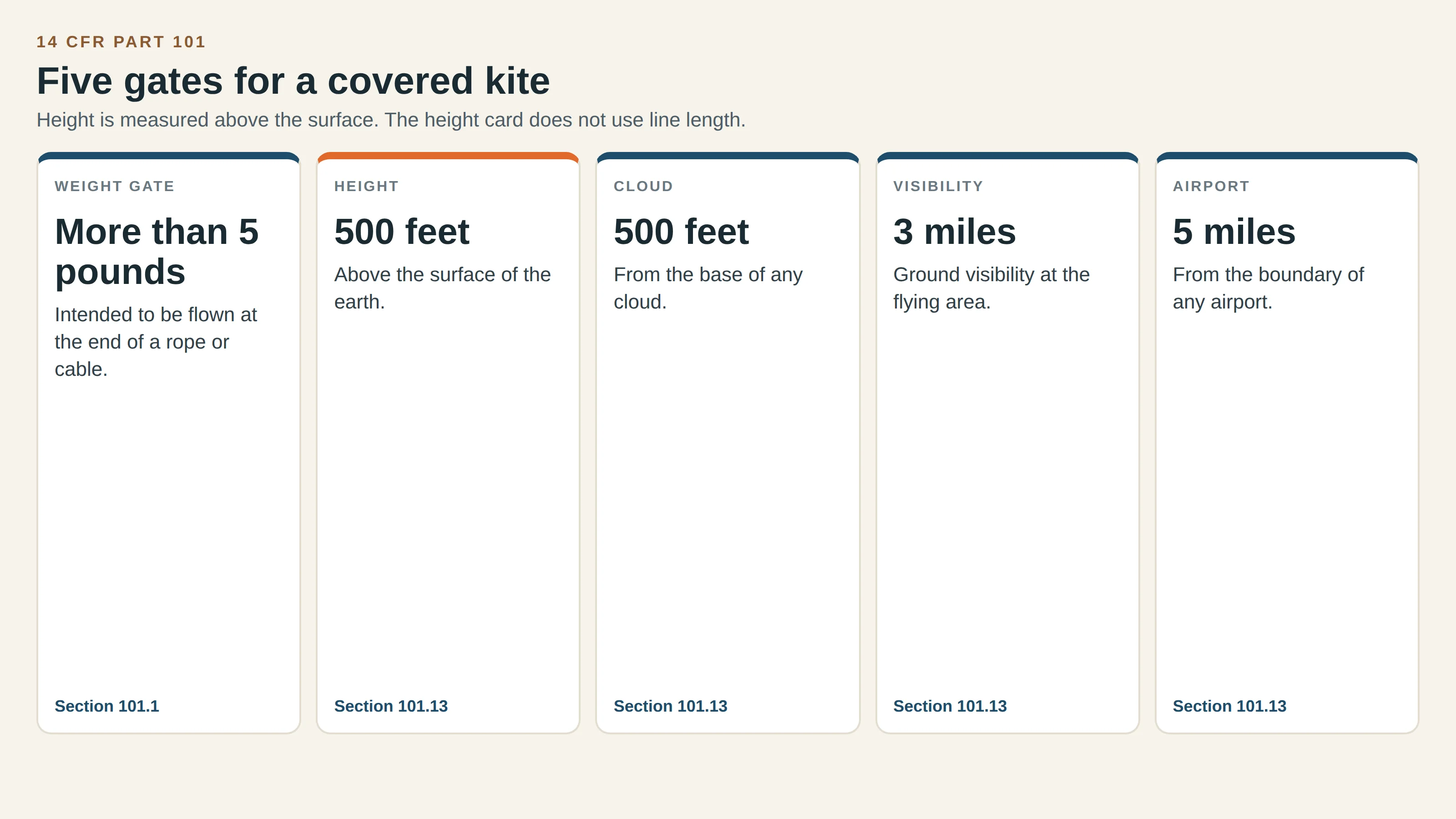
Except under section 101.7, 14 CFR 101.1 covers kites weighing more than 5 pounds on rope or cable. Section 101.13 bars flying them more than 500 feet above the surface, less than 500 feet from cloud base, under three miles of ground visibility, or within five miles of an airport boundary. Line length differs from height.
What height does US Part 101 actually limit?
Section 101.13(a) says that, except as paragraph (b) provides, no person may operate a moored balloon or kite more than 500 feet above the surface of the earth. That sentence is a height above the surface. It does not measure the line paid off the reel. Reel drag and spool fit stay on the kite reel drag and line size guide.
In the eCFR title 14 text (issue date 2026-11-10, marked up to date as of 2026-11-16 in the titles index), Subpart B carries the source line Docket 1580, 28 FR 6722, June 29, 1963, unless otherwise noted.
When notice is required, the flyer reports the height above the surface of the earth at which the kite is to be operated. That item is the same kind of height, not a length of rope.
Which kites does that part cover?
Section 101.1(a) prescribes rules governing the operation in the United States of the operations it lists. Except as provided for in section 101.7, the kite on that list weighs more than 5 pounds and is intended to be flown at the end of a rope or cable. A kite that weighs 5 pounds is outside that clause, and the 500-foot surface limit above belongs to the kite the part names.
Section 101.7(a) says no person may operate any moored balloon, kite, amateur rocket, or unmanned free balloon in a manner that creates a hazard to other persons, or their property. Section 101.7(b) says no person operating any of those may allow an object to be dropped from it if that action creates a hazard to other persons or their property.
For the purposes of this part, a gyroglider attached to a vehicle on the surface of the earth is considered to be a kite. The amendment citation on section 101.1 ends with amendment 101-10, 85 FR 79826, December 11, 2020.
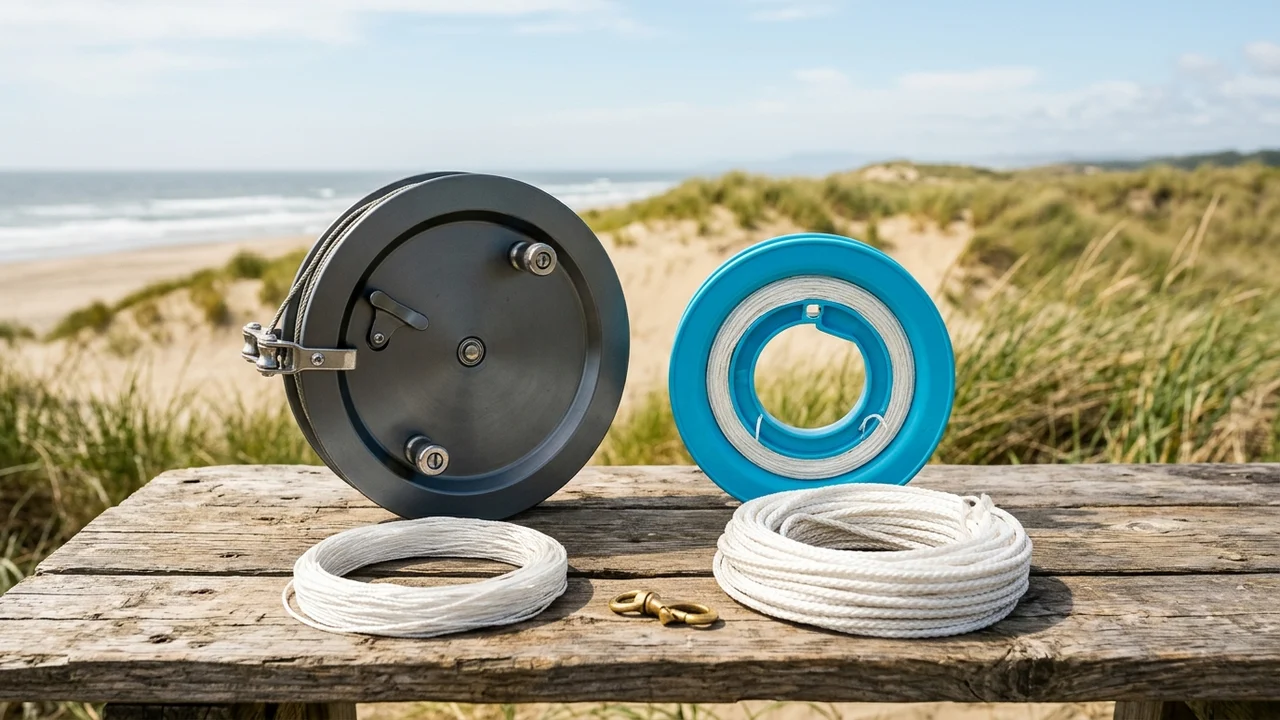
Line material, and the choice of a single line or a dual-line set, is a separate decision. See kite string materials.
What cloud, visibility, airport, and shield limits sit beside the height?
The same operating paragraph sets three limits next to height. No person may operate the kite less than 500 feet from the base of any cloud. No person may operate it from an area where the ground visibility is less than three miles. No person may operate it within five miles of the boundary of any airport.
Paragraph (b) is the shield. Paragraph (a) does not apply to the operation of a balloon or kite below the top of any structure and within 250 feet of it, if that shielded operation does not obscure any lighting on the structure. Those 250 feet are the distance from the structure.
When do notice, marking, and a waiver apply?
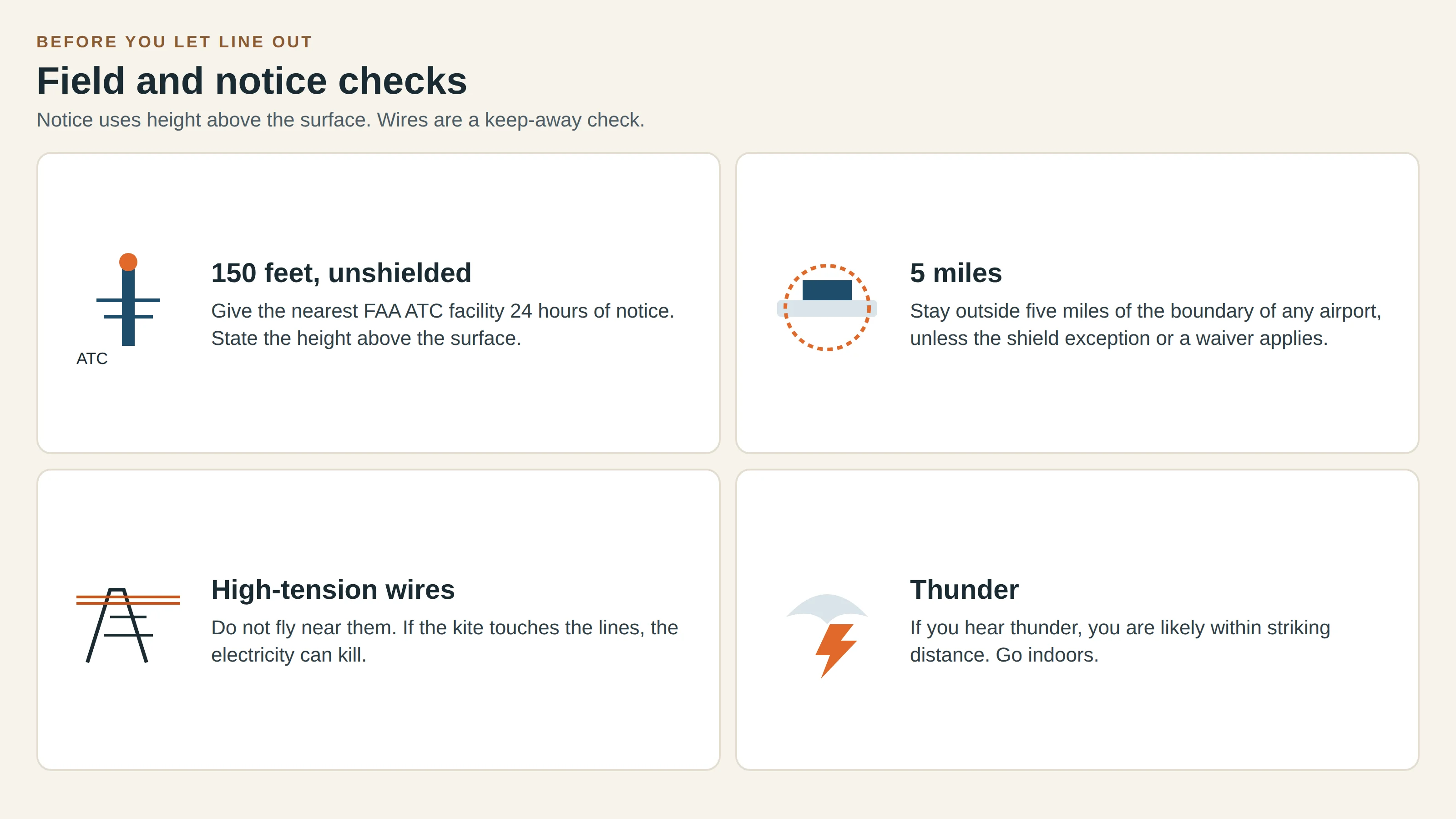
Under section 101.15, no person may operate an unshielded moored balloon or kite more than 150 feet above the surface of the earth unless, at least 24 hours before beginning the operation, he gives the listed information to the FAA ATC facility nearest the place of intended operation. The notice includes the size and weight of the kite, and the height above the surface at which the kite is to be operated.
Day and night marks are in section 101.17. No person may operate a moored balloon or kite between sunset and sunrise unless the kite and its mooring lines are lighted so as to give a visual warning equal to that required for obstructions to air navigation in the FAA publication Obstruction Marking and Lighting. Between sunrise and sunset, the mooring lines need colored pennants or streamers at not more than 50 foot intervals beginning at 150 feet above the surface of the earth and visible for at least one mile.
Under section 101.3, no person may conduct operations that require a deviation from this part except under a certificate of waiver issued by the Administrator.
Under section 101.5, no person may operate a kite in a prohibited or restricted area unless he has permission from the using or controlling agency, as appropriate. Section 101.11 says this subpart applies to moored balloons and kites, and that inside a restricted area the operator must comply only with section 101.19 and with additional limitations imposed by the using or controlling agency. Section 101.19 says no person may operate a moored balloon unless it has a device that will automatically and rapidly deflate the balloon if it escapes from its moorings. The permission rule is written for a prohibited or restricted area.
Why is the length of the line not the height?
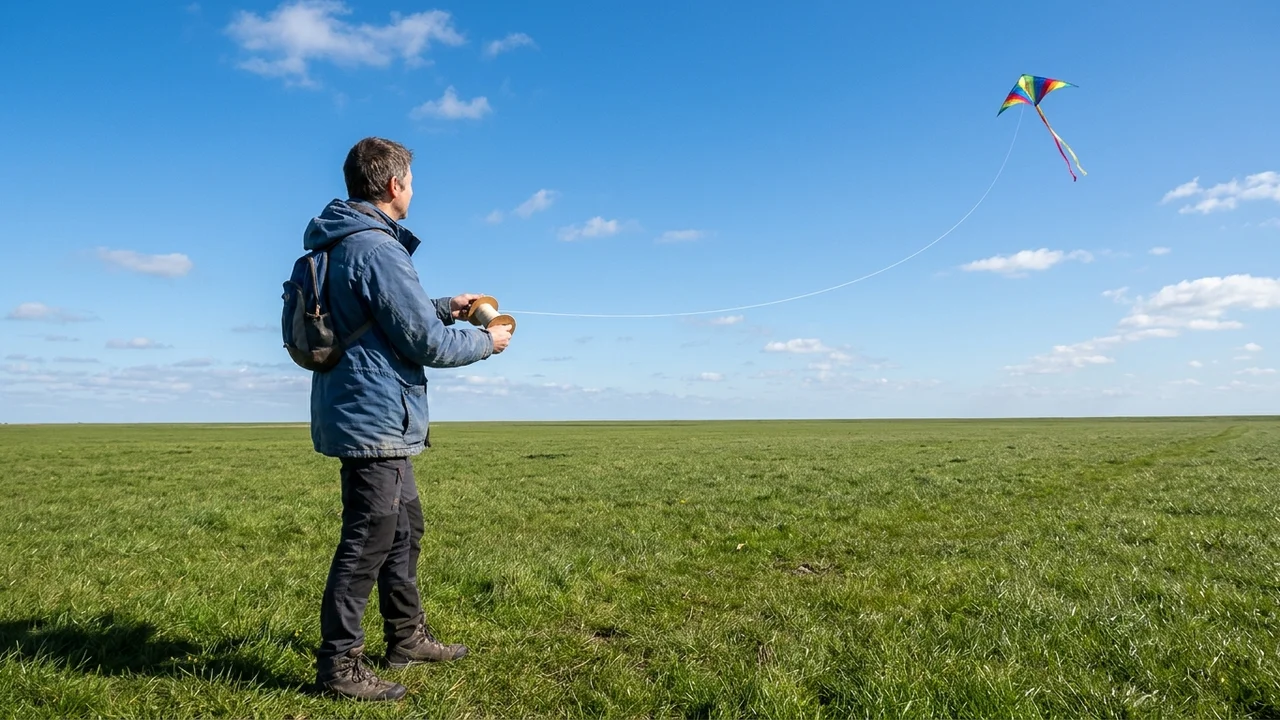
On the NASA Glenn control-line page, cruising flight shows a gentle curve from the hand of the flyer to the kite as the line sags under its own weight. Mathematical equations describe that sag and can be used to determine the altitude. The curve is a catenary, developed to describe cables hanging under their own weight:
Y = C2 + (D/p) * cosh [(p/D) * X + C1]
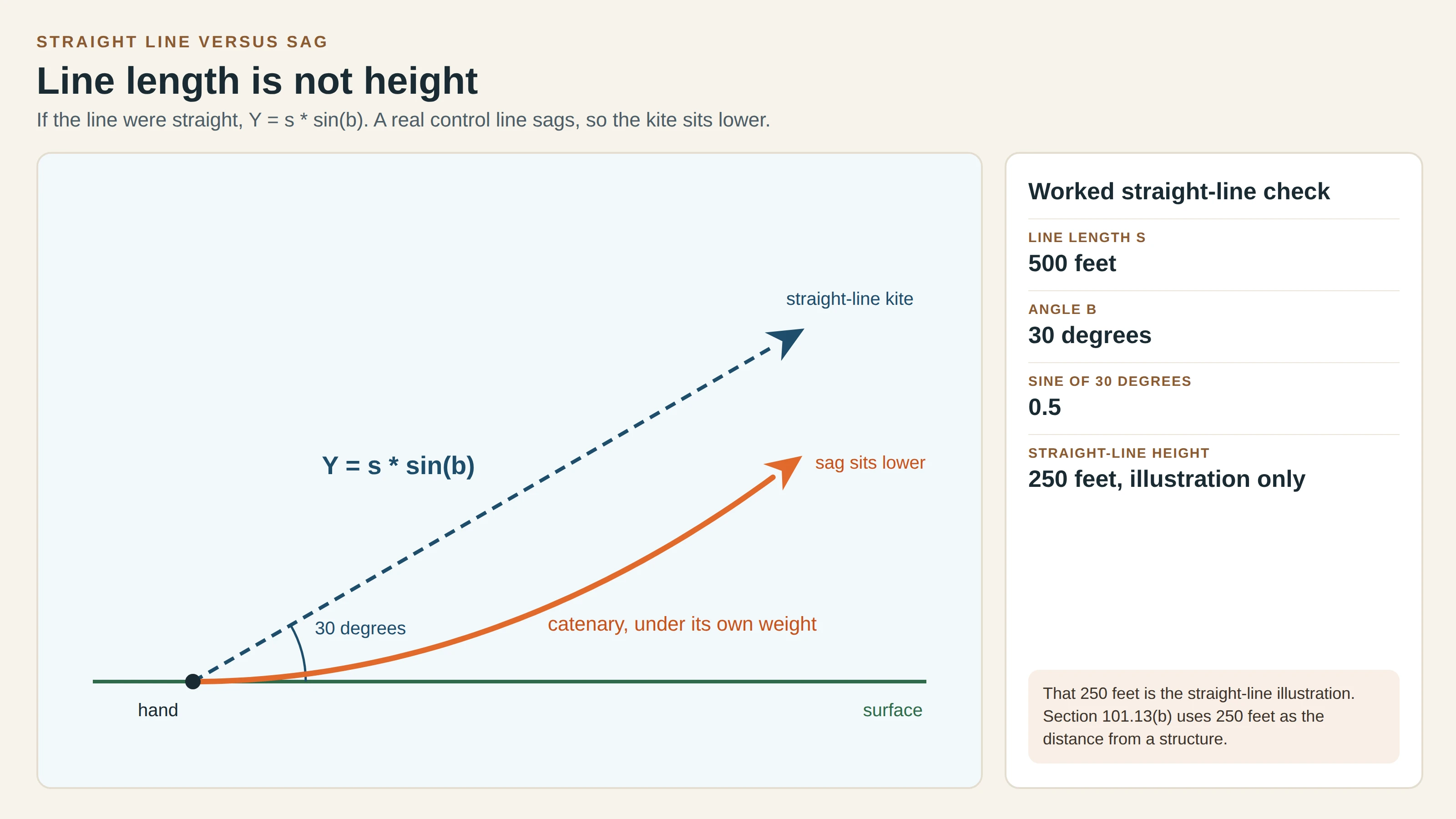
The shape of the line is not a straight line, so trigonometry cannot get the height for a given length of line. If the line were straight, Y = s * sin(b), where dY/dX = tan(b) = (L - W) / D, and a line of sight can use trigonometry because that sight line is straight. The control line remains the sagging curve.
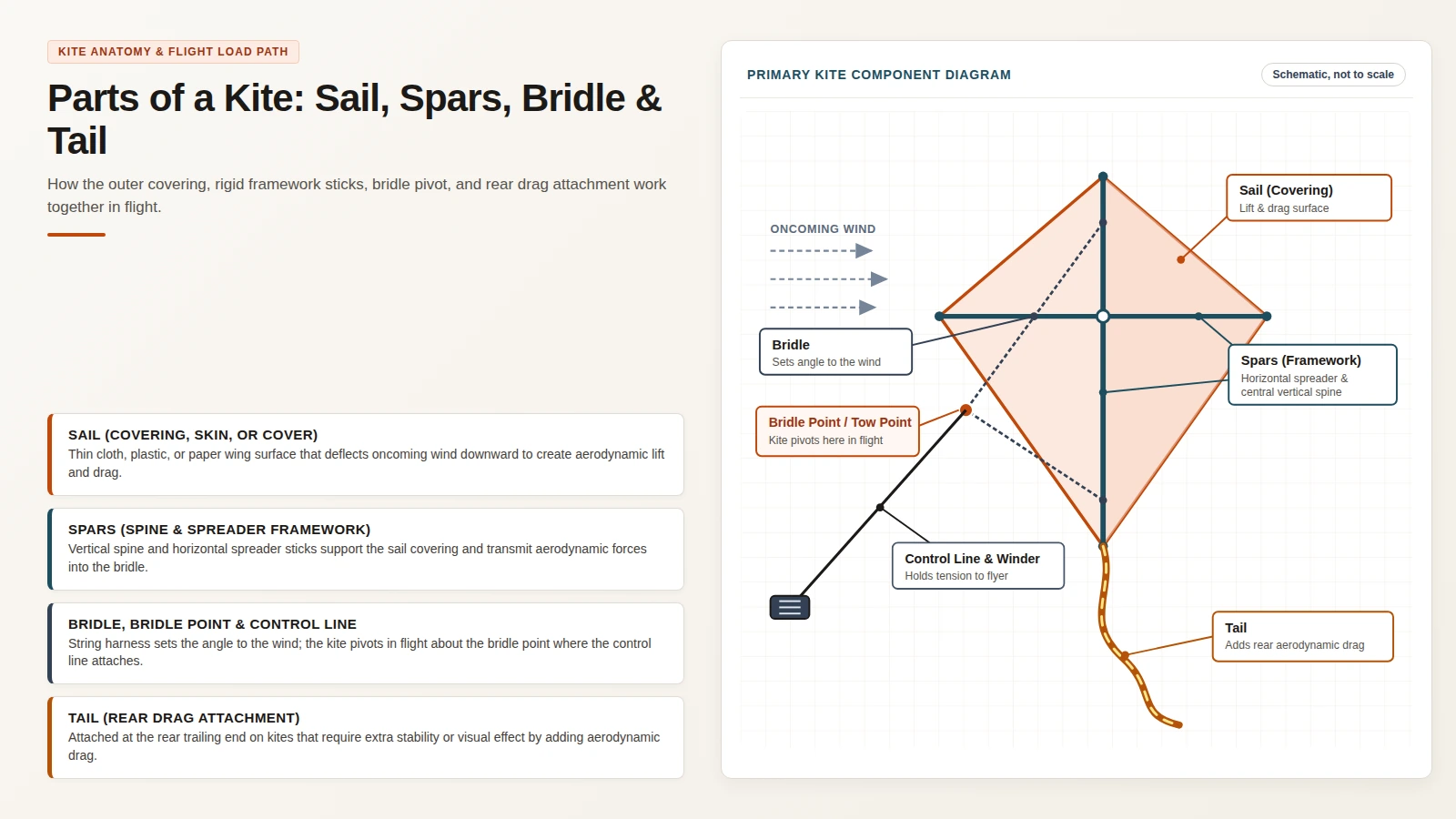
The forces on a kite page gives tan b = Pv / Ph. Knowing the bridle angle, the length of line, and the weight per length of line, you can predict the height at which the kite flies. Length is one of those three inputs.
On the sine and cosine table, at 30 degrees the exact sine is 1/2 and the decimal sine is 0.5. For a straight line only, take s as 500 feet and b as 30 degrees. Then Y = 500 * 0.5 = 250 feet. That 250 feet is a straight-line illustration. The line in flight sags, so the kite is lower than that straight line. The 250 feet in section 101.13(b) remains the shield distance from a structure.
Launch position and the wind window are on how to fly a kite.
How do the UK and Canadian rules differ?
In the United Kingdom, article 92 of the Air Navigation Order applies to kites. A relevant aircraft must not be operated so as to represent a hazard to other airspace users. Without the permission of the CAA, the tether, mooring or towing equipment, or the kite while being launched or ground towed, must not extend more than 60 metres above ground level. Within the aerodrome traffic zone of a notified aerodrome during its notified operating hours, operation is barred except during the day and in Visual Meteorological Conditions, and with the permission of the person in charge of the aerodrome, the appropriate air traffic control unit, or the CAA. A kite that is flown, launched, moored, tethered, or ground towed must be operated in accordance with any guidance the CAA issues for that operation.
A different sentence in the same article says a balloon in captive or tethered flight must not be flown within 60 metres of any vessel, vehicle, or structure except with permission. That sentence is about a balloon. The kite figure stays 60 metres above ground level.
Current Canadian Aviation Regulations section 602.45 says no person shall fly a kite into cloud or in a manner that is or is likely to be hazardous to aviation safety. The historical note on section 602.45 is SOR/2019-11, section 17. Section 602.41 is marked Repealed, SOR/2019-11, section 16. Keep the UK limit in metres and the US limit in feet.
What do you check before you let line out?
NASA kite safety says to fly in an open field or near the shore where there are no obstacles, and never near trees, a highway, houses, or high-tension wires. If the kite touches the lines you can be killed by the electricity. The National Weather Service says there is no safe place outside when thunderstorms are in the area. If you hear thunder, you are likely within striking distance of the storm. When thunder roars, go indoors.
More kite field guides are on the blog.
- Weigh the kite against more than 5 pounds before using the Part 101 limits.
- If the part applies, plan height above the surface, not line paid out, against 500 feet.
- Keep the kite at least 500 feet from the base of any cloud.
- Ground visibility not less than three miles.
- Not within five miles of an airport boundary unless the shield exception fits or a waiver covers the deviation.
- Unshielded above 150 feet: give the nearest FAA ATC facility 24 hours’ notice, and state height above the surface.
- Day pennants and night lighting when the part applies.
- In a prohibited or restricted area, get the using or controlling agency’s permission.
- Fly in an open field or near the shore where there are no obstacles, and never near trees, a highway, houses, or high-tension wires.
- If you hear thunder, go indoors.
Frequently Asked Questions
How high can you legally fly a kite in the United States?
For a kite that weighs more than 5 pounds and is flown at the end of a rope or cable, 14 CFR 101.13 says not more than 500 feet above the surface of the earth. That figure is a height. It is not the length of line on the reel.
Which kite weight brings the 500-foot limit into play?
Except as provided for in section 101.7, section 101.1(a)(2) covers any kite that weighs more than 5 pounds and is intended to be flown at the end of a rope or cable. A kite weighing exactly 5 pounds does not meet the more-than-5-pounds test. Section 101.7 separately states that no person may operate any moored balloon, kite, amateur rocket, or unmanned free balloon in a manner that creates a hazard to other persons or their property.
Can you fly a kite near an airport?
Section 101.13 says not within five miles of the boundary of any airport, except the shielded operation below the top of a structure and within 250 feet of it when that operation does not obscure the structure's lighting. A deviation from the part needs a certificate of waiver.
Can you fly a kite in a restricted area?
Section 101.5 requires permission from the using or controlling agency before a covered kite is operated in a prohibited or restricted area. Inside a restricted area, section 101.11 says to comply only with section 101.19 and with additional limitations imposed by the using or controlling agency. Section 101.19 is an automatic rapid-deflation rule written for a moored balloon.
Why is the length of the line not the height of the kite?
NASA Glenn says the control line sags and is not straight, so trigonometry on that length does not give the height. If the line were straight, the height would be line length times the sine of the angle. At 30 degrees that sine is 0.5, so 500 feet of line is a straight-line height of 250 feet, and sag leaves the kite lower. That 250 feet is not the structure distance in section 101.13(b).
How do UK and Canadian altitude rules differ from the US rule?
The UK order says that, without CAA permission, the tether, or the kite while being launched or ground towed, must not extend more than 60 metres above ground level. Current Canadian section 602.45 states that no person shall fly a kite into cloud or in a manner that is or is likely to be hazardous to aviation safety, with no foot or metre figure in that section. Section 602.41 is marked Repealed. Keep each limit in the unit its statute uses.
References & Sources
- 14 CFR 101.1 Applicability — eCFR
- 14 CFR 101.3 Waivers — eCFR
- 14 CFR 101.5 Operations in prohibited or restricted areas — eCFR
- 14 CFR 101.7 Hazardous operations — eCFR
- 14 CFR 101.11 Applicability of moored balloons and kites — eCFR
- 14 CFR 101.13 Operating limitations — eCFR
- 14 CFR 101.15 Notice requirements — eCFR
- 14 CFR 101.17 Lighting and marking requirements — eCFR
- Kite Safety — NASA Glenn Research Center
- Control Line Equations — NASA Glenn Research Center
- Forces on a Kite — NASA Glenn Research Center
- The Air Navigation Order, article 92 — legislation.gov.uk
- Canadian Aviation Regulations, section 602.45 — Justice Laws
- Sine and cosine — Wikipedia
- Lightning Safety — National Weather Service