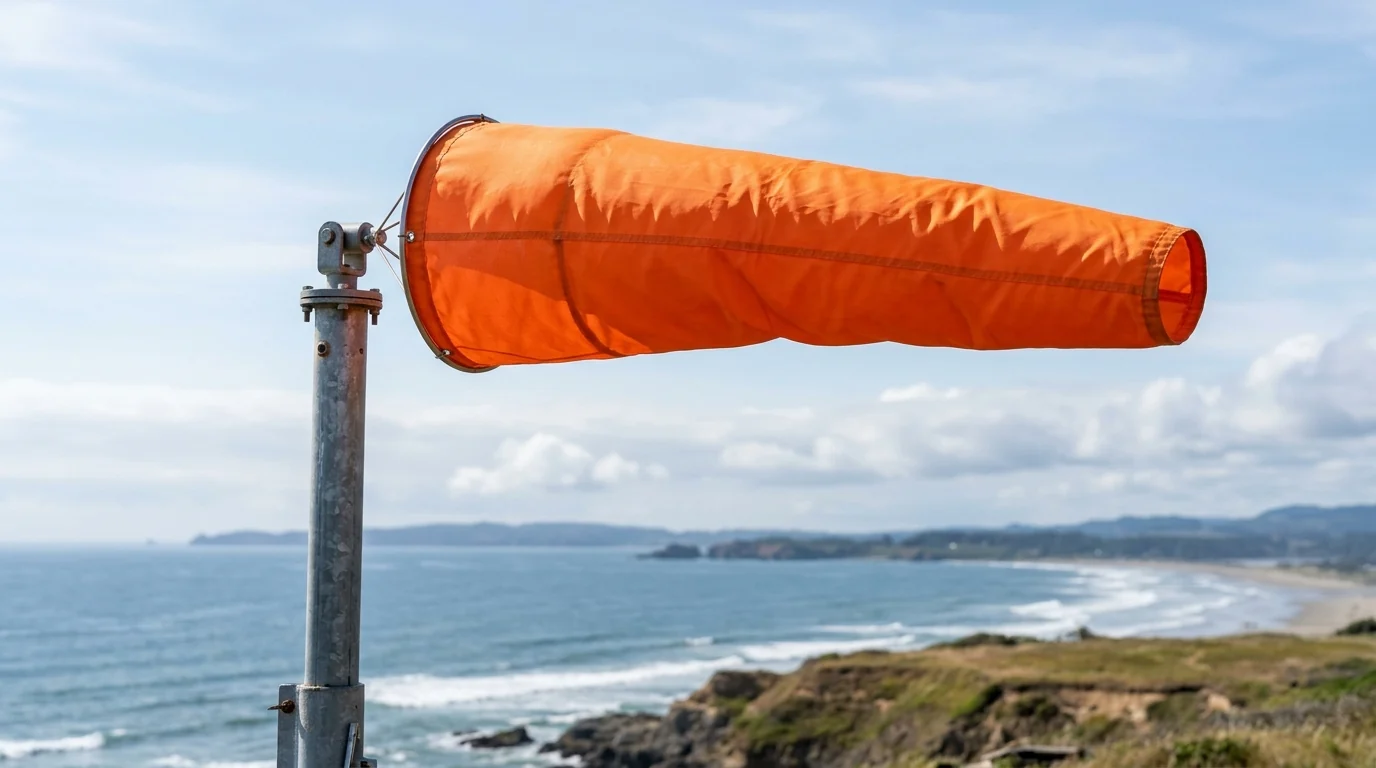
Checking a windsock by length alone can lead to the wrong choice between a calibrated wind cone and a decorative hanger or miss hardware wear before damage starts. Use the published specifications and inspection record below to compare throat-to-length geometry, coated fabric weight and air permeability, and swivel rotation.
In the FAA Aeronautical Information Manual wind direction indicator guidance, a wind cone, wind sock, or wind tee is installed near the operational runway to indicate wind direction. In that FAA guidance, the large end of the wind cone or wind sock points into the wind, just as the large end (cross bar) of the wind tee points into the wind. The FAA specification for wind cone assemblies covers fabric windsocks and their supporting structures used at airports and heliports to indicate surface wind conditions. Compare the documented throat diameters, fabric weights, and swivel hardware below before selecting or servicing a windsock.
| Windsock category or named model | Documented mouth and length specification |
|---|---|
| FAA Size 1 airport wind cone | Size 1 fabric windsock minimum effective length is eight feet (2.5 m). |
| FAA Size 1 throat opening | Size 1 fabric windsock throat end opening diameter is 18 inches (0.45 m). |
| FAA Size 2 airport wind cone | Size 2 fabric windsock minimum effective length is twelve feet (3.75 m). |
| FAA Size 2 throat opening | Size 2 fabric windsock throat end opening diameter is 36 inches (0.9 m). |
| Into The Wind Airport Windsock material | On the Into The Wind Airport Windsock product page, the windsock is made of ripstop polyester. |
| Into The Wind Airport Windsock length | On the Into The Wind Airport Windsock product page, the windsock measures 39“ long. |
| Into The Wind Airport Windsock mouth width | On the Into The Wind Airport Windsock product page, the windsock measures 9“ across at mouth. |
| Into The Wind Airport Windsock wind limit | On the Into The Wind Airport Windsock product page, the windsock is recommended for windspeeds up to 15mph. |
| Into The Wind Stars and Stripes Windsock diameter | On the Into The Wind Stars and Stripes Patriotic USA Windsock product page, the windsock measures 7“ in diameter. |
| Into The Wind Stars and Stripes Windsock length and fabric | On the Into The Wind Stars and Stripes Patriotic USA Windsock product page, the windsock is 40“ long and built with tough, UV resistant fabric. |
How Windsock Mouth Diameter, Cone Taper, and Framework Govern Extension
A windsock expands when air enters the throat hoop faster than it escapes through the cloth and trailing opening. Comparing calibrated aviation wind cones with recreational windsocks clarifies why uncalibrated garden sleeves cannot be read as wind-speed instruments.
In the FAA specification for wind cone assemblies, the environmental wind speed requirement for the assembly is up to 75 knots (140 km/hr or 86 mph). Under that FAA fabrication specification, the fabric windsock must be made so it takes the shape of a truncated cone (a cone with the tip sliced off) when it is filled with air. In the same FAA specification, the taper of the fabric windsock from the throat to the trailing end is designed to cause the windsock to fully extend when exposed to a wind of 15 knots (28 km/hr or 17 mph).
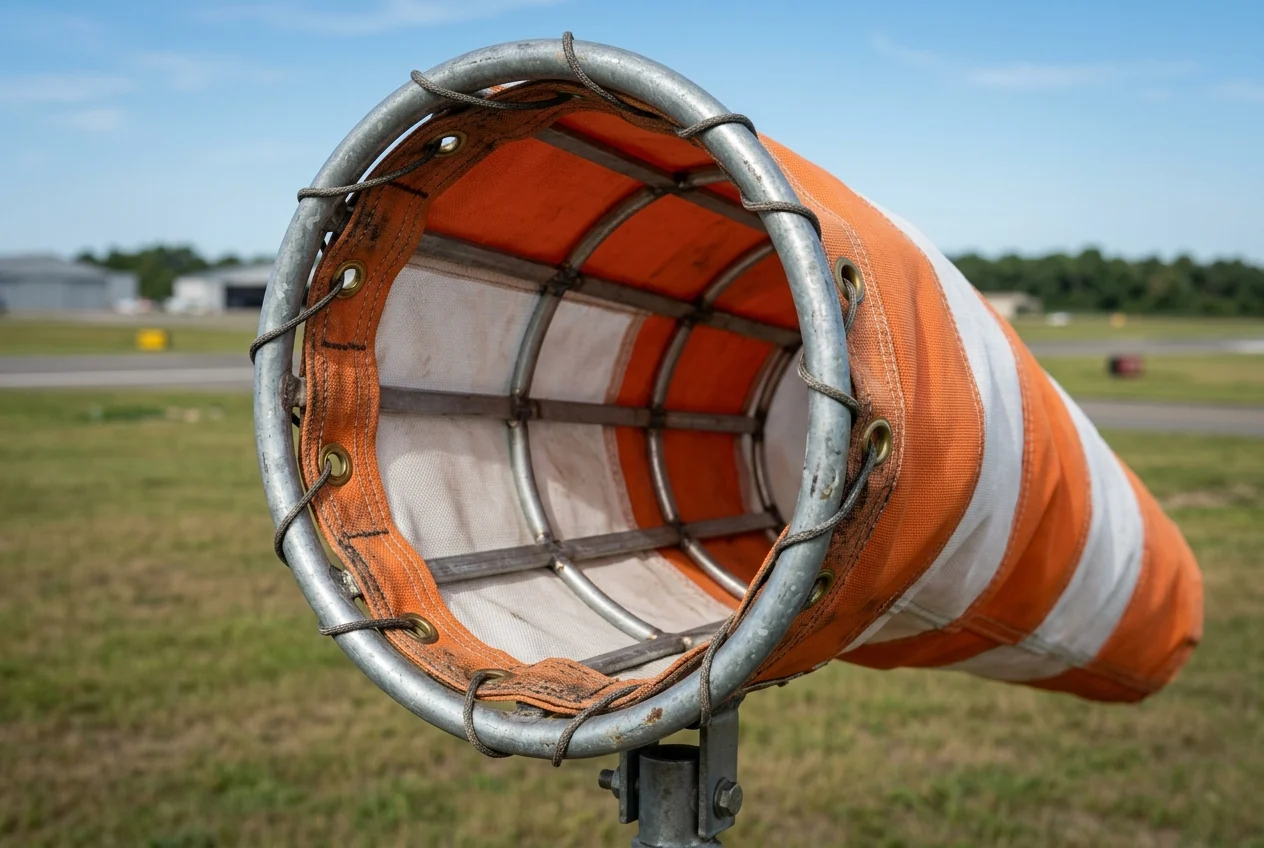
The throat support structure determines how the mouth presents itself in calm air and rain:
-
In the FAA wind cone assembly specification, a framework must be provided to hold the throat of the fabric windsock fully open under no wind conditions and to provide an interface with the support.
-
Under that FAA framework specification, the framework will be constructed to deter the accumulation of water in the windsock and support the fabric windsock in a rigid position for three-eighths of its length.
-
Under the FAA fabrication specification, the fabric windsock must be reinforced at all points that are subject to abrasion by flexing against the metal framework.
-
In the same FAA fabrication specification, the fabric windsock must be designed to allow removal and replacement without the use of special tools or stitching.
-
The FAA fabrication specification also states that the fabric windsock must be constructed to allow water drainage out of the area of the basket assembly.
-
In the FAA qualification pull test for windsock cone attachment to the metal framework, tension applied to the free end of the wind cone is 45 pounds (200 N) for Size 1.
-
In the same FAA qualification pull test for windsock cone attachment to the metal framework, tension applied to the free end of the wind cone is 100 pounds (450 N) for Size 2.
-
On the Into The Wind Peace Love and Happiness Windsock product page, the windsock is made of weather and fade-resistant polyester fabric, with a polycarbonate plastic hoop that maintains windsock shape.
-
On the Into The Wind Rainbow Lattice Windsock product page, the windsock is made with UV-resistant SunTex nylon, with an all-applique design and hemmed tails for extra durability.
Takeaway: Treat throat diameter, cone taper, and internal basket support as an integrated system; only a wind cone whose taper is designed to fully extend at a stated wind (FAA: 15 knots) is an aviation extension specification — not a recreational sleeve.
Windsock Fabric Weight, Air Permeability, and UV Resistance
A windsock sleeve must stay light enough to lift in gentle air while remaining low enough in porosity to hold internal pressure and tough enough to survive constant flapping and sunlight. For a broader look at how kite builders compare sailcloths, see our guide to ripstop nylon and polyester kite fabrics.
In the ASTM standard test methods for fabric mass per unit area, these test methods cover the measurement of fabric mass per unit area, traditionally referred to as fabric weight, and are applicable to most fabrics. In the ASTM standard test method for air permeability of textile fabrics, this test method covers the measurement of the air permeability of textile fabrics. Under that ASTM air permeability scope, the fabrics may be untreated, heavily sized, coated, resin-treated, or otherwise treated. The ASTM air permeability significance statement notes that hot calendaring can be used to flatten fabric components, thus reducing air permeability. Conversely, the same ASTM significance statement notes that yarn extension in woven fabric would open up the fabric, increase the free area, and increase the air permeability.
In G. William Tyrrell Jr.’s Mastering Nylon reference, urethane or acrylic is rolled into the cloth’s grain under high pressure and some heat, giving the fabric slickness and low porosity which to various degrees make the cloth water- and windproof. In the same Mastering Nylon reference, wind, weather, and wear-and-tear on a kite you fly a lot eventually break down the crispness of the coating and soften the fabric.
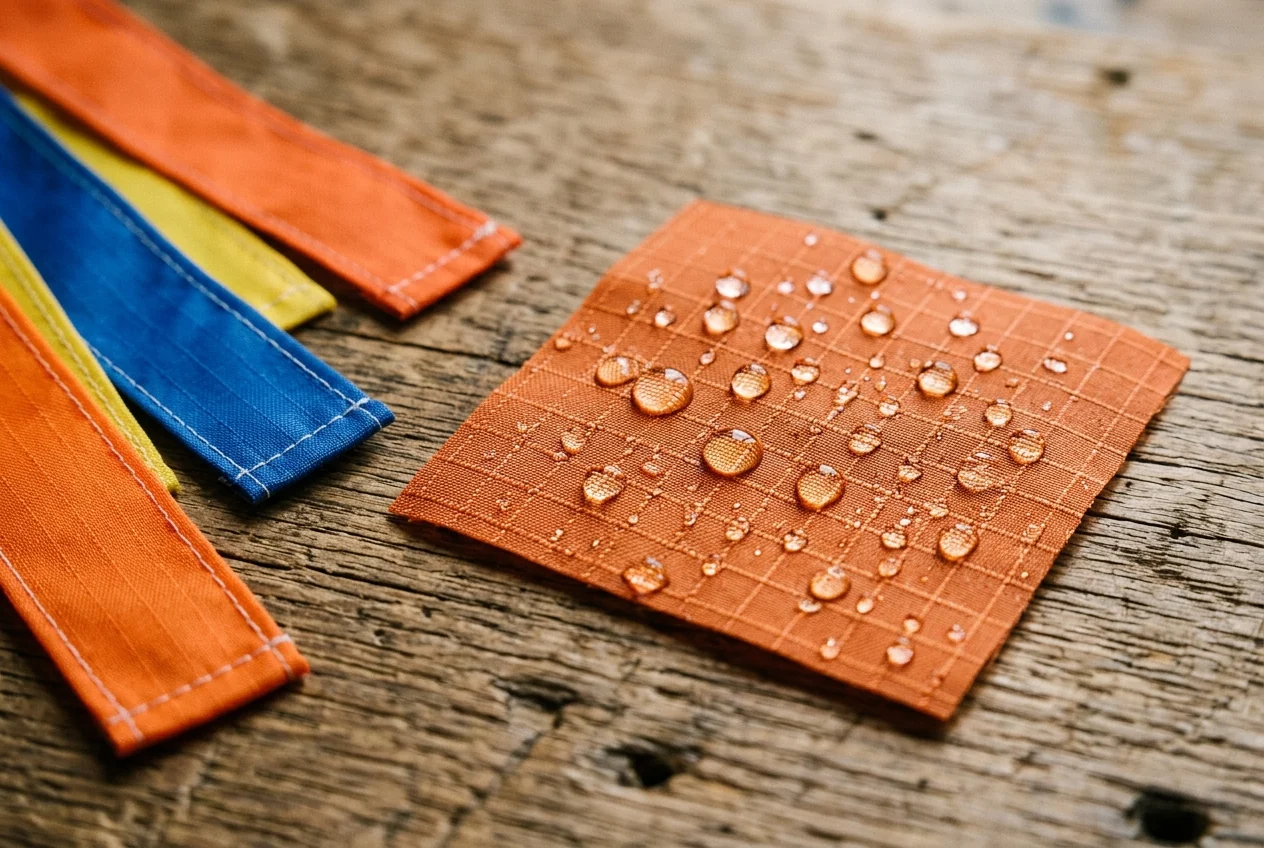
Aviation wind cone specifications and specialty kite/banner fabric distributors publish distinct mechanical and weathering benchmarks:
- Under the FAA wind cone fabric specification, fabric for the windsock may be made of cotton, a synthetic material, or a blend of the two, and may be coated.
- Under the FAA wind cone fabric specification, the fabric must be water repellent.
- Under the FAA wind cone fabric specification, the color of the windsock fabric may be natural (white), yellow, or orange as specified by the purchaser, and no lettering or logos are allowed on the windsock.
- In the FAA wind cone fabric specification, the minimum breaking strength requirement in the warp direction is 150 pounds (667 N), determinable by Method 5102 of FED-STD-191A.
- In the FAA wind cone fabric specification, the minimum breaking strength requirement in the filling direction is 150 pounds (667 N), determinable by Method 5102 of FED-STD-191A.
- In the FAA wind cone fabric specification, the colorfastness requirement is a Good or Excellent rating as determined by Method 5671 of FED-STD-191A.
For lighter ripstop cloths and heavier banner nylons sold by kitemaking suppliers, the table below lists the published figures for each named material.
| Material and property | Published specification |
|---|---|
| Icarex PC-31 coating and weight label | Known as PC-31 (Polycarbonate 31g/yd²), Icarex fabric has a polyurethane (PU) coating on both sides that ensures exceptional airtightness. |
| Icarex reinforcement grid | On Top Fabrics’ Icarex specification sheet, the fabric features double-yarn reinforcement woven at 10mm intervals in both the warp and fill directions. |
| Icarex areal weight | On Top Fabrics’ Icarex specification sheet, Weight is 37 (g / m2). |
| Icarex tearing strength | On Top Fabrics’ Icarex specification sheet, Tearing strength is Warp 1.2 / Fill 1.2 kg. |
| Icarex warp breaking strength | On Top Fabrics’ Icarex specification sheet, Breaking strength in Warp is 28 (kg / 5cm). |
| Icarex fill breaking strength | On Top Fabrics’ Icarex specification sheet, Breaking strength in Fill is 31 (kg / 5cm). |
| Icarex warp breaking elongation | On Top Fabrics’ Icarex specification sheet, Breaking elongation in Warp is 12 (% / 5cm). |
| Icarex fill breaking elongation | On Top Fabrics’ Icarex specification sheet, Breaking elongation in Fill is 18 (% / 5cm). |
| Icarex air permeability | On Top Fabrics’ Icarex specification sheet, Air Permeability is 0.02 (cc / cm2 / sec). |
| Icarex UV resistance statement | On Top Fabrics’ Icarex specification sheet, Icarex has excellent UV resistance due to being polyester, keeping its original color intensity better than nylon. |
| Chikara nylon yarn type | On Top Fabrics’ Chikara specification sheet, Type of nylon is 30Denier Nylon 6.6. |
| Chikara coating | On Top Fabrics’ Chikara specification sheet, Coating is Double sided Polyurethane / Double sided WR. |
| Chikara areal weight | On Top Fabrics’ Chikara specification sheet, Weight is 41 (g / m2). |
| Chikara tearing strength | On Top Fabrics’ Chikara specification sheet, Tearing strength is Warp 5.0 / Fill 5.0 kg. |
| Chikara warp breaking strength | On Top Fabrics’ Chikara specification sheet, Breaking strength in Warp is 40 (kg / 5cm). |
| Chikara fill breaking strength | On Top Fabrics’ Chikara specification sheet, Breaking strength in Fill is 36.1 (kg / 5cm). |
| Chikara warp breaking elongation | On Top Fabrics’ Chikara specification sheet, Breaking elongation in Warp is 49.3 (% / 5cm). |
| Chikara fill breaking elongation | On Top Fabrics’ Chikara specification sheet, Breaking elongation in Fill is 51.2 (% / 5cm). |
| Chikara air permeability | On Top Fabrics’ Chikara specification sheet, Air Permeability is 0.03 (cc / cm2 / sec). |
| Nylon UV degradation note | On Top Fabrics’ Chikara specification sheet, many nylon fabrics are attacked by ultraviolet radiation and may crack or disintegrate if they are not UV-stable. |
| Mastering Nylon sunlight wear note | In G. William Tyrrell Jr.’s Mastering Nylon reference, wear on nylon includes degradation of colors and cracking caused by sunlight after many hours of flight. |
| Bainbridge heavier ripstop nylon | On Fly Market Kitemaking Supply’s Bainbridge ripstop nylon page, this heavier fabric holds dye better than .75 ounce ripstop and is described as great for flappy things like banners, windsocks, and spinners. |
| Bainbridge banner nylon edge finishing | On Fly Market Kitemaking Supply’s Bainbridge banner nylon page, for banners and flags, this is the heavier weight, UV resistant fabric whose edges must be hot cut or hemmed because unsealed edges will fray. |
| Bainbridge banner nylon width | On Fly Market Kitemaking Supply’s Bainbridge banner nylon page, Width is 60“ wide. |
| Bainbridge banner nylon weight | On Fly Market Kitemaking Supply’s Bainbridge banner nylon page, Weight is 3.1oz/square yard. |
If a windsock or kite sail develops a small puncture or slit away from the hardware collar, use our step-by-step guide on how to repair a kite sail tear rather than flying a torn panel in gusty wind.
Takeaway: Check whether your windsock uses polyester or UV-stabilized nylon, verify that its water-repellent coating has not lost crispness and softened, and confirm that all trailing edges are hot cut or hemmed.
Windsock Care: Swivel Rotation, Throat Abrasion, and Washing
A windsock needs a free-turning pivot or hanging swivel so it can align with wind shifts.
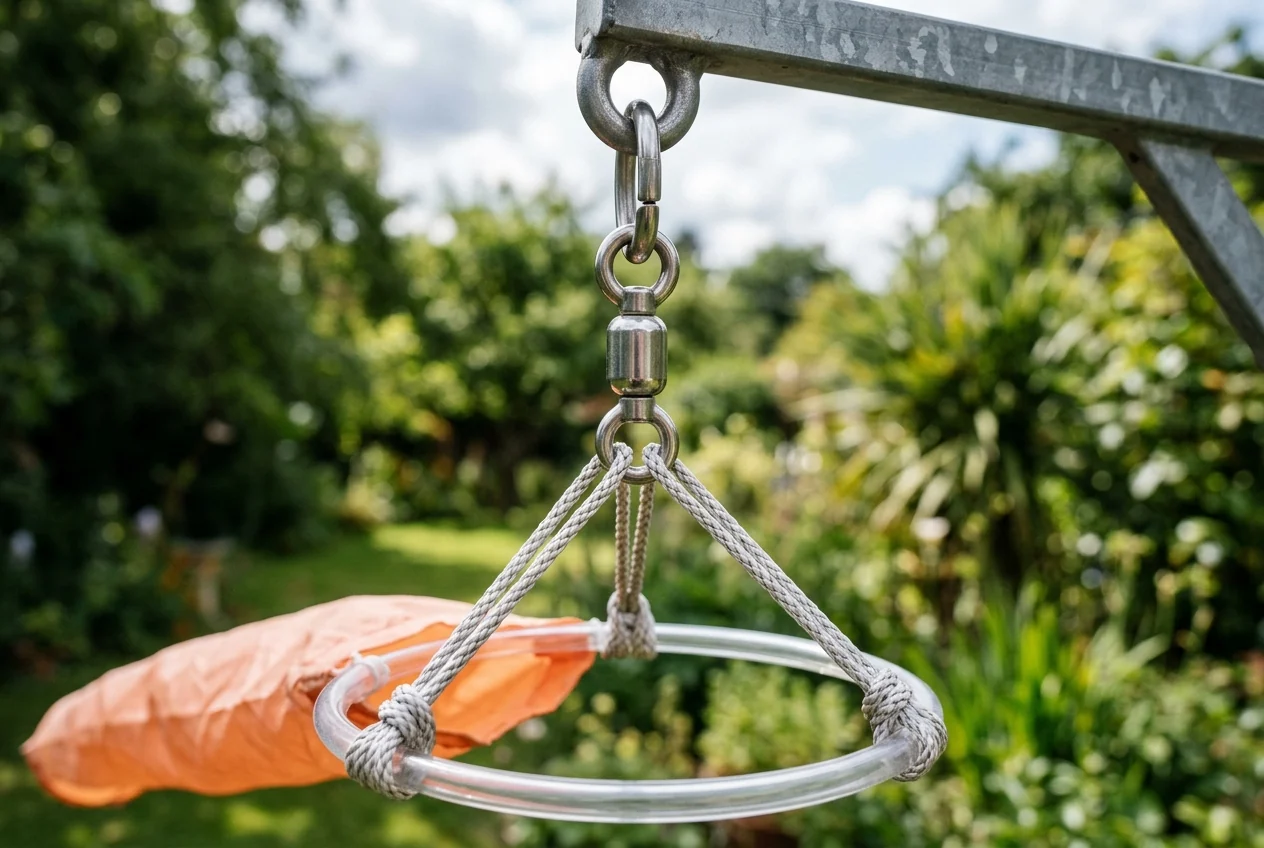
Compare the rotation hardware and care requirements across rigid-framework wind cones and hanging decorative windsocks:
- Vertical-shaft wind cone pivots: In the FAA wind cone assembly specification, the windsock must move freely about the vertical shaft it is attached to when subjected to wind of 3 knots (5.6 km/hr or 3.5 mph) or more and indicate the true wind direction within ±5 degrees. In the same FAA framework specification, bearings, bushings, or like devices will be either permanently lubricated or provided with fittings to allow periodic lubrication.
- String bridles and snap swivels on hanging windsocks: On the Into The Wind Peace Love and Happiness Windsock product page, the windsock features eight color-coordinated tails with sewn edges for lasting durability and includes a string bridle with attached snap swivel for easy hanging. On Fly Market Kitemaking Supply’s Windsock swivels page, double-ended swivels are sold for windsocks and tails.
- Washing and line drying ripstop nylon: In G. William Tyrrell Jr.’s Mastering Nylon reference, ripstop nylon can be washed in warm water and hung on a clothesline to dry, and should not be put in a dryer. For broader coastal salt and sand rinsing steps on outdoor sails, see our guide on cleaning sand and salt from a kite.
Takeaway: Inspect the swivel and throat hoop whenever you wash the fabric, and never tumble-dry coated ripstop nylon.
Windsock vs Wind Spinner: Wind-Vane Alignment and Shared Fabrics
Comparing a windsock vs wind spinner starts with whether you want a directional wind vane or a rotating garden display. In the FAA wind cone assembly specification, when the fabric windsock is attached to the framework, the combination must perform as a wind vane.
Fly Market’s heavier Bainbridge ripstop is described as great for banners, windsocks, and spinners, but the mounting hardware and maintenance checks differ between a hanging wind sleeve and a rotating spinner hub. If you are servicing a rotating spinner rather than a windsock, follow our dedicated guide to wind spinner bearings, blade balance, and corrosion checks.
Takeaway: Choose a windsock when you want a wind-vane sleeve that aligns with the wind direction, and consult our spinner maintenance guide when checking rotating hub bearings and balance.
Windsock Selection and Care Inspection Record
Copy this checklist before hanging a new windsock or servicing a weathered sleeve. Recording observations before and after cleaning helps separate fabric wear from swivel binding.
| Inspection item | Observation to record | Your notes |
|---|---|---|
| Windsock type and model | Rigid-basket wind cone, tapered airport-style sleeve, or cylindrical tailed hanger | ____________________ |
| Documented mouth diameter and length | Stated throat opening and body length from product sheet | ____________________ |
| Throat hoop or framework condition | Roundness of polycarbonate hoop or metal basket; freedom from cracks or bent ribs | ____________________ |
| Collar reinforcement and drainage | Condition of fabric at framework contact points; clear water drainage path | ____________________ |
| Fabric type and coating feel | Polyester or nylon; crisp water-repellent coating versus softened, porous cloth | ____________________ |
| UV and color condition | Even color intensity versus sun fading or brittle surface cracking | ____________________ |
| Trailing end and tail edges | Intact hot-cut or hemmed edges versus unsealed fraying threads | ____________________ |
| Pivot bearing or snap swivel check | Free rotation by hand; permanently lubricated unit, grease fitting, or replaceable snap swivel | ____________________ |
| Cleaning action and recheck date | Warm-water wash and clothesline dry completed; date returned to service | ____________________ |
Browse all guides in the Windsocks and Spinners category or return to the main blog index for more outdoor fabric and hardware tutorials.
Sources
- Federal Aviation Administration — Aeronautical Information Manual, Wind Direction Indicators
- Federal Aviation Administration — Advisory Circular Specification for Wind Cone Assemblies
- ASTM International — Standard Test Method for Air Permeability of Textile Fabrics (Public Abstract and Scope)
- ASTM International — Standard Test Methods for Mass Per Unit Area of Fabric (Public Abstract and Scope)
- Top Fabrics — Icarex High-End Ripstop Polyester Specifications
- Top Fabrics — Chikara High-End Ripstop Nylon Specifications
- Fly Market Kitemaking Supply — Mastering Nylon by G. William Tyrrell Jr.
- Fly Market Kitemaking Supply — Bainbridge Banner Nylon, Heavier Ripstop Nylon, and Windsock Swivels Specifications
- Into The Wind — Airport Windsock, Rainbow Lattice Windsock, Peace Love and Happiness Windsock, and Stars and Stripes Windsock Specifications
Frequently Asked Questions
Which way does a windsock point in the wind?
In the FAA Aeronautical Information Manual wind direction indicator guidance, the large end of the wind cone or wind sock points into the wind, just as the large end (cross bar) of the wind tee points into the wind. In the FAA specification for wind cone assemblies, the taper of the fabric windsock from the throat to the trailing end is designed to cause the windsock to fully extend when exposed to a wind of 15 knots (28 km/hr or 17 mph).
How do you wash and dry a ripstop nylon windsock?
In G. William Tyrrell Jr.'s Mastering Nylon reference, ripstop nylon is fairly easy to care for: you can wash it in warm water and hang it on a clothesline to dry, and you should not put it in a dryer.
Why do windsock tails fray at the tips?
On Fly Market Kitemaking Supply's Bainbridge banner nylon page, for banners and flags, this is the heavier weight, UV resistant fabric whose edges must be hot cut or hemmed because unsealed edges will fray. On the Into The Wind Rainbow Lattice Windsock product page, the windsock is made with UV-resistant SunTex nylon, with an all-applique design and hemmed tails for extra durability.
What is the difference between a windsock and a wind spinner?
In the FAA wind cone assembly specification, when the fabric windsock is attached to the framework, the combination must perform as a wind vane. On Fly Market Kitemaking Supply's Bainbridge ripstop nylon page, this heavier fabric holds dye better than .75 ounce ripstop and is described as great for flappy things like banners, windsocks, and spinners.