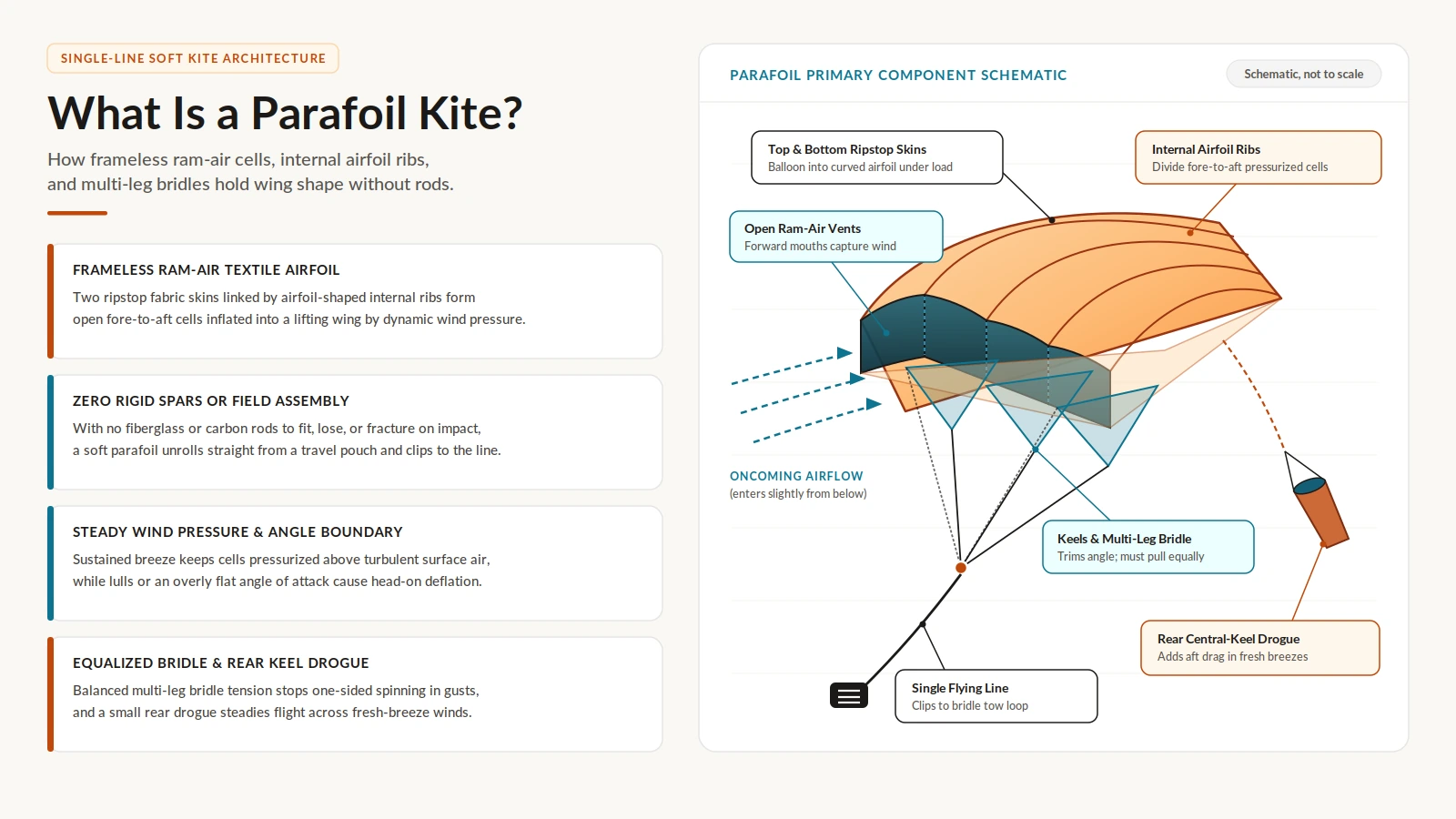
A parafoil kite is a frameless, nonrigid textile airfoil built from top and bottom fabric skins joined by airfoil-shaped internal ribs into fore-to-aft cells. Rather than using rigid spars, dynamic air pressure enters open leading-edge vents and inflates the wing into a lifting cross-section, offering compact travel packing and crash resistance whenever steady wind maintains internal pressure.
That frameless ram-air structure sets soft parafoils apart from sparred triangular deltas and rigid cellular boxes. For a cross-family comparison of flying angles and pack lengths, see our delta, parafoil, and box kite comparison, or review standard kite terminology in parts of a kite.
How do a parafoil kite’s ram-air cells inflate without rods?
A parafoil kite stays rigid in the sky through ram-air inflation, where dynamic air pressure from oncoming wind enters forward-facing leading-edge vents and pressurizes internal chambers between two layers of fabric. Airfoil-shaped vertical ribs tie the top and bottom skins together so the ballooning fabric holds a classic wing cross-section under bridle tension.
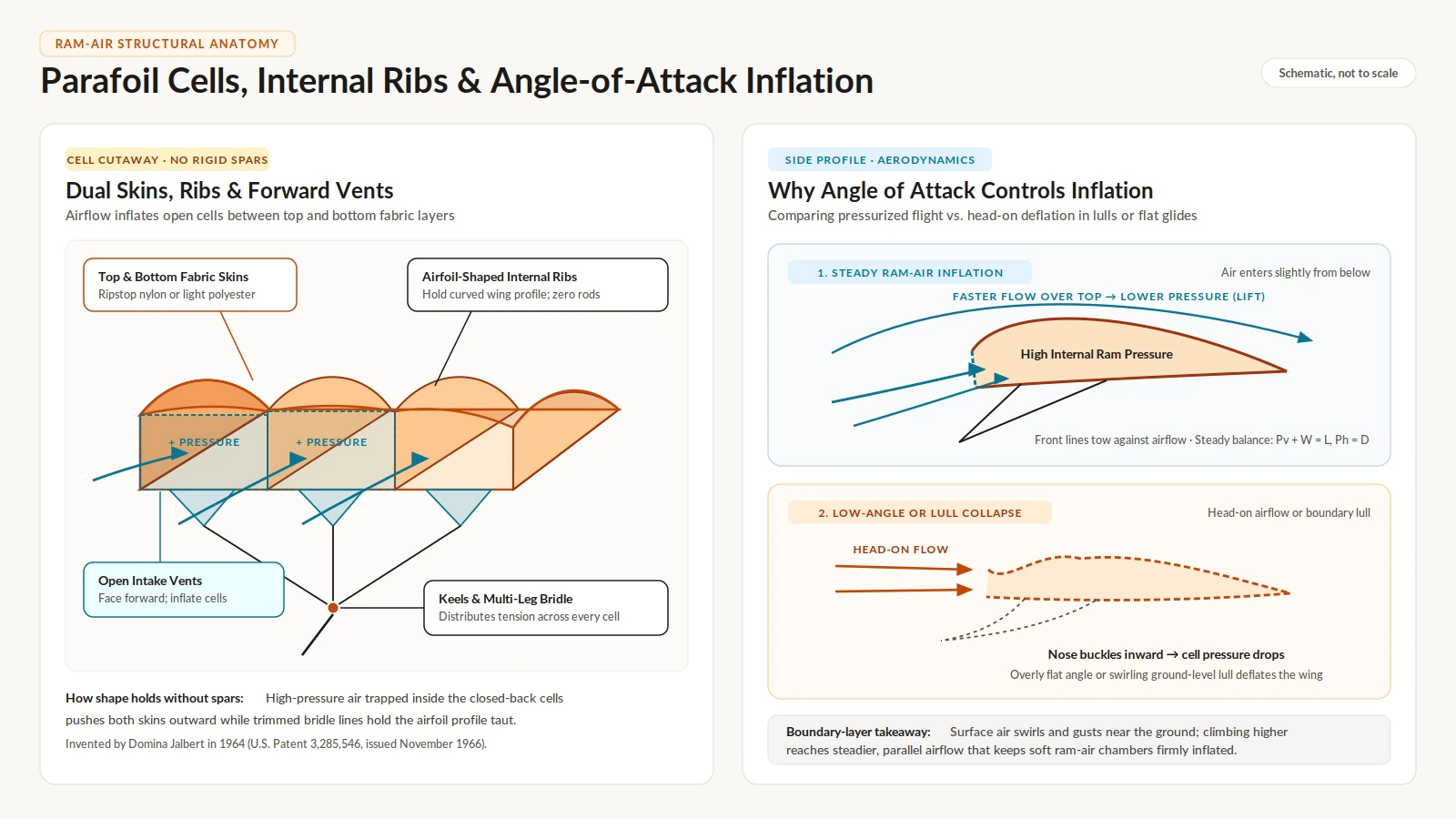
Inside the frameless cell, rib, and keel layout
On a soft parafoil, fabric tension and internal air pressure replace every wooden, fiberglass, or carbon rod found in framed kites. Most parafoils are sewn from ripstop nylon, though lightweight polyester sailcloth such as Icarex is also used on foil designs to reduce weight and keep cells airborne in lower winds.
Once airflow pressurizes the chambers, the curved upper skin accelerates passing air relative to the flatter lower surface. As the Smithsonian National Air and Space Museum explains via Bernoulli’s principle, faster airflow over the top lowers air pressure above the wing compared with slower air below, pushing the kite upward while line tension provides the counteracting pull. Under steady flight, NASA Glenn Research Center models three principal forces in equilibrium: vertical line pull plus kite weight equals aerodynamic lift, horizontal pull equals aerodynamic drag, and the tangent of the bridle angle equals vertical pull divided by horizontal pull.
| Parafoil component | Structural placement | Aerodynamic role | Field trade-off or tuning note |
|---|---|---|---|
| Top and bottom fabric skins | Dual ripstop nylon or lightweight polyester layers | Balloon under internal pressure into a lifting wing profile | Lighter polyester helps in gentle winds; ripstop nylon favors outdoor durability |
| Internal airfoil ribs | Vertical fabric walls stitched between top and bottom skins | Divide the canopy into fore-to-aft cells and hold wing camber | More cells with higher aspect ratios refine wing efficiency |
| Open leading-edge vents | Forward-facing mouths along the front of the wing | Capture oncoming airflow to maintain higher internal cell pressure | Must face airflow arriving slightly from below to stay pressurized |
| Keels and multi-leg bridle | Underside fabric fins and multiple shroud lines meeting at one tow loop | Trim angle of attack and spread line load evenly across cells | Every bridle leg must pull straight with zero slackness to prevent spinning |
| Rear central-keel drogue | Optional open fabric chute tethered behind the rear central keel | Adds stabilizing aft drag to damp oscillation in fresh winds | Attach in brisk wind; remove in light air to preserve lift |
From Domina Jalbert’s 1964 patent to modern soft foils
The ram-air parafoil was developed in 1964 by Domina Jalbert (1904–1991), a kite designer who worked on hybrid balloon-kite platforms for carrying scientific instruments and envisioned the soft wing suspending aerial platforms or recovering space equipment. Jalbert filed U.S. patent 3,285,546 for his multi-cell wing type aerial device in October 1964 and received the patent in November 1966; in 2019 he was posthumously awarded the Fédération Aéronautique Internationale (FAI) Gold Parachuting Medal for inventing the parafoil.
Today, parafoil geometry spans recreational kite flying, powered parachutes, paragliding, kitesurfing, speed flying, wingsuit flying, and skydiving, and the world’s largest kite is a parafoil variant. Dual-line frameless stunt foils evolved from the same lineage: Ted Dougherty’s 6-cell Sparless Stunter set a 460-square-foot (43 square metre) record in September 1988 and debuted in January 1989 as the first totally sparless parafoil stunt kite.
What wind conditions keep a parafoil kite inflated?
A parafoil kite needs steady, uninterrupted wind pressure flowing into its forward-facing vents to stay inflated, because soft cells have no rigid frame to hold shape during lulls. On the National Weather Service Beaufort Wind Scale, Force 3 Gentle Breeze through Force 5 Fresh Breeze deliver clean ram-air pressurization, while Force 2 Light Breeze requires careful drag reduction.
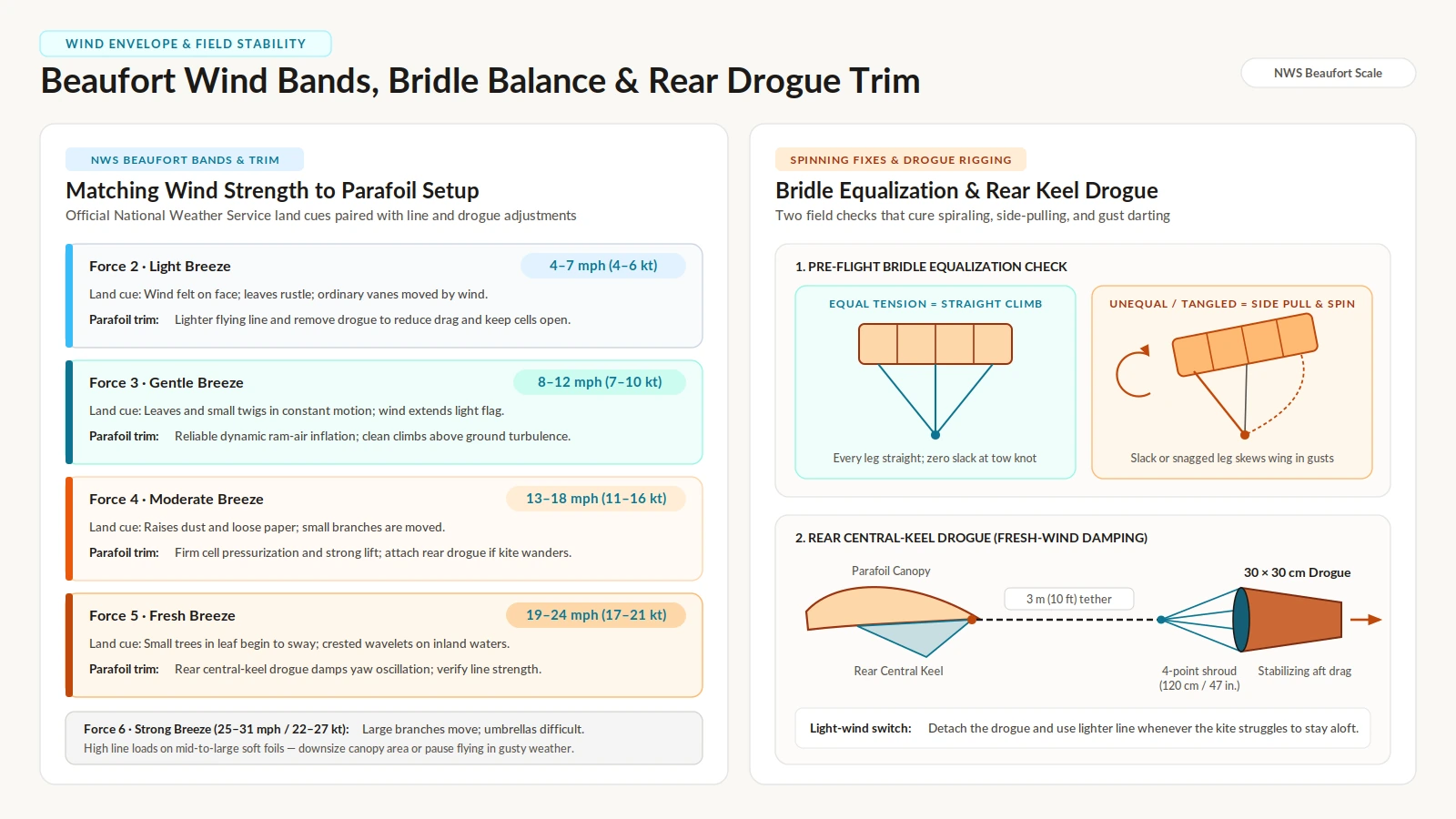
Field observations on land let you gauge wind readiness without carrying an anemometer:
| NWS Beaufort Force | Wind speed (mph / knots) | Official NWS land observation | Parafoil inflation and trim guidance |
|---|---|---|---|
| Force 2 (Light Breeze) | 4 to 7 mph (4 to 6 knots) | Wind felt on face; leaves rustle; ordinary vanes moved by wind | Marginal near ground turbulence; use lighter flying line and remove the rear drogue |
| Force 3 (Gentle Breeze) | 8 to 12 mph (7 to 10 knots) | Leaves and small twigs in constant motion; wind extends light flag | Reliable ram-air cell inflation; climbs smoothly once above surface air |
| Force 4 (Moderate Breeze) | 13 to 18 mph (11 to 16 knots) | Raises dust and loose paper; small branches are moved | Firm cell pressurization and strong lift; attach a rear drogue if the wing wanders |
| Force 5 (Fresh Breeze) | 19 to 24 mph (17 to 21 knots) | Small trees in leaf begin to sway; crested wavelets form on inland waters | Rear central-keel drogue helps the kite cope with brisk gusts; verify line rating |
| Force 6 (Strong Breeze) | 25 to 31 mph (22 to 27 knots) | Large branches in motion; whistling heard in telegraph wires; umbrellas used with difficulty | Heavy line tension on larger soft foils; downsize canopy area or pause in gusty weather |
Near-ground air often feels weaker and more erratic than air just above tree height. NASA Glenn Research Center notes that wind near the surface swirls and gusts inside Earth’s boundary layer, whereas wind higher off the ground flows more steadily and parallel to the surface. Getting a soft parafoil above that turbulent ground layer is often the difference between repeated luffing and rock-solid overhead flight. For deeper wind-selection context across kite families, read our guides on kite flying wind speed and ideal wind speed by kite frame.
How do you launch, fly, and pack a parafoil kite?
Launching a single-line parafoil kite requires zero rod assembly: unroll the fabric canopy on open grass, pull the multi-leg bridle straight so no shroud hangs slack, attach your flying line via a loop or Lark’s Head knot, let steady breeze inflate the open cells, and pay out line steadily as the wing climbs.
Follow this repeatable field routine from setup through pack-down:
- Unroll and clear the intake vents: Spread the soft canopy flat on open ground with the open leading-edge mouths facing cleanly into the wind and all trailing ribbons or drogue tethers laid straight behind the wing.
- Equalize the multi-leg bridle: Hold the keels steady, pull gently on the short bridle tow line to stretch every bridle leg taut, and check that all lines lie straight with zero tangles or slackness. Need a knot refresher before clipping in? See how to attach kite string to a bridle or pigtail.
- Attach the flying line securely: Tie your flying line through the bridle loop knot or secure it with a Lark’s Head knot behind the stopper knot for fast attachment and removal at the field.
- Inflate and climb above surface turbulence: Let airflow fill the open front chambers before releasing, then feed line smoothly so the parafoil climbs out of swirling boundary-layer air into steadier wind aloft. If surface air is patchy, review our kite launch and wind window guide.
- Pack with the wind at your back: Stand facing away from the wind so the sail does not blow back into your hands. Fold the kite in half down its centerline (laying any attached drogue and loose tether flat over the keel), roll from top to bottom away from yourself into a narrow tube, fold in half twice, and wind the bridle lines neatly around the bundle to avoid tangles on the next outing. After beach sessions, follow our separate guide to clean kite sand, salt, and storage.
Why does a parafoil kite keep spinning or collapsing?
A parafoil kite spins repeatedly when unequal or tangled multi-leg bridle lines skew one side of the soft canopy, creating asymmetric lift and pull during gusts. It collapses when dynamic air pressure drops inside surface lulls or when the angle of attack flattens so oncoming airflow strikes the leading edge head-on.
Fixing asymmetric spinning and fresh-wind instability
Because NASA Glenn’s kite geometry model shows that a kite pivots about its bridle point according to the balance between center of gravity, center of pressure, and aerodynamic force vectors, even one snagged shroud line twists a frameless wing. When a gust strikes, lift and drag jump simultaneously and the kite rotates around the bridle point to rebalance torques; if one side of the bridle carries extra tension, that rotation turns into a continuous spin.
Hobbyist parafoil construction testing demonstrates two reliable field cures. First, weigh the keels down on flat ground, pull the tow line taut, and slide any adjustable Prusik or sliding knots until every bridle leg sits equally straight with zero slackness, then make tiny adjustments if the canopy still pulls toward one side during gusts. Second, in brisk Force 4 to Force 5 breezes, attach a small stabilizing drogue to the rear of the central keel. On a compact four-cell parafoil, a drogue cut from a 30 cm by 30 cm square sheet with four equally spaced rim bridle holes—rigged with two 120 cm (47 in.) lengths of 20-pound Dacron or nylon line and tethered by 3 m (10 ft.) of heavier 100-pound handling line via half hitches and a Lark’s Head knot—provides enough aft drag to help the kite cope with fresh winds.
Preventing low-wind and flat-angle deflation
Parafoil aerodynamics also explain why soft wings collapse abruptly when trim goes wrong. Airflow entering a parafoil arrives more from below than its visible flight path suggests, so the frontmost bridle lines tow directly against the airstream. When the angle of attack drops too low, airflow meets the open leading-edge vents head-on, making it difficult to keep the chambers pressurized without deflating.
| Flight symptom | Root aerodynamic or rigging cause | Immediate field fix |
|---|---|---|
| Pulls hard left or right and enters repeated spins | Tangled bridle shroud or unequal bridle leg tension skewing one side of the canopy | Land the kite, lay keels flat, stretch all bridle legs taut, and equalize sliding knots until zero slack remains |
| Darts side to side and dives during fresh-wind gusts | Excess lift and drag torque rotating the canopy faster than aft drag can damp | Attach a stabilizing rear drogue to the rear of the central keel (for example, on a 3 m / 10 ft. tether) |
| Front vents buckle inward and kite folds downward in lulls | Dynamic pressure drops in surface boundary-layer lulls or angle of attack is too flat | Remove the rear drogue, switch to lighter flying line, and climb into steadier wind above surface turbulence |
For structured bridle diagnostics before moving knots, check our kite bridle adjustment guide, and compare tail and drogue drag options in kite tail length and stability.
What are the differences between a parachute and a parafoil?
A traditional round parachute is a single-layer dome built purely to create drag with no aerodynamic lift, whereas a ram-air parafoil uses dual fabric skins and internal ribs to form pressurized wing cells that generate lift, forward glide, and steering control. A parafoil parachute flies free as a glider, while a parafoil kite remains tethered by a ground line.
| Feature | Round parachute | Ram-air parafoil parachute | Single-line parafoil kite |
|---|---|---|---|
| Canopy structure | Single-layer dome sewn from triangular cloth gores | Top and bottom fabric skins joined by airfoil ribs into open cells | Top and bottom fabric skins joined by airfoil ribs into open cells |
| Primary aerodynamic force | Pure drag to slow vertical descent; no aerodynamic lift | Aerodynamic lift plus forward glide and controlled descent rate | Aerodynamic lift balanced against line tension and weight |
| Flight constraint | Free descent through the atmosphere | Mechanically a free-flight glider steered via control lines | Tethered to the flyer by a single control line via multi-leg bridle |
| Opening or stability hardware | Apex vent hole reduces pendulum oscillation | Riser drag canopy called a slider slows line spread and opening shock | Equalized multi-leg bridle plus optional rear central-keel drogue |
As Wikipedia’s parachute reference documents, early ram-air canopies suffered severe deployment shock until designers added a rectangular fabric drag canopy called a slider on the riser lines to slow line spread during inflation. Ram-air wing geometry also shows how aspect ratio—defined by NASA Glenn as wingspan squared divided by frontal projected area—trades stability against glide efficiency. Low aspect ratio ram-air canopies (span 1.8 times the chord) stay extremely stable with gentle stall behavior, medium aspect ratios around 2.1 typically use seven cells for predictable inflation, and high aspect ratios up to 2.7 typically use nine or more cells for flatter glide. Rectangular ram-air canopies shaped like open-fronted air mattresses also behave more forgivingly than tapered elliptical designs because they resist rapid dives under small shifts in load.
How does a soft foil kite differ from an inflatable kite?
A soft foil kite relies entirely on wind-pressurized internal fabric cells to hold its airfoil shape, whereas a leading edge inflatable (LEI) kite is a single-skin canopy supported by pre-pumped internal air bladders. Soft foils offer higher aerodynamic efficiency and steady overhead lift, while LEI bladders float indefinitely on water without open chambers that can flood.
| Design dimension | Open-cell soft parafoil kite | Closed-cell water foil kite | Leading edge inflatable (LEI) kite |
|---|---|---|---|
| How shape is maintained | Wind fills open leading-edge fore-to-aft cells | Limited center leading-edge inlets with valves plus internal cell-wall holes | Pre-inflated bladder along leading edge and struts on a single-skin canopy |
| Inflation speed and prep | Fast self-inflation directly in the breeze; zero pump needed | Slower to inflate than open-fronted foils due to restricted valved inlets | Requires pumping bladders before launch |
| Water relaunch behavior | Open cells can take on water if downed on waves | Valves help keep air inside and water out for water use | Floats on water indefinitely with no internal chambers to fill with water |
| Line setups and common sizing | Single-line recreational models; 2-, 3-, or 4-line traction foils | 2-, 3-, or 4-line depowerable power systems | 2, 4, or 5 control lines with bar; commonly 5 to 18 square metres |
| Notable efficiency or subtypes | High efficiency; generates significant lift even parked overhead | Retains airfoil section and overhead lift | Invented by Dominique and Bruno Legaignoux; C-kite, bow, hybrid, and delta subtypes |
In practice, recreational park and beach flyers looking for compact, zero-pump single-line flying choose open-cell soft parafoils. Closed-cell valved foils and multi-line LEI kites belong to specialized water and traction sports rather than casual single-line outings.
Are parafoil kites easy and durable for kids, and what safety limits apply?
Compact soft parafoil kites are among the easiest and most durable designs for kids and travelers because they contain no rigid spars to assemble, lose, or fracture on nose-first impacts. Still, larger parafoils produce strong lift suited for lofting line laundry, so choose a manageable canopy size and follow open-field airspace safety limits.
Three practical checks keep family parafoil outings trouble-free:
- Match canopy size to flyer strength: Compact pocket and small single-line parafoils pack effortlessly into a backpack and keep hand pull light for children, while mid-size and large parafoils generate substantial pull in Force 4 to Force 5 winds that is better handled by older flyers or anchored properly. For age-based starter choices across all single-line designs, read our guide to single line kite types.
- Avoid hard-wind over-pull and tangled bridles: Untangle multi-leg bridle lines before handing the winder to a child so the kite does not whip into low spins on launch, and step down in size or pack away when winds climb into Force 6 strong-breeze gusts.
- Respect airspace and site clearances: Fly in open parks or beaches well away from overhead power lines, roads, and thunderstorms. In the United States, 14 CFR § 101.1 applies federal Part 101 rules to any kite weighing more than 5 pounds flown on a rope or cable, and 14 CFR § 101.13 prohibits operating covered moored kites more than 500 feet above the surface of the earth, less than 500 feet from the base of any cloud, where ground visibility is less than three miles, or within five miles of any airport boundary. Review full height and airspace guidance in how high you can fly a kite.
Frequently Asked Questions
What is a parafoil kite?
A parafoil kite is a frameless, nonrigid textile airfoil made from top and bottom fabric skins joined by airfoil-shaped internal ribs into fore-to-aft cells. Instead of fiberglass or carbon rods, dynamic air pressure enters forward-facing leading-edge vents and inflates the soft chambers into a lifting wing.
What is the difference between a parachute and a parafoil?
A traditional round parachute is a single-layer dome that acts purely as a drag device with no aerodynamic lift. A ram-air parafoil uses dual fabric skins and internal ribs to form pressurized wing cells that create lift, forward glide, and steering control; as a parachute it flies free with a riser slider, whereas a parafoil kite stays tethered to a flying line.
Why does my parafoil kite keep spinning or collapsing?
Repeated spinning or pulling to one side traces back to unequal or tangled multi-leg bridle lines that load one side of the wing unevenly during gusts. Collapsing happens when airflow drops inside turbulent ground-level lulls or when the angle of attack flattens so wind strikes the open vents head-on.
Are parafoil kites good for kids and beginners?
Compact single-line parafoil kites are well suited for families and travel because they contain no rigid spars to assemble, lose, or snap on nose-first crashes. Larger parafoils generate strong pull capable of lofting line laundry, so match canopy size to the flyer's strength and fly in open fields clear of obstacles.
What is the difference between a foil kite and an inflatable LEI kite?
A soft foil kite relies on wind-pressurized internal cells (either open-fronted or closed with leading-edge valves) and delivers high aerodynamic efficiency with steady overhead lift. A leading edge inflatable (LEI) kite uses pre-pumped structural bladders on a single-skin canopy so it floats indefinitely on water with no chambers that can fill with water.
References & Sources
- Parafoil — ram-air inflation, Domina Jalbert patent, and glider mechanics — Wikipedia
- Foil kite — open-cell vs. closed-cell water foils, efficiency, and development — Wikipedia
- Leading edge inflatable kite — bladder structure, water relaunch, and subtypes — Wikipedia
- Parachute — round drag canopies vs. ram-air cells, aspect ratio, and sliders — Wikipedia
- Beaufort Wind Scale — official mph, knot, and land observation bands — National Weather Service (NOAA)
- Forces on a Kite — weight, line tension, lift, drag, and boundary layer flow — NASA Glenn Research Center
- Kite Geometry Definitions — projected area, aspect ratio, and bridle balance — NASA Glenn Research Center
- How Kites Fly — Bernoulli lift, kite components, and line tension — Smithsonian National Air and Space Museum
- 14 CFR § 101.1 — Applicability for moored balloons and kites — Legal Information Institute, Cornell Law School (eCFR)
- 14 CFR § 101.13 — Operating limitations for moored balloons and kites — Legal Information Institute, Cornell Law School (eCFR)